
How to Navigate Divorce Through Collaborative Law
Our Blog
How to Navigate Divorce Through Collaborative Law

Divorce doesn’t have to mean months of courtroom battles and mounting legal bills. Collaborative divorce offers a different path-one where both spouses work together with trained professionals to reach fair agreements outside of litigation.
At Harnage Law PLLC, we’ve seen how this approach transforms outcomes for families in Melbourne Florida. When you choose collaborative law, you gain control over your future instead of leaving decisions to a judge.
What Collaborative Law Actually Means
Collaborative law in Melbourne Florida is a structured negotiation process where both spouses and their attorneys commit in writing to resolve divorce issues without going to court. This isn’t mediation where a neutral third party guides you toward agreement. Instead, each spouse hires their own trained attorney who represents their interests while all parties pledge to stay out of the courtroom. The moment either side files a lawsuit or threatens litigation, both attorneys must withdraw, which creates strong incentive for everyone to negotiate seriously. You control the timeline, the meeting locations, and the pace of settlement discussions instead of waiting months for a judge’s availability.
How the Team Works Together
Collaborative divorce involves more than just lawyers. A typical team includes a financial neutral who helps both spouses understand asset division and support calculations, and a mental health professional who addresses communication barriers and emotional concerns, particularly around parenting decisions. This team approach costs roughly $10,000 to $25,000 for both spouses combined, which is significantly lower than traditional litigation that often runs $15,000 to $100,000 or more.
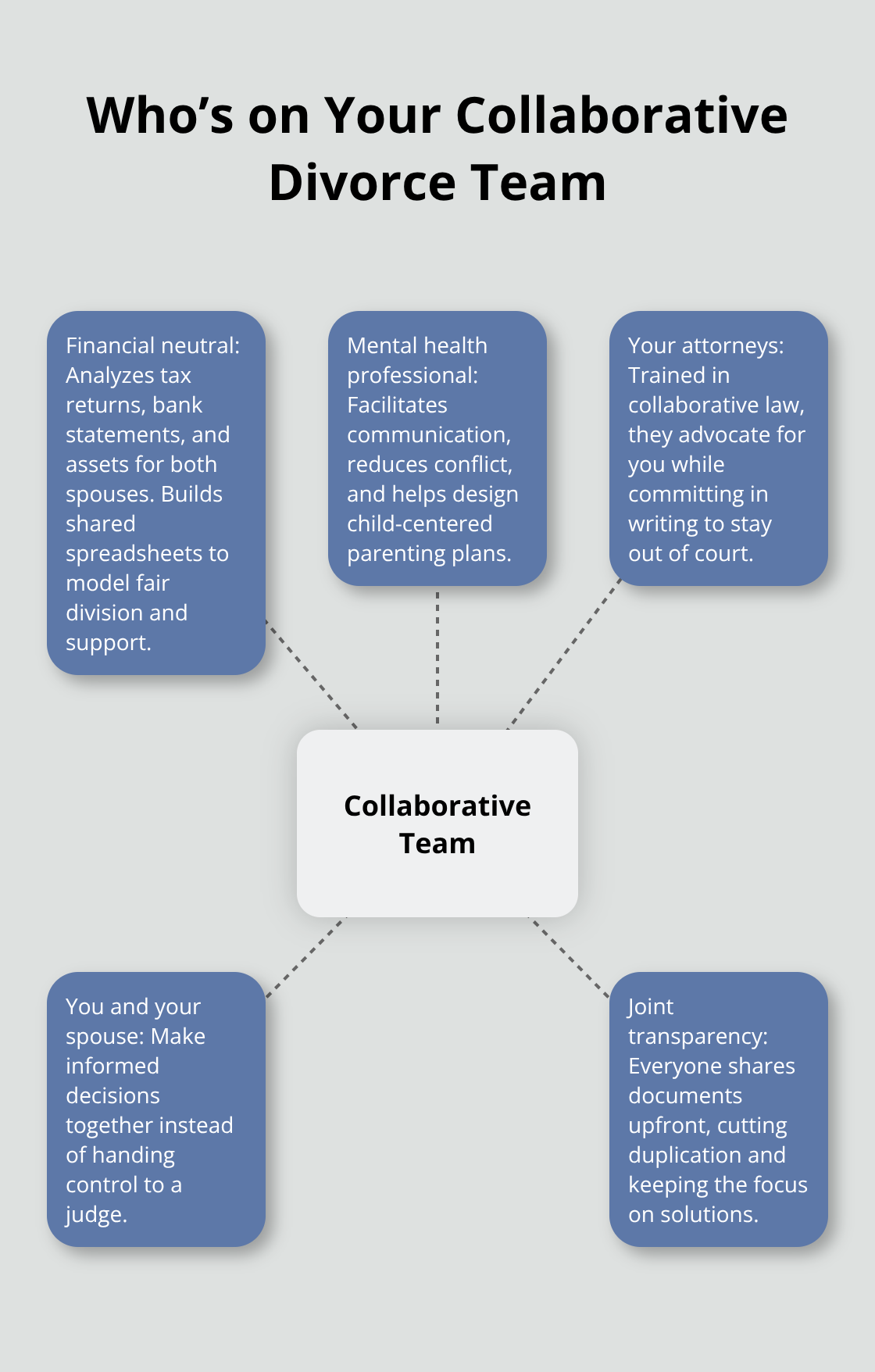
The financial neutral typically charges $150 to $300 per hour while mental health professionals bill $100 to $300 hourly. Each professional works for both parties jointly rather than being hired separately by each spouse, which eliminates duplicative costs and keeps everyone focused on shared solutions.
Why Collaborative Law Differs from Court Battles
Traditional litigation forces you into an adversarial system where discovery can take months, court schedules control your life, and a judge makes final decisions about your children and assets based on limited courtroom testimony. Collaborative divorce eliminates formal discovery because both spouses voluntarily share tax returns, bank statements, and financial records upfront. Most collaborative cases resolve within 6 to 12 months, compared to 12 to 24 months or longer for contested litigation. You avoid public court records, which means your family’s private matters stay private. The settlement you reach becomes a mutual agreement you both own, rather than a court order imposed by someone unfamiliar with your family’s actual needs.
What Happens Next in Your Collaborative Journey
Once you understand how collaborative law works, the actual process unfolds through specific steps that move you from initial commitment to final settlement. Each phase requires active participation and honest communication from both spouses, supported by your team of professionals. The structured approach keeps momentum moving forward while protecting your interests at every stage.
How the Collaborative Process Unfolds in Melbourne Florida
Starting with Commitment and Team Assembly
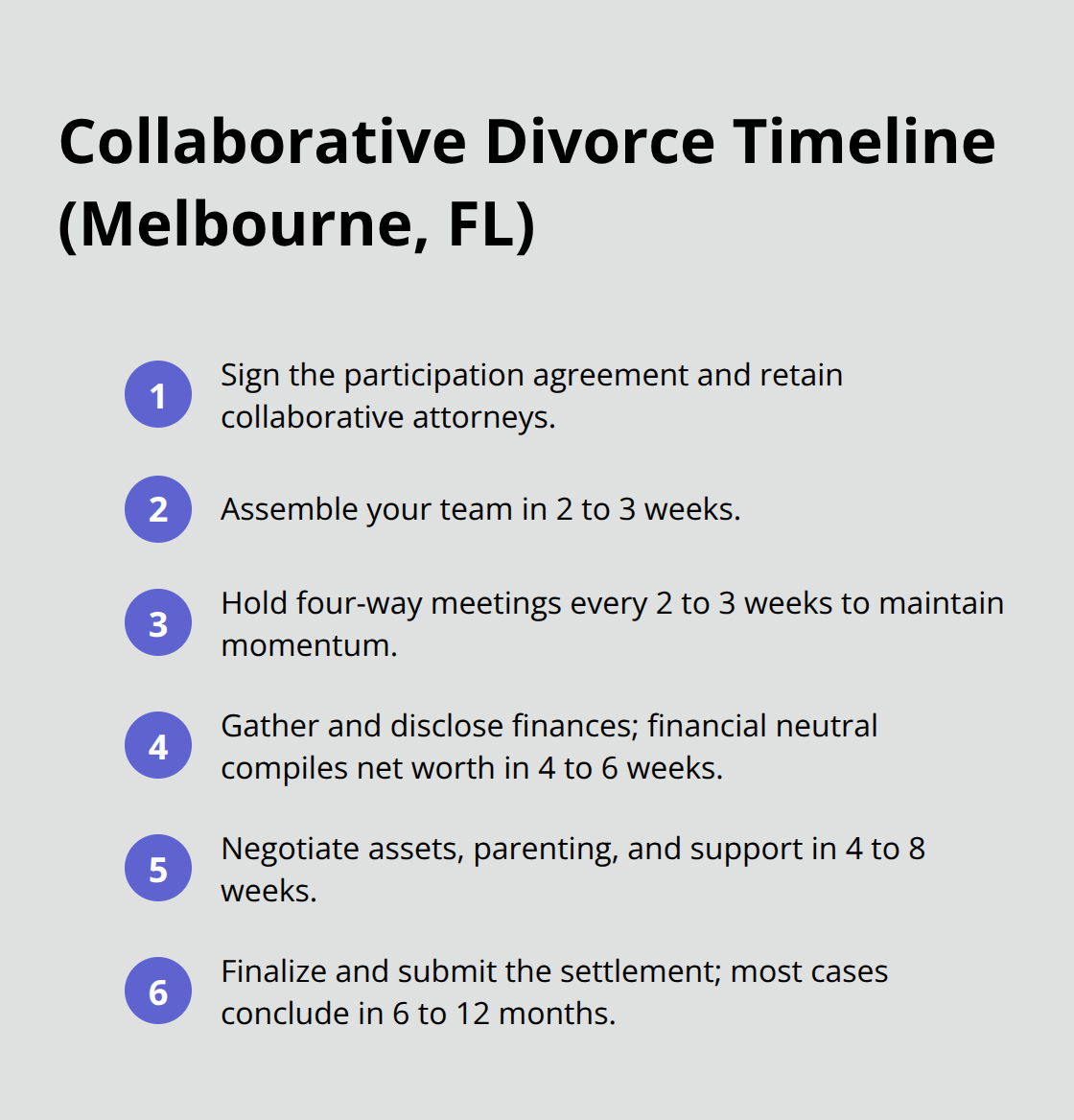
Both spouses must sign a participation agreement that commits you to negotiation and bars your attorneys from going to court. This agreement isn’t just paperwork-it’s your enforcement mechanism. Once signed, you assemble your team by hiring separate attorneys trained in collaborative law and selecting a financial neutral and mental health professional who work jointly for both parties. This team assembly typically takes two to three weeks. You’ll schedule regular four-way meetings where all parties and both attorneys sit together. Unlike litigation where communication flows through lawyers and court documents, collaborative meetings happen face-to-face with direct conversation. Scheduling these meetings every two to three weeks maintains momentum, as gaps longer than a month often stall progress and extend timelines.
Gathering and Sharing Financial Information
Information gathering happens immediately and completely. You must voluntarily disclose all financial documents including tax returns for the past three years, current pay stubs, bank statements, investment accounts, retirement statements, and property valuations. The financial neutral reviews these materials and prepares a net worth statement showing all assets and debts for both spouses. This typically takes four to six weeks. Full disclosure is non-negotiable in collaborative divorce-hiding assets or income undermines the entire process and often triggers a switch to litigation.
Moving Into Active Negotiation
Once financial information is clear, negotiation meetings shift focus to dividing assets, determining child custody arrangements, and calculating child support and alimony. Most couples complete this phase within four to eight additional weeks. The mental health professional attends some meetings to address communication barriers and help parents develop parenting plans that prioritize children’s stability. When agreement emerges on all issues, your attorneys draft a settlement agreement that becomes your final divorce judgment. The judge reviews and signs it without modification if both spouses have agreed, which typically occurs within six to twelve months from start to finish. This structured timeline (from initial commitment through final judgment) gives you a clear roadmap for what lies ahead, allowing you to plan your financial and personal transition with confidence.
Advantages of Choosing Collaborative Divorce in Melbourne Florida
Cost Savings That Matter
Collaborative divorce costs significantly less than traditional litigation because you eliminate discovery delays, court filing fees, and multiple professionals working separately. The total cost for both spouses combined typically ranges from $10,000 to $25,000, while contested litigation averages $15,000 to $100,000 or more depending on complexity and court timelines. A collaborative case resolves within 6 to 12 months from start to finish, whereas litigation commonly takes 12 to 24 months or longer when court schedules control your timeline. You avoid duplicative costs since the financial neutral and mental health professional work jointly for both parties rather than each spouse hiring separate professionals. The financial neutral charges $150 to $300 per hour and the mental health professional charges $100 to $300 per hour, but splitting these costs between spouses reduces your individual burden significantly.
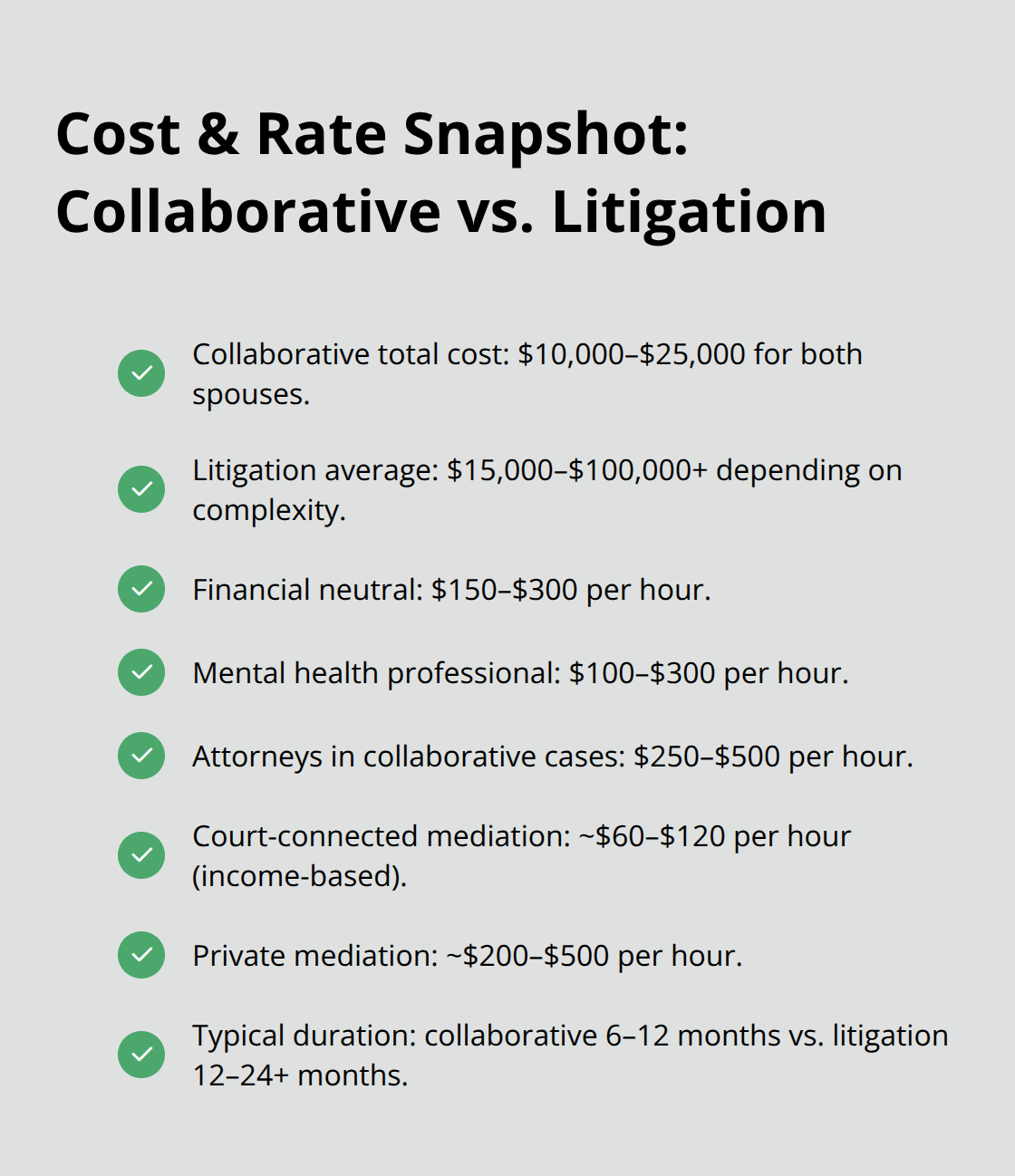
Attorneys in collaborative cases typically charge $250 to $500 per hour, but the streamlined process without formal discovery means fewer billable hours overall. Court-connected mediation in Florida costs roughly $60 to $120 per hour based on household income, while private mediation runs $200 to $500 per hour, making collaborative divorce a middle ground that offers more structure. The real savings come from avoiding litigation’s hidden costs: court filing fees, motion practice, depositions, subpoenas, and expert witness testimony that easily add tens of thousands to your bill.
Control Over Your Family’s Future
Collaborative divorce gives you control over outcomes that a judge would otherwise decide, and this control translates directly to better results for your family. You negotiate every detail of asset division, child custody, visitation schedules, and support amounts instead of presenting your case to a judge who spends limited time with your family. Parents who use collaborative divorce report better post-divorce relationships because the process models respectful negotiation rather than courtroom warfare, which children witness and internalize. When both parents demonstrate problem-solving and mutual respect during divorce, they establish a foundation for cooperative co-parenting that benefits children for years afterward. The settlement you reach is one you both created and agreed to, not one imposed by court order, which means you’re far more likely to follow it willingly and modify it cooperatively when circumstances change.
Building Lasting Agreements
If your child’s school schedule shifts or one parent’s job changes, you can adjust custody and support through a simple written agreement rather than filing motions and waiting for court dates. Families who choose litigation often find themselves back in court within two years fighting over modifications, but collaborative families avoid this trap because they’ve built genuine agreement into their settlement. The mental health professional on your team helps address communication barriers and parenting concerns during the process itself, rather than leaving emotional wounds unhealed after a judge’s decision. This approach means you transition to single parenthood with less resentment and more clarity about what your children actually need from each parent.
Conclusion
Collaborative divorce in Melbourne Florida works best when both spouses genuinely want to resolve their differences without courtroom battles and can communicate respectfully while sharing financial information openly. The financial advantage alone makes sense for most divorcing couples-spending $10,000 to $25,000 on collaborative law beats the $15,000 to $100,000 or more that litigation demands, especially when you factor in the 6 to 12 month timeline versus 12 to 24 months or longer in court. You preserve your family’s privacy, avoid public court records, and build a settlement both spouses genuinely agreed to rather than one a judge imposed.
Your children benefit from seeing parents solve problems cooperatively instead of fighting in front of a judge, and you establish a foundation for cooperative co-parenting that lasts years after your divorce concludes. This approach isn’t right for situations involving domestic violence, substance abuse, or severe power imbalances where one party cannot negotiate fairly. But for families willing to work together, collaborative divorce offers faster resolution, lower costs, and outcomes you actually control.
Starting your collaborative divorce journey in Melbourne Florida begins with finding an attorney trained in this approach. We at Harnage Law PLLC handle sensitive family law cases including divorce and child custody with personalized attention to your specific situation. Contact us to discuss whether collaborative law fits your circumstances and to assemble the right team for your family’s transition.