
Melbourne FL Child Support: What Parents Should Understand
Our Blog
Melbourne FL Child Support: What Parents Should Understand
Child support calculations in Melbourne FL can feel overwhelming for parents navigating the system. The rules, income considerations, and modification processes often leave families confused about their obligations and rights.
We at Harnage Law PLLC created this guide to break down how Melbourne FL child support actually works. You’ll learn what courts consider, how to handle changes, and which mistakes to avoid.
How Florida Courts Calculate Your Child Support Obligation
Income and the Baseline Obligation
Florida’s child support system relies on a straightforward income-based formula, but the numbers matter more than most parents realize. The state uses the Income Shares Model to establish a baseline obligation through the child support guidelines chart. For example, with a combined monthly income of $7,000 for one child, the baseline support obligation sits at $1,212 per month. Each parent’s share depends on their percentage of total income-if both earn equally, each parent would owe $606 monthly under this scenario. Income includes wages, disability payments, unemployment benefits, and other regular earnings. The calculation follows a mechanical process until courts apply it to real circumstances, which is where most parents misunderstand what they’ll actually owe.
Time-Sharing and the Substantial Method
The number of overnight visits your child spends with each parent dramatically reshapes the final obligation, and this is where many parents get blindsided. If both parents maintain at least 20 percent time-sharing (roughly 73 overnights per year or more), Florida applies the Substantial Time-Sharing method, which increases the basic obligation by 150 percent before allocating shares. This means a parent with significant overnight custody does not automatically pay less-the calculation multiplies the obligation, then adjusts based on each parent’s overnight percentage. Additional support obligations layer on top of the baseline: 100 percent of licensed childcare costs, total monthly health insurance costs actually paid, and noncovered medical expenses.
Deviations and Statutory Factors
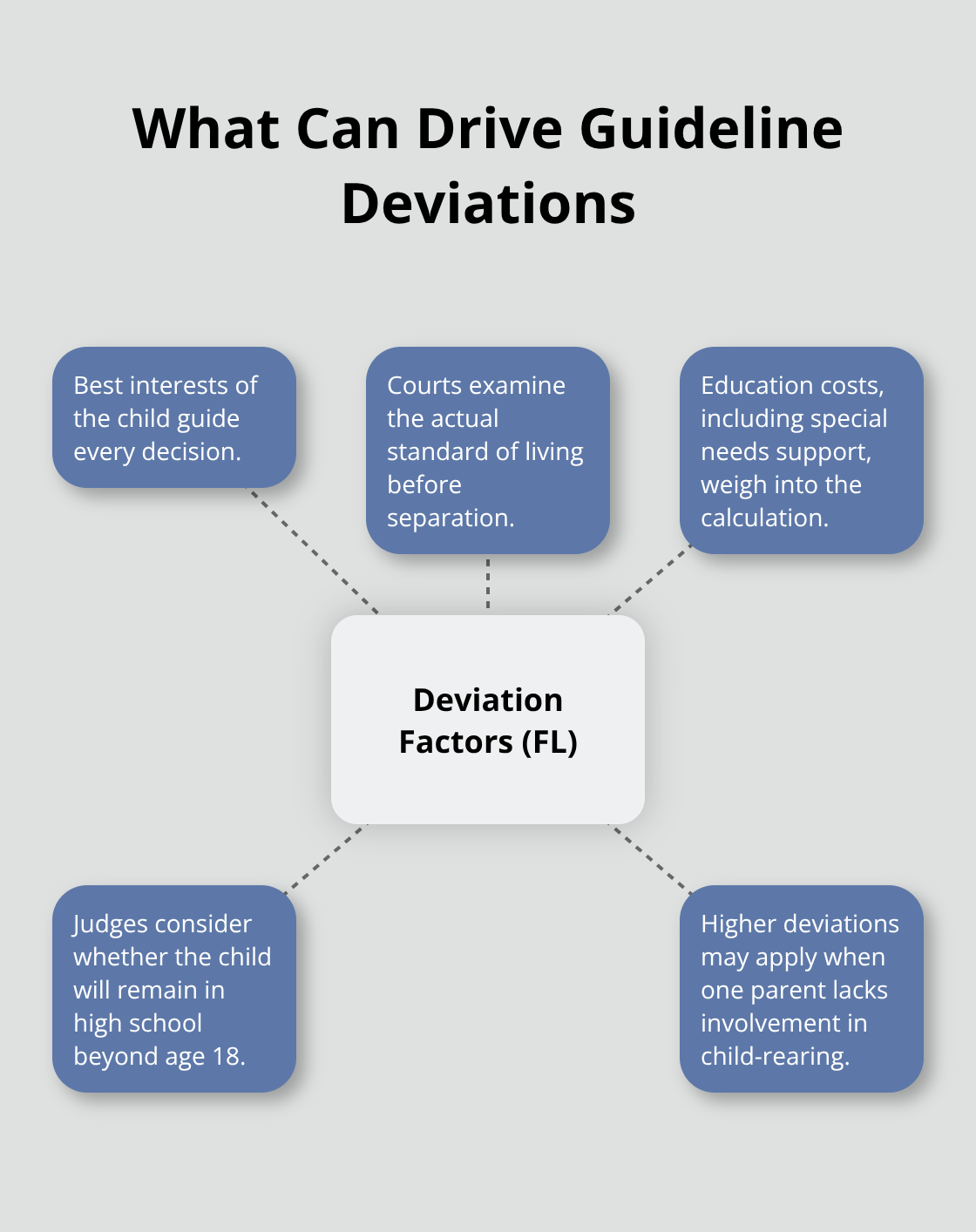
Courts will not deviate more than 5 percent from these guidelines without documented reasons, though higher deviations are possible when one parent lacks involvement in child-rearing or other statutory factors apply. The child’s best interests control every decision, which means courts examine the actual standard of living before separation, education costs including special needs support, and whether the child will remain in high school beyond age 18. These factors create flexibility within a rigid framework, allowing judges to account for situations that the guidelines alone cannot address.
Modification Thresholds and Timing
If circumstances change substantially, either parent can request modification through the Florida Department of Revenue or petition the circuit court directly. The threshold depends on how long the order has been in place: if the order is less than 3 years old, a modification must show a change of at least 15 percent and at least $50; if older than 3 years, the threshold drops to 10 percent and at least $25. Courts apply this framework to thousands of cases annually, making the guidelines predictable for straightforward situations but requiring careful analysis when time-sharing is unequal, income fluctuates, or special expenses arise. Understanding these calculation methods prepares you for what comes next-the specific mistakes that derail many parents and how to avoid them.
Modifying Child Support When Life Changes
Child support orders are not permanent fixtures carved in stone. Florida law recognizes that income shifts, custody arrangements change, and unexpected expenses emerge. The modification process exists precisely because the circumstances that produced your initial order will almost certainly differ at some point. Parents in Melbourne FL who understand when and how to modify their orders avoid years of overpaying or underpaying support.
Understanding Modification Thresholds
The threshold for modification depends entirely on how long your order has been in place. If your order is less than three years old, you must demonstrate a change of at least 15 percent and at least $50 per month to qualify for modification. Once your order passes the three-year mark, the threshold drops to 10 percent and at least $25 monthly. This means a parent paying $606 monthly under a newer order needs to show a change to approximately $695 or lower to trigger modification, while the same parent with an older order needs only a $61 change.
Courts will not modify orders based on temporary or short-term changes. A job loss lasting three months does not meet the standard, but extended unemployment or a permanent shift to lower-paying work does. Involuntary changes like severe illness, injury, or layoffs satisfy the requirement, while voluntary decisions such as quitting your job, accepting lower pay, or incarceration generally do not. This distinction matters enormously because parents who voluntarily reduce their income to lower their support obligation face judicial skepticism.
Enforcement Actions and Payment Accountability
Non-payment of child support carries real consequences that accumulate quickly. The Florida Department of Revenue pursues enforcement through multiple mechanisms when a parent falls behind. Wage garnishment remains the most common enforcement tool, allowing the state to intercept earnings directly from an employer’s payroll. The state can also seize tax refunds (both state and federal), applying them toward arrears. Driver’s license suspension represents another powerful enforcement lever that forces non-compliant parents to address their obligations.
Asset seizure can occur when other methods prove insufficient. Parents facing legitimate hardship such as unemployment or reduced earning capacity should contact the Florida Department of Revenue immediately rather than ignoring the debt, as proactive communication often leads to temporary payment adjustments or enrollment in community resources. Courts may also require life insurance or bonds to secure ongoing support obligations, protecting the receiving parent if the paying parent dies or defaults.
Filing for Modification and Qualifying Changes
The Florida Department of Revenue or circuit court will review modification petitions based on documented changes in financial circumstances or custody arrangements. Income changes are the most straightforward grounds, including job loss, promotion, or shift from self-employment to W-2 wages. Changes in time-sharing percentages also trigger modification analysis because the Substantial Time-Sharing method recalculates the entire obligation when overnights shift significantly.
Healthcare costs, childcare expenses, and special education needs for the child can also support modification requests if they materially change what was ordered previously. Filing through the Department of Revenue is typically simpler and less expensive than petitioning circuit court directly, though either path is available. The parent seeking modification bears the burden of proving that change meets the statutory threshold. Courts apply the same guidelines and factors used for the original order, meaning your modification must show that the percentage change and dollar amount both satisfy the legal standard.
Understanding these modification rules positions you to act when circumstances shift, but knowing the rules and navigating the actual process are two different challenges. The next section addresses the mistakes that derail parents even when they have legitimate grounds for change.
Common Child Support Mistakes Parents Make in Melbourne FL
Failing to Report Income Changes Promptly
Parents in Melbourne FL consistently make three preventable errors that transform manageable child support situations into legal nightmares. The first mistake-failing to report income changes promptly-costs parents thousands in unnecessary payments or exposes them to enforcement action they could have avoided. When your income shifts, whether up or down, you must inform the Florida Department of Revenue or file a modification petition immediately. A parent who receives a $200 monthly raise and continues paying the original amount without requesting modification overpays by roughly $2,400 annually, assuming a 15 percent income increase meets the modification threshold. Conversely, a parent whose income drops from job loss but delays reporting that change accumulates arrears that compound with interest and enforcement fees.
The state does not automatically adjust orders when circumstances change-you must initiate the process yourself. Too many parents assume their employer notified the court or that the state monitors income independently. Neither happens. You must take action, which means gathering recent pay stubs, tax returns, or employment documentation and submitting modification paperwork within weeks of the income change, not months later.
Ignoring Court Orders and Making Informal Agreements
The second critical mistake involves ignoring court orders or attempting informal payment arrangements without court approval. Parents sometimes agree with the other parent to pay less than ordered, skip months, or restructure payments outside the legal system. These informal agreements hold zero legal weight in Florida. A parent who accepts a lower payment because the other parent claims hardship still owes the full court-ordered amount-the informal reduction creates no defense against enforcement action.
The state pursues wage garnishment, tax refund seizure, and license suspension based on what the order requires, regardless of any gentlemen’s agreement between parents. Additionally, attempting to enforce an informal arrangement leaves you with no legal recourse if the other parent stops paying altogether. Formal modification through the court or Department of Revenue protects both parents and establishes enforceable terms that hold up under scrutiny.
Neglecting Documentation and Records
The third mistake-neglecting documentation and records-undermines your credibility when modification disputes arise or enforcement becomes necessary. Parents who lack organized records of income, expenses, time-sharing days, or medical costs cannot effectively prove their modification requests meet the statutory threshold. A parent claiming substantial childcare expenses must produce receipts, invoices, or payment statements showing the actual monthly amounts paid to licensed providers. One parent claiming 50 percent time-sharing needs calendar documentation, school pickup records, or other proof demonstrating overnight percentages.
Courts require concrete evidence, not assertions. Parents who maintain detailed records from the moment an order takes effect position themselves to modify successfully when circumstances genuinely change and to defend themselves if the other parent initiates modification. Documentation transforms vague claims into verifiable facts that judges can rely on when making decisions about your case.
Final Thoughts
Melbourne FL child support obligations demand consistent attention and proactive management throughout your case. The calculation methods, modification thresholds, and enforcement mechanisms outlined in this guide form the foundation of how courts handle support in Florida. Parents who understand these rules avoid costly mistakes and respond effectively when circumstances shift.
The three preventable errors discussed earlier-failing to report income changes, ignoring court orders, and neglecting documentation-account for the majority of child support disputes that escalate unnecessarily. A parent who reports income changes promptly, maintains formal modification requests through proper channels, and keeps organized records of expenses and time-sharing demonstrates responsibility that courts recognize and respect. These actions cost minimal time and money upfront but save thousands in overpayment, enforcement fees, and legal complications later.
Your specific situation depends on factors unique to your family: your income level, custody arrangement, additional expenses, and how long your current order has been in place. If your Melbourne FL child support situation involves complex income calculations, contested modifications, or enforcement challenges, contact Harnage Law PLLC for personalized legal guidance that protects your rights and serves your family’s interests.