
Child Support Enforcement Florida: Ensuring Obligations Are Met
Our Blog
Child Support Enforcement Florida: Ensuring Obligations Are Met
Child support enforcement in Florida can feel overwhelming when payments fall behind or circumstances change. At Harnage Law PLLC, we help families navigate the enforcement process and recover unpaid support.
Whether you’re dealing with arrears, need to modify an order, or face interstate complications, understanding your options matters. This guide walks you through how Florida’s system works and what steps you can take.
How Florida’s Child Support System Actually Works
The Foundation: Payment Processing and Initial Enforcement
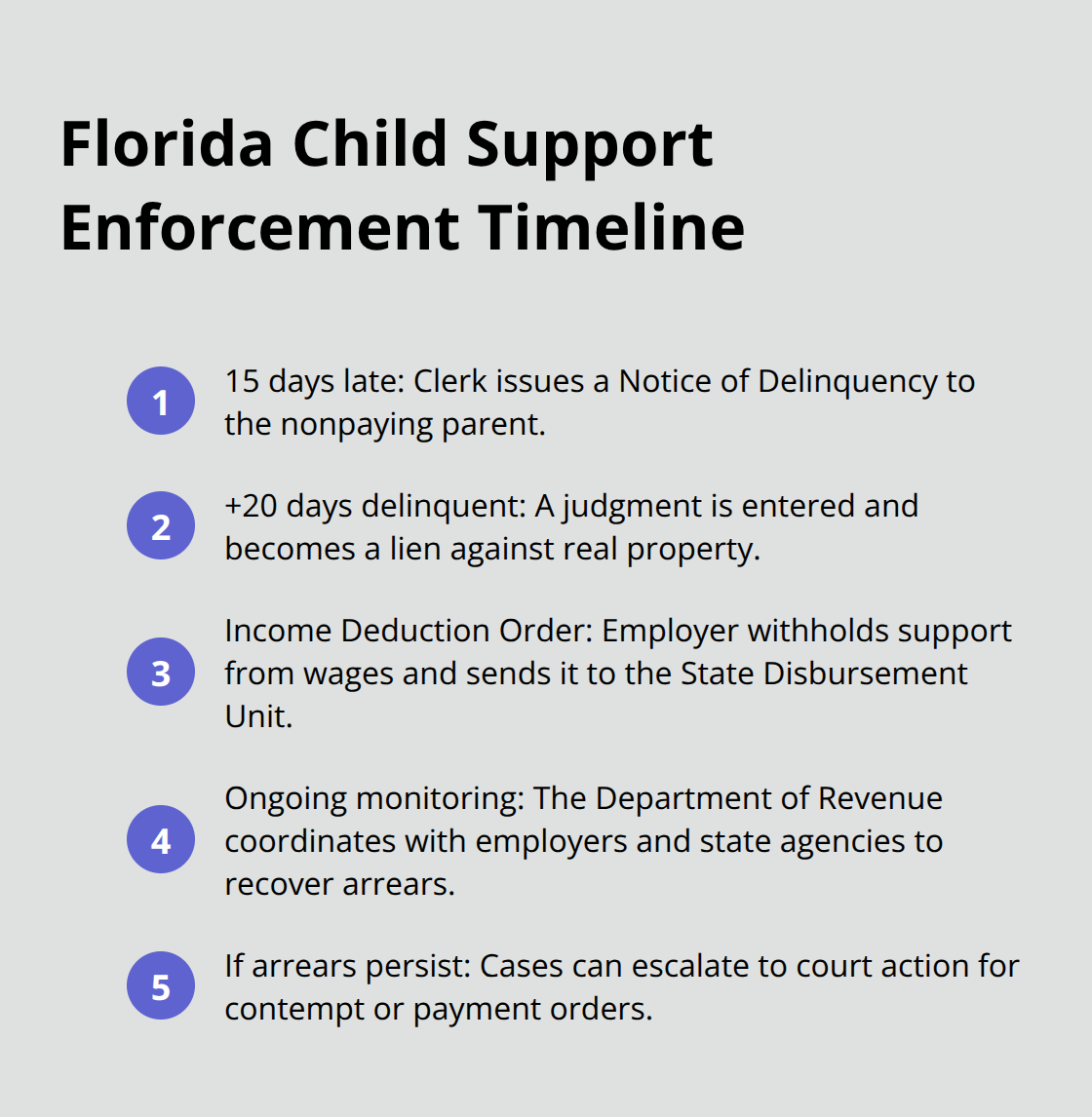
Florida’s child support enforcement operates through the Florida Department of Revenue, which manages over 1.2 million active cases and distributes more than $1.6 billion annually to families. The system works in stages: after a court establishes a support order, the State Disbursement Unit centralizes all payments, then distributes funds to the receiving parent. When payments arrive on time, the process runs smoothly. But when they don’t, enforcement kicks in immediately. If a payment is 15 days late, the Clerk’s Office issues a Notice of Delinquency to the nonpaying parent. If delinquency continues for another 20 days, a judgment is entered, which becomes a lien against their real property. This isn’t theoretical-it’s the actual mechanism that triggers everything else. The Department of Revenue monitors payments, initiates enforcement actions, and coordinates with employers and state agencies to recover arrears.
Income Withholding: The Most Effective Tool
Income withholding remains the most effective enforcement mechanism available. When a parent falls behind, the Department of Revenue sends an Income Deduction Order directly to the employer, who must withhold the support amount from wages and remit it to the State Disbursement Unit. This happens automatically without court involvement in most cases, and it works because employers face penalties for noncompliance. The withholding order cuts through delays and excuses-money moves from the paycheck to the receiving parent with minimal friction.
License Suspension and Asset Interception
Florida suspends driver’s licenses for delinquent support, a consequence that motivates compliance quickly since most people cannot function without driving privileges. The state also intercepts tax refunds, insurance settlements, and workers’ compensation benefits to recover past-due amounts. These tools cast a wide net, capturing income from multiple sources and making it harder for nonpaying parents to hide assets.
Court Actions and Contempt Proceedings
For cases involving significant arrears or parents who refuse to pay despite having income, the Department of Revenue files circuit court actions. Courts can order full or partial payment of arrears, find the parent in contempt of court, or require participation in job training programs. If a parent is found in willful contempt and the court determines they have the present ability to pay a specific dollar amount, incarceration is possible until payment is made. Passport denial represents another enforcement option-the state prevents passport renewal or issuance when past-due support exceeds a certain threshold, which affects parents who travel internationally.
When Enforcement Alone Isn’t Enough
These enforcement tools work well when the nonpaying parent has income or assets to pursue. However, circumstances vary significantly from case to case, and some situations require more targeted legal strategies. Understanding which enforcement mechanism applies to your specific situation-and when to escalate to court action-makes the difference between recovering partial arrears and securing full compliance.
Common Challenges in Child Support Cases
When Income Withholding Fails
Enforcement tools work well when nonpaying parents maintain steady employment, but reality often presents obstacles that standard mechanisms cannot overcome. A parent might lose their job right after income withholding begins, making wage garnishment impossible. Another parent could intentionally work under the table or move assets to relatives’ names to avoid interception.
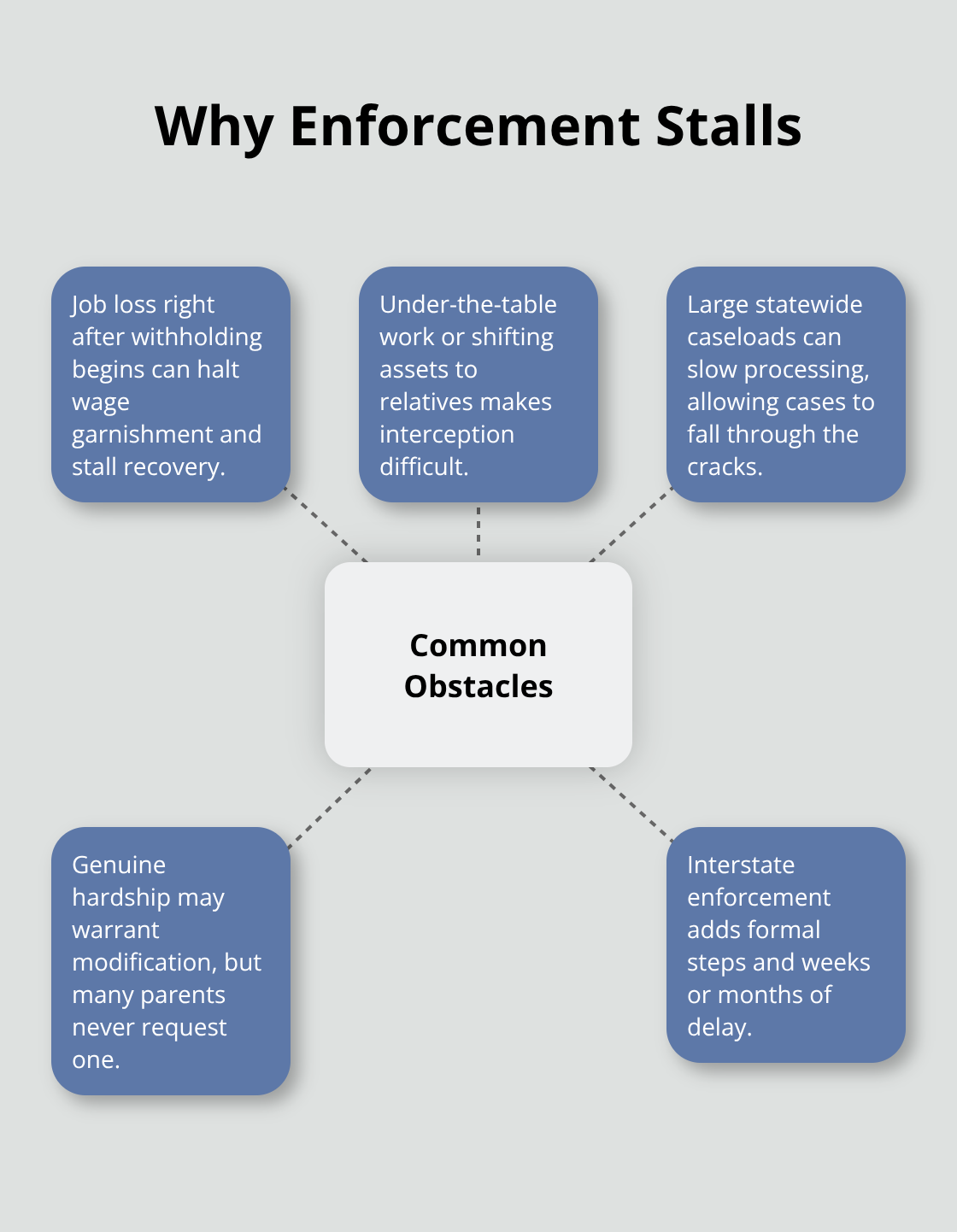
The Florida Department of Revenue handles over 1.2 million cases annually, which means individual situations sometimes fall through cracks in the system or require months to process. When a nonpaying parent faces genuine financial hardship-job loss, medical emergency, business failure-they may qualify for a modification rather than continued enforcement, yet many parents never request one.
The Modification Problem
This gap creates a dangerous situation where arrears pile up, the parent’s desperation grows, and eventual court action becomes more contentious and expensive than early modification would have been. Additionally, some parents deliberately underreport income or claim self-employment losses to reduce their support obligation, requiring you to request a modification hearing with documentation proving their actual earning capacity. The reality is that enforcement alone cannot recover support from someone with zero income or hidden assets. Courts can only order payment from income or assets that actually exist.
Interstate Enforcement Delays
Interstate complications add another layer of difficulty. If your child’s other parent lives in a different state, Florida must coordinate with that state’s child support agency through the Uniform Interstate Family Support Act framework, which adds weeks or months to enforcement timelines. Some states respond quickly to enforcement requests; others have significant backlogs. A parent might move to another state specifically to complicate collection efforts, knowing that interstate enforcement requires formal legal channels rather than simple local action.
Building Your Case for Court Action
Documentation becomes your strongest tool when standard enforcement mechanisms stall. You should maintain detailed records of every missed payment, document all communication attempts, and pursue modification hearings promptly when circumstances change. These steps create the evidence needed for successful court action and prevent arrears from becoming unrecoverable. The key insight is that enforcement mechanisms assume the nonpaying parent has income or assets-when those assumptions fail, you need legal strategy tailored to your specific situation rather than reliance on standard enforcement processes alone.
When enforcement hits these obstacles, understanding your legal options becomes essential. The next section examines the strategies that work when standard mechanisms fall short.
Strategies for Successful Child Support Collection
Document Every Payment from Day One
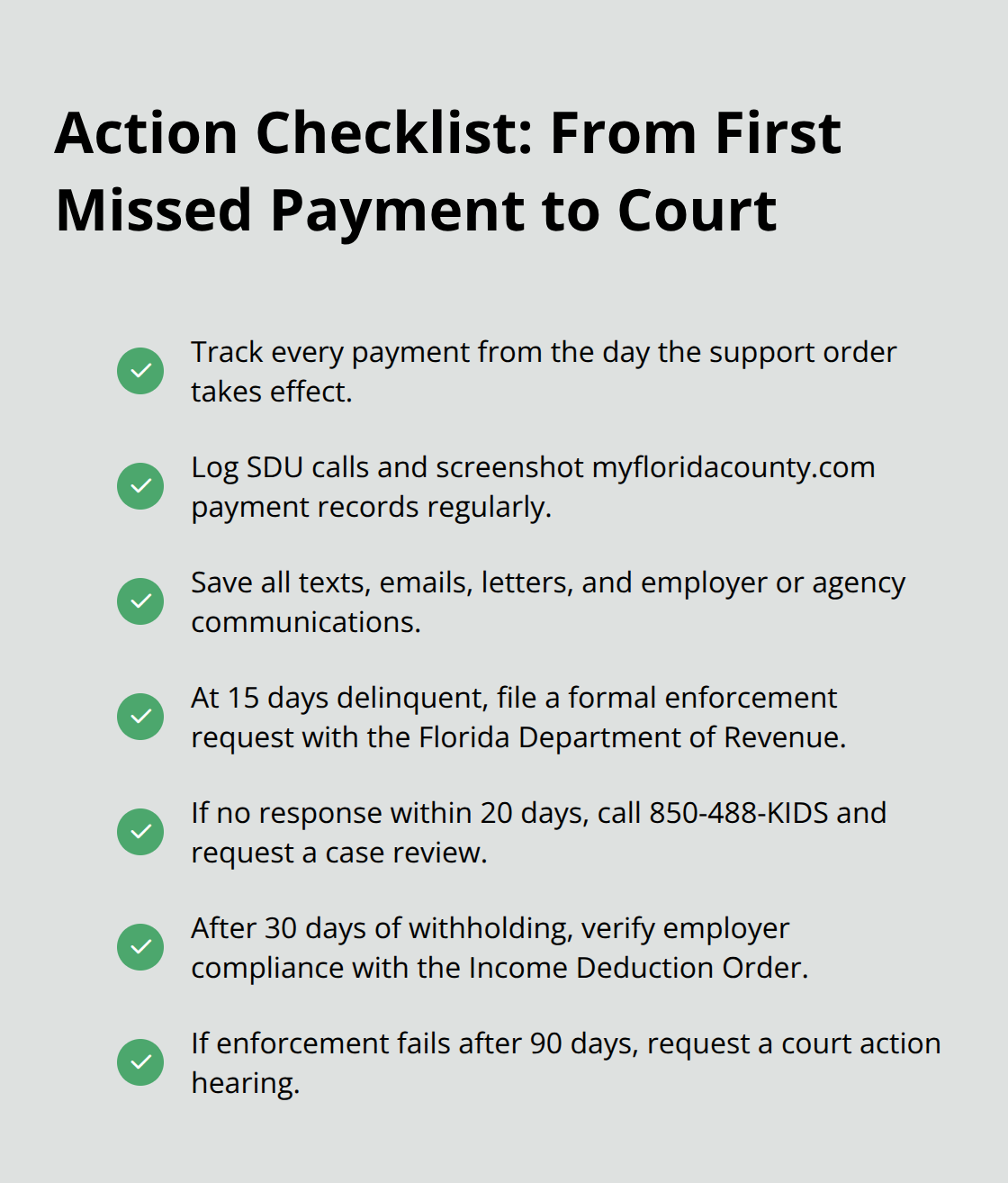
The difference between recovering arrears and watching them accumulate often comes down to how well you document everything from the start. Start tracking every payment the moment a support order takes effect. Record the date, amount expected, amount received, and any communication about missed payments. The State Disbursement Unit maintains official records, but you should maintain your own parallel documentation because discrepancies happen and you need proof independent of government systems.
When you call the SDU at 877-769-0251 to check payment status, document that call with the date and what information you received. Screenshot online payment records from www.myfloridacounty.com regularly since systems can change or records can be lost. Keep all written communication with the nonpaying parent, their employer, or enforcement agencies. Text messages, emails, and letters become critical evidence if you eventually file for contempt of court.
Courts take documented patterns seriously. If you can show 12 consecutive missed payments with your own records plus SDU confirmation, the judge sees clear willful noncompliance. Without documentation, you have only your word against theirs, which weakens your position significantly.
Push the Florida Department of Revenue to Act
Working effectively with the Florida Department of Revenue means understanding their process and pushing when they move slowly. File a formal request with the Department of Revenue for enforcement action if the nonpaying parent is 15 days delinquent, since this triggers the Clerk’s Notice of Delinquency and begins the chain of enforcement mechanisms. However, the department processes over 1.2 million cases annually, meaning your case may take weeks to move through their system.
If you have not received a response within 20 days, contact them directly at 850-488-KIDS during business hours. Request a case review and provide your documentation showing the delinquency pattern. When income withholding is implemented, verify that the employer actually received and is complying with the Income Deduction Order by requesting confirmation from the department after 30 days.
Verify Employer Compliance and Address Gaps
If withholding stops or the employer claims they never received the order, escalate immediately because employers sometimes ignore these orders or claim the employee left their position. For interstate cases, request expedited processing and provide the nonpaying parent’s current address and employer information immediately, since delays in locating the obligor across state lines can stretch timelines to six months or longer.
Escalate to Court Action When Necessary
When standard enforcement mechanisms have been attempted for at least 90 days without success, request a court action hearing. The department will file a circuit court action seeking payment of arrears, contempt findings, or job training participation requirements. Courts take these actions seriously because willful noncompliance with a support order violates state law. If the court determines the nonpaying parent has present ability to pay a specific dollar amount but refuses to do so, incarceration becomes a possible outcome until compliance occurs.
Final Thoughts
Child support enforcement in Florida requires persistence and strategic action rather than passive waiting. The Florida Department of Revenue manages over 1.2 million cases annually, which means standard enforcement mechanisms move slowly without active monitoring on your part. Document every missed payment, contact the department when delinquency reaches 15 days, and escalate to court action when enforcement mechanisms fail after 90 days.
Circumstances vary dramatically across cases-some nonpaying parents respond to income withholding while others intentionally change jobs or work under the table to avoid payment. Your specific situation determines which strategy works best, and that’s where legal representation becomes valuable. Seek counsel when standard enforcement has failed, when hidden income appears likely, when interstate complications arise, or when you need to file for contempt of court.
Contact Harnage Law PLLC to discuss your child support enforcement Florida situation and determine whether legal representation will accelerate your path to full compliance and payment recovery.