
Family Law Guidance Florida: Clear, Civil Steps Forward
Our Blog
Family Law Guidance Florida: Clear, Civil Steps Forward
Family law in Florida involves specific rules and procedures that affect major life decisions. Whether you’re facing divorce, custody disputes, or support questions, understanding the process makes a real difference.
We at Harnage Law PLLC have guided countless families through these situations. This guide breaks down what you need to know to move forward with clarity.
How Florida Divides Assets, Sets Support, and Handles Contested vs. Uncontested Cases
Uncontested Cases Move Faster and Cost Less
When you and your spouse reach agreement on all major issues-property division, child support, custody, and alimony-your case becomes uncontested. These cases typically resolve in three to six months and cost significantly less because no trial preparation or extended court battles occur. The court still reviews your agreement to confirm it serves the children’s best interests and complies with state law, but approval is routine when both sides consent.
Contested Cases Require Court Intervention
Disagreement on even one significant issue transforms your case into a contested matter. The court must hold hearings and potentially a trial to decide the outcome. These cases drag on for 12 to 24 months or longer and consume substantial legal fees because discovery, depositions, and trial preparation become necessary. Florida courts strongly encourage mediation before trial, and many counties require it. A neutral third party helps you and your spouse negotiate settlements without a judge deciding for you. This step saves time and money while giving you more control over the final agreement than a judge would provide.
Property Division Follows Equitable Distribution Rules
Florida follows an equitable distribution model, not a 50-50 split. The court starts from a presumption that marital property-anything acquired during the marriage-divides fairly, but fairness doesn’t always mean equal. The length of the marriage, each spouse’s financial contributions, the earning capacity of each party, and the impact on dependent children shape how assets and debts actually split. A 20-year marriage typically results in a more balanced division than a five-year marriage.
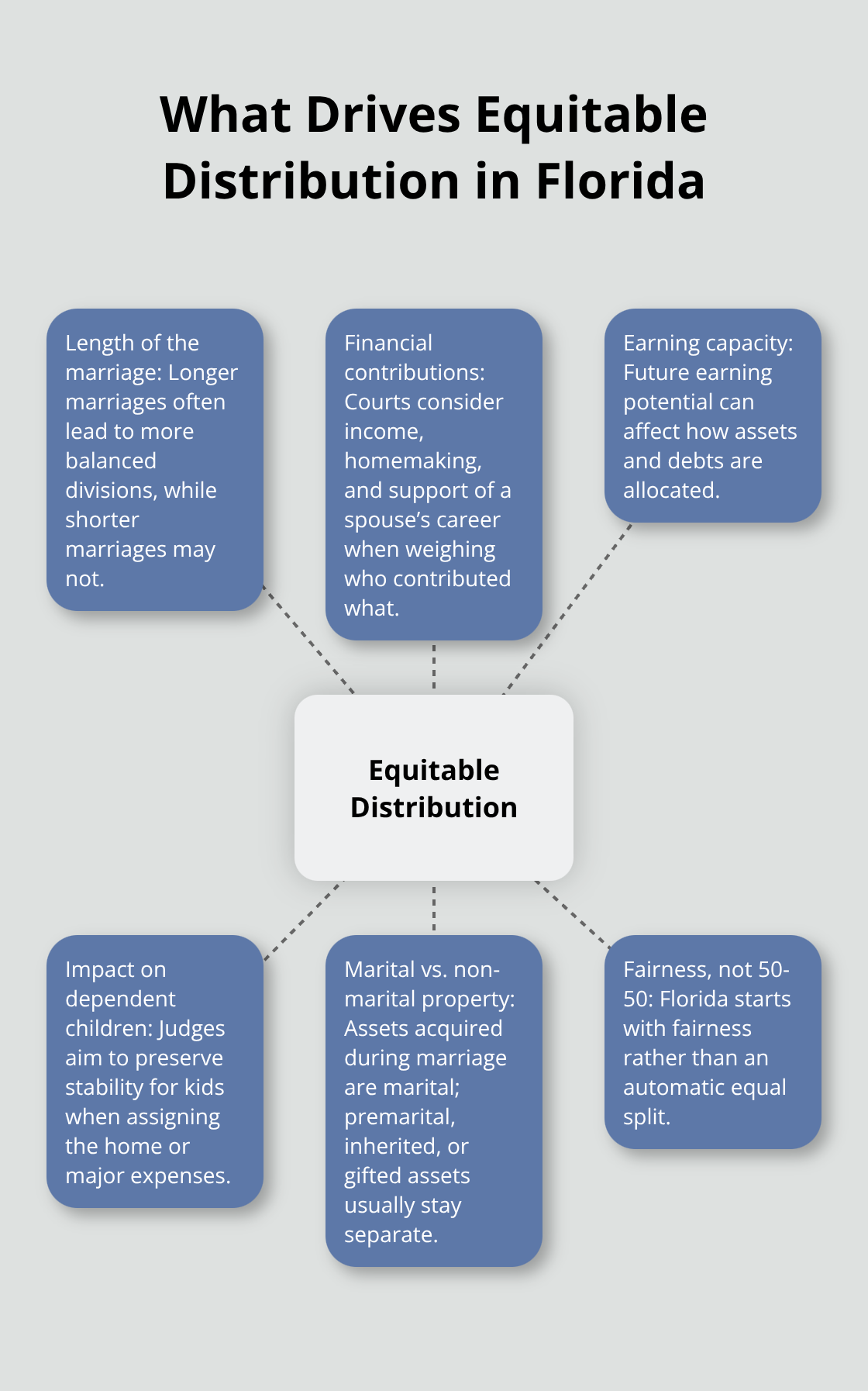
Non-marital property, including assets owned before marriage or received as inheritance or gifts, stays with the original owner.
Child Support Calculations and Alimony Forms
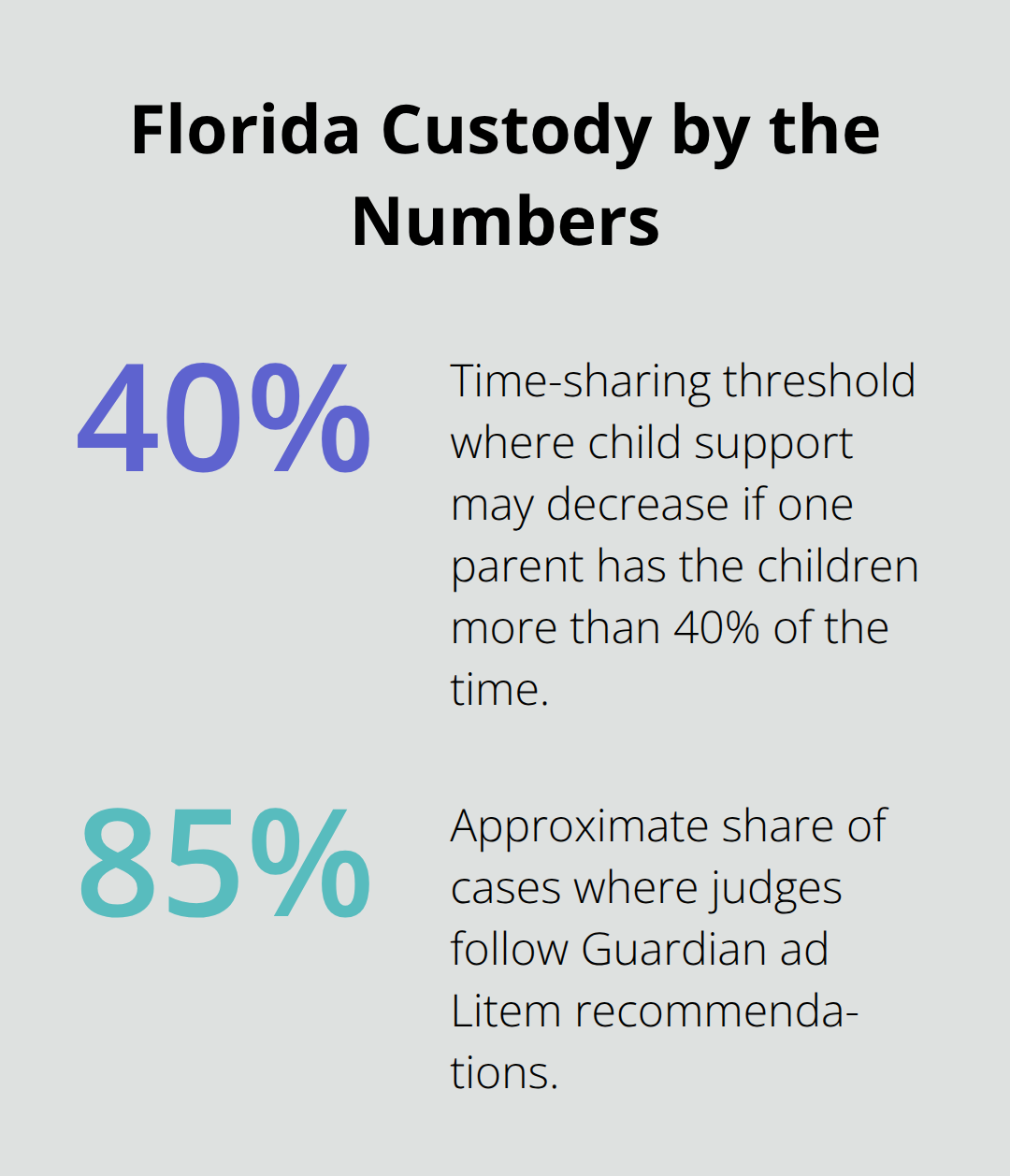
Child support follows Florida’s guidelines based on combined parental income and the number of children. For two parents with combined income of $10,000 monthly and two children, the guideline amount is roughly $2,000 monthly before adjustments. The calculation increases with income but decreases if one parent has the children more than 40 percent of the time.
Alimony comes in several forms depending on the marriage length and circumstances. Rehabilitative alimony lasts up to five years and supports a spouse returning to education or work. Durational alimony continues for no longer than the length of the marriage itself. Long-term alimony applies only in exceptional cases involving lengthy marriages where one spouse lacks earning capacity. Courts award alimony based on the standard of living during marriage, the ability of one spouse to pay, and the other spouse’s need and earning potential.
What Happens Next in Your Case
Understanding these financial and procedural frameworks helps you anticipate what comes next. Your custody arrangements and parenting schedule will shape how courts view your case, and judges consider specific factors when determining what serves your children’s best interests.
Filing for Divorce in Florida and What Comes Next
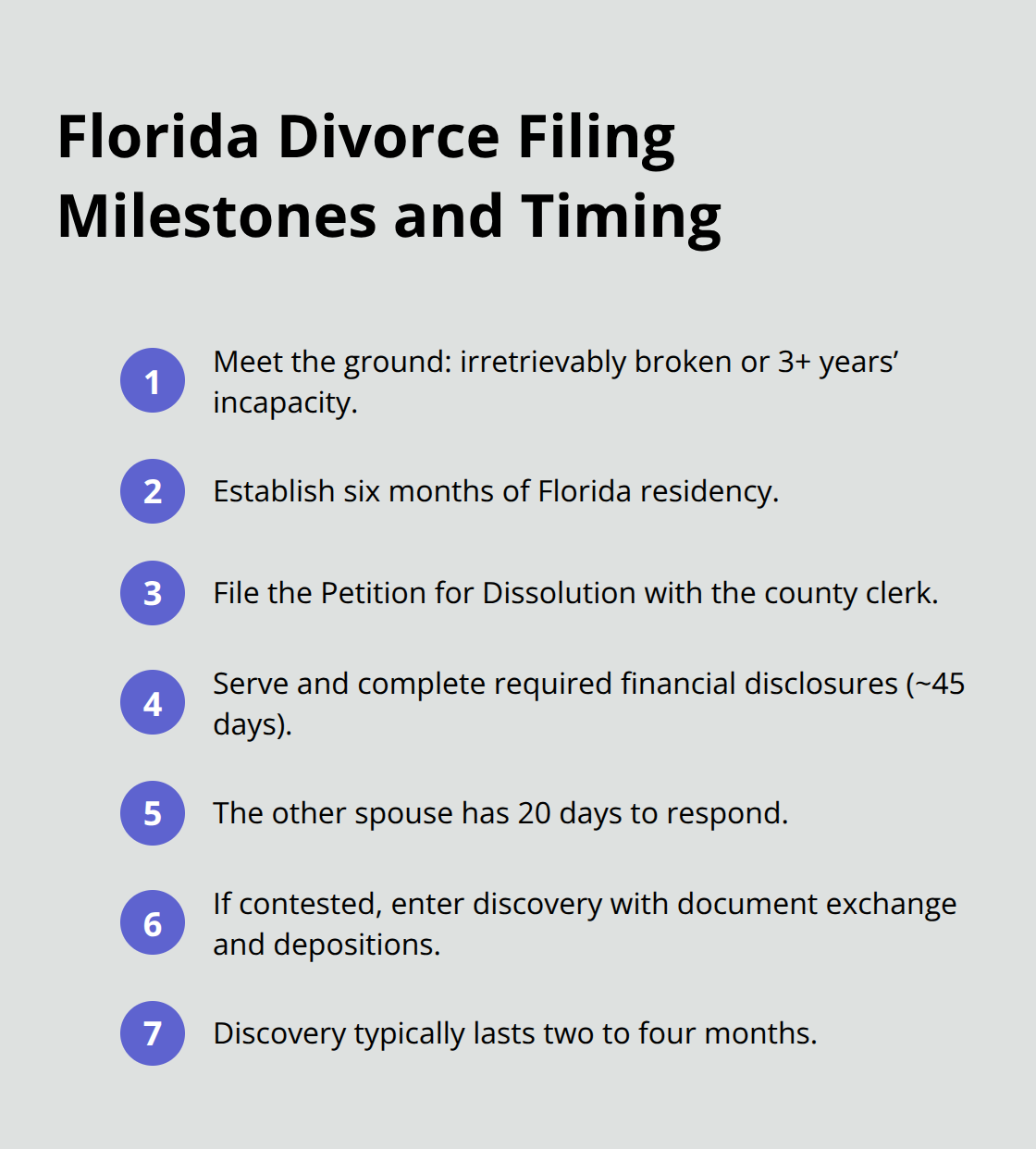
Florida requires you to meet one straightforward ground for divorce: the marriage must be irretrievably broken, or one spouse must be mentally incapacitated for at least three years. You also need six months of Florida residency before filing. The actual filing involves submitting a Petition for Dissolution of Marriage to your county clerk, along with financial disclosures required within approximately 45 days. These disclosures include a financial affidavit and a child support guidelines worksheet if children are involved. Many couples skip the formal disclosure requirement through a joint waiver if they’ve already negotiated all terms, which accelerates the timeline considerably. Once filed, the other spouse has 20 days to respond. If they don’t contest your petition, you move toward an uncontested resolution. If they do respond with disagreement on any issue, the case becomes contested and enters the discovery phase, where both sides exchange documents, answer written questions, and sometimes sit for depositions. This phase typically lasts two to four months depending on case complexity and how quickly your attorney and the other side exchange information.
Timeline Reality and What Slows Cases Down
Uncontested divorces in Florida average three to six months from filing to final judgment. Contested cases stretch to 12 to 24 months or longer because discovery, mediation, and trial preparation consume substantial time. Counties vary significantly in their timelines; some move cases through court faster than others. Many Florida counties now require mediation before trial, which actually helps because a neutral mediator often helps you reach settlement faster than fighting it out in court. If mediation succeeds, your case resolves without a judge deciding for you. If it fails, you proceed to trial, which adds months of waiting for a court date and trial preparation. The six-month waiting period for divorce finalization in Florida applies whether your case is contested or uncontested, so even simple cases cannot close before six months from filing. During this waiting period, temporary orders may address child support, custody, alimony, or attorney fees if either spouse requests them. Protecting your financial position during this waiting period matters significantly because temporary orders remain in place until the final judgment.
Gather Documentation Before You File
Before filing, collect documentation of all assets, debts, income, and expenses. Bank statements, tax returns, retirement account statements, mortgage documents, and credit card statements become critical evidence if your spouse contests the division. Separate any non-marital property by documenting when you acquired it and whether it came from inheritance or a gift. Open a separate bank account in your name only if you haven’t already, and move a portion of jointly held funds proportional to your needs during the separation. Courts view this action neutrally if done reasonably, but taking all joint funds appears aggressive and can prejudice a judge against you.
Protect Your Assets and Avoid Costly Mistakes
Change passwords on financial accounts and email if you share them with your spouse, not to hide information but to prevent unauthorized access. Do not hide assets, transfer funds to others’ names, or destroy financial records because courts view these actions as fraud and they backfire dramatically in your case. Do not make major purchases, take on significant debt, or liquidate retirement accounts without consulting your attorney because these actions complicate property division and trigger sanctions. If your spouse has a history of financial control or abuse, speak with your attorney about obtaining a temporary restraining order that prevents either party from transferring assets without court permission.
Comply with Court Orders After Filing
After filing, comply strictly with all court orders regarding temporary support, custody schedules, and financial disclosures because violating orders damages your credibility with the judge and can result in contempt findings or attorney fee awards against you. Keep detailed records of all parenting time, support payments, and communications with your spouse to document compliance and establish patterns if enforcement becomes necessary later. Your custody arrangements and the parenting schedule you establish during this phase will shape how judges view your case and influence the final outcome.
How Florida Courts Handle Custody and Parenting Time
Courts Separate Legal and Physical Custody
Florida courts separate custody into two distinct concepts: parental responsibility, which means legal decision-making authority over education, healthcare, and major life choices, and time-sharing, which refers to the actual schedule of when each parent has the children. Courts strongly favor shared parental responsibility between both parents unless evidence shows that joint decision-making would harm the child. A judge considers multiple factors when determining custody arrangements, including each parent’s ability to foster the parent-child relationship, the stability of each parent’s home and community, the child’s adjustment to school and peers, the health and fitness of each parent, and the preferences of children old enough to express them meaningfully. Florida courts do not automatically award custody based on gender or parental income; instead, judges focus narrowly on what serves the child’s best interests.
The Guardian ad Litem’s Role in Contested Cases
If you cannot agree with your spouse on custody terms, the court will appoint a Guardian ad Litem to investigate the situation and recommend arrangements. This independent advocate for your child carries significant weight with judges, so their findings often shape the final custody order. Before trial, the Guardian ad Litem will interview both parents, visit both homes, speak with teachers and healthcare providers, and assess the child’s overall wellbeing. Their report typically runs 10 to 20 pages and includes specific recommendations that judges follow in roughly 85 percent of cases according to family law research.
Common Time-Sharing Patterns That Work
Florida courts recognize several common time-sharing patterns, including alternating weeks, two weeks at each parent’s home, the 3-4-4-3 rotation where parents alternate three and four day blocks, the 2-2-5-5 rotation splitting weekdays evenly while one parent takes weekends, and the 2-3-2 rotation used frequently for working parents. The schedule you choose should match your work schedule, commute distance between homes, and the child’s school location because constant transitions frustrate children and create enforcement problems later. If you live 45 minutes apart, weekly exchanges become burdensome; a two-week rotation or 3-4-4-3 pattern works better. If you live nearby and both work flexible schedules, a 2-2-5-5 rotation allows more balanced contact.
Building a Detailed Parenting Plan
Your parenting plan must address not just the basic schedule but also transportation logistics, how you’ll handle school breaks and holidays, which parent covers specific medical and educational decisions, how you’ll communicate about the child’s needs, and what happens when circumstances change. Courts expect detailed parenting plans that anticipate real-world situations. Include provisions for illness, school conferences, extracurricular activities, overnight guests, and how you’ll handle disagreements without returning to court. The more specific your plan, the fewer disputes arise later.
Uncontested Custody Settlements Protect Your Child
If you and your spouse reach agreement on custody and parenting time before trial, the court will approve your uncontested arrangement if it serves the child’s best interests. Uncontested custody settlements avoid months of litigation, reduce conflict exposure for your child, lower legal costs substantially, and give you control over the outcome rather than leaving decisions to a judge. Harnage Law PLLC helps families craft detailed parenting agreements that work in practice and stand up if enforcement becomes necessary.
Final Thoughts
Florida family law involves specific procedures and timelines that affect your family’s future. The steps outlined in this guide-understanding asset division, navigating divorce filing requirements, and establishing custody arrangements-form the foundation for moving forward with clarity. Family law guidance in Florida requires more than general knowledge because your situation involves unique financial circumstances, children with specific needs, and relationships that demand careful handling.
The decisions you make during divorce or custody disputes shape outcomes for years to come. Resources exist throughout Florida to support your case, including the Florida Courts website, county clerks, mediation services, and legal aid organizations. These resources help, but they cannot replace personalized legal counsel tailored to your specific circumstances and local court practices.
Contact Harnage Law PLLC to discuss your situation and clarify your options. An initial consultation explains what to expect in your specific case and outlines a path forward that protects your rights and your family’s wellbeing. We at Harnage Law PLLC provide experienced legal representation for family law cases across Florida, handling sensitive matters including divorce and child custody with personalized attention designed to achieve the best possible outcomes for your family.