
Divorce Process Melbourne Florida: From Filing To Final Decree
Our Blog
Divorce Process Melbourne Florida: From Filing To Final Decree
Going through a divorce in Melbourne Florida involves multiple legal steps, financial decisions, and family considerations that can feel overwhelming without proper guidance.
At Harnage Law PLLC, we help clients navigate the divorce process in Melbourne Florida with clarity and confidence. This guide walks you through filing requirements, asset division, spousal support, child custody, and support arrangements so you understand what to expect at each stage.
What You Must Do Before Filing for Divorce in Melbourne Florida
Meet Florida’s Residency and Venue Requirements
Starting a divorce in Melbourne Florida requires meeting specific legal requirements before you file anything with the court. Florida law mandates that at least one spouse must have lived in the state for a minimum of six months before filing. This residency requirement is non-negotiable, and acceptable proof includes a Florida driver’s license, voter registration, or utility bills. You file your case in Brevard County Circuit Court if you or your spouse currently resides there.
Understand the Grounds for Divorce
Florida recognizes two grounds for divorce: either the marriage is irretrievably broken or one party has been declared legally incompetent for more than three years. The irretrievably broken standard applies to nearly all divorces, and Florida does not require you to prove fault or provide specific reasons. If your spouse disputes that the marriage is irretrievably broken, the court can order counseling and delay proceedings up to three months to attempt reconciliation, but this rarely changes the outcome.
Organize Your Financial Records and Documents
Before you walk into the Brevard County Clerk’s Office, organize your financial records and identify all marital assets and debts. You must file a Petition for Dissolution of Marriage along with financial affidavits, a parenting plan if you have children, and a child support guidelines worksheet if applicable. The filing fee in Brevard County is approximately $400, though fee waivers are available if you face genuine financial hardship. The clerk’s office processes e-filing, which speeds up the administrative timeline.
Complete the Filing and Service Process
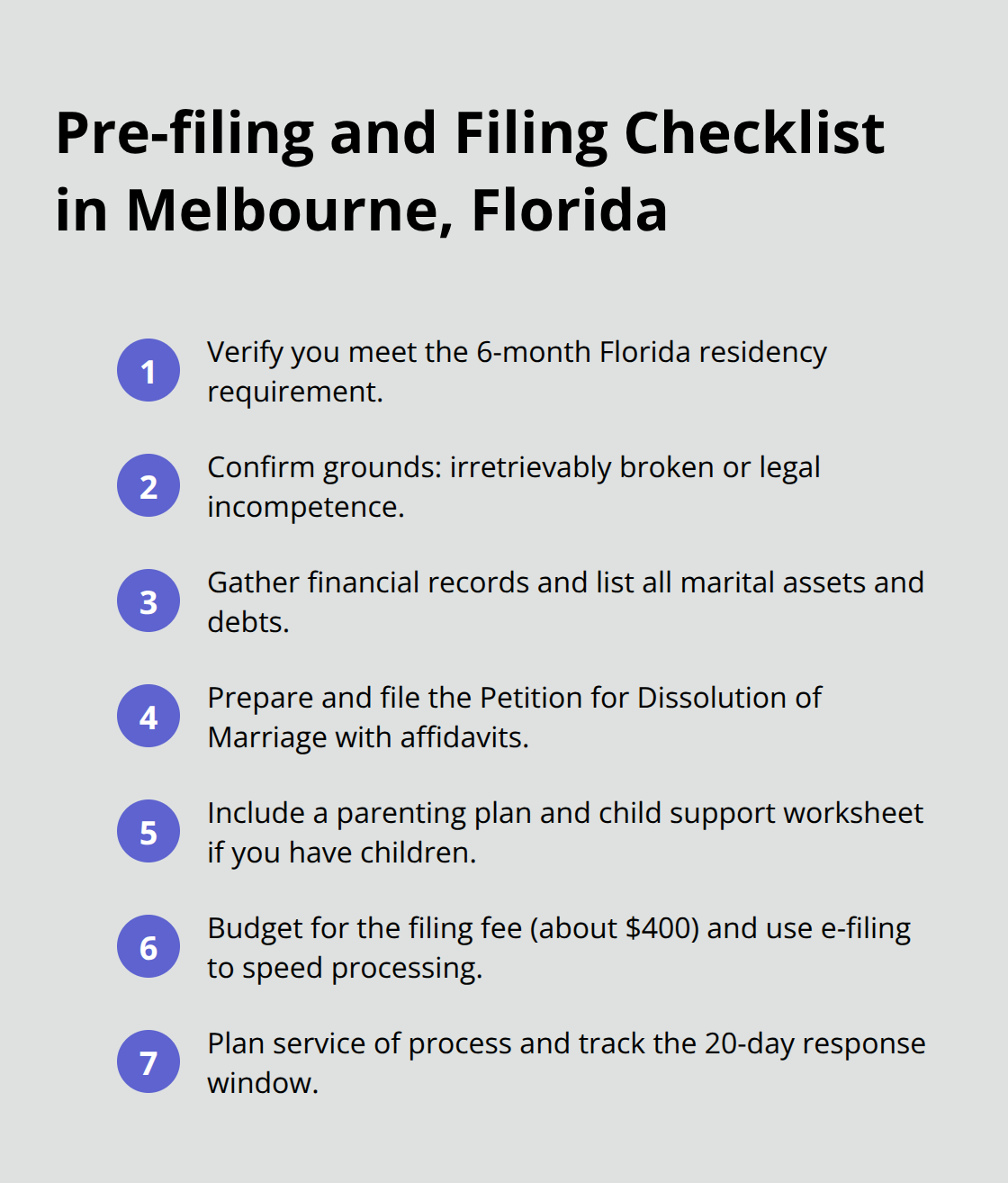
After you file, you receive a case number and a judge is assigned to oversee your case. You must then serve your spouse with the petition through personal delivery, certified mail, or a process server. Your spouse has 20 days to file a written answer or counter-petition. One critical detail: you cannot receive a final decree before 20 days after serving your spouse, which means the absolute minimum timeline from service to final judgment is three weeks, though most uncontested cases finish in three to four months and contested cases often take over a year.
Once service is complete and your spouse responds, the next phase involves financial disclosure and the mandatory mediation process that shapes how your assets, support obligations, and custody arrangements are ultimately resolved.
How Florida Courts Divide Property and Award Spousal Support
Understanding Equitable Distribution in Melbourne Florida Divorces
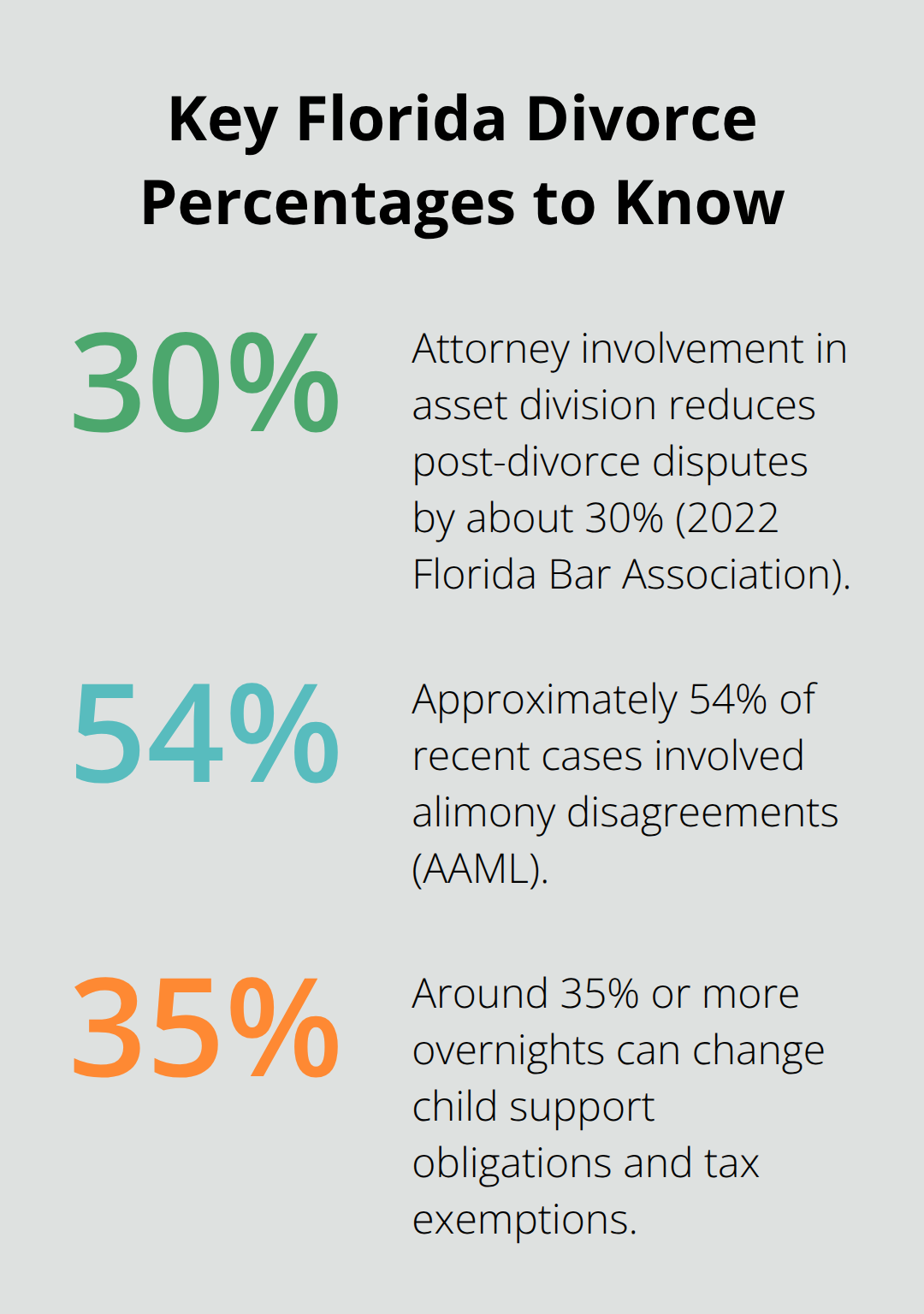
Florida law treats marital property division and spousal support as separate but related financial issues that directly affect your post-divorce financial stability. When you file for divorce in Melbourne Florida, the court applies equitable distribution, which does not mean a straight 50-50 split but rather a fair division based on multiple factors including the length of your marriage, each spouse’s earning capacity, contributions to the marriage, and the standard of living during the relationship. The court presumes marital property should be divided equally, but that presumption can shift depending on circumstances. A 2022 Florida Bar Association study found that legal counsel involvement in asset division reduces the likelihood of post-divorce disputes by approximately 30 percent, which matters because disagreements over property often resurface years later when financial situations change.
You must inventory all marital assets and debts, including real estate, vehicles, bank accounts, retirement accounts, mortgages, and other loans. The financial affidavits you filed during the initial process should reflect this inventory, and both spouses must exchange detailed financial information including bank statements, tax returns, and property valuations by court deadlines. Incomplete or misleading disclosures trigger sanctions from the judge, so accuracy is non-negotiable.
Types of Alimony and Duration Limits
Spousal support, also called alimony, operates under different rules than property division and depends heavily on how long you were married. Florida recognizes three types of alimony: bridging, rehabilitative, and durational. Bridging alimony helps one spouse transition to single life, rehabilitative alimony supports a spouse who is returning to work or school, and durational alimony provides support for a set period after divorce.
The American Academy of Matrimonial Lawyers reported a rise in alimony disputes, with approximately 54 percent of recent cases involving alimony disagreements. Marriage length determines duration limits: short marriages under 10 years typically qualify for support lasting no longer than the marriage itself, moderate marriages between 10 and 20 years may receive support for up to half the marriage length, and long marriages of 20 years or more can result in indefinite support.
Factors Courts Consider in Alimony Calculations
Courts examine factors like earning capacity, age and health, ability to work, standard of living during the marriage, and contributions to the other spouse’s career or education. If one spouse sacrificed career advancement to raise children or support the other’s professional development, that sacrifice weighs heavily in alimony calculations. Alimony is taxable income to the recipient and tax-deductible to the payor, which has real financial consequences for both parties, so discussing tax implications with an accountant alongside your divorce attorney prevents costly surprises.
Settlement Through Mediation Versus Trial
The mandatory mediation process in Brevard County typically costs between 150 and 300 dollars per hour and is usually split between spouses. Reaching a settlement agreement on property and alimony before trial saves substantially more money and time than litigating these issues before a judge. Once you and your spouse resolve property division and support obligations through settlement or mediation, the court moves forward with finalizing custody and support arrangements for any children involved.
Child Custody, Parenting Plans, and Child Support in Melbourne Florida
How Florida Courts Prioritize Your Children’s Best Interests
When children are involved in your divorce, the court’s primary concern shifts entirely to their best interests, and this focus overrides almost every other consideration in your case. Florida law uses the term time-sharing instead of custody, and the court presumes that frequent, continuing contact with both parents is in the child’s best interest unless safety or other serious factors intervene. The parenting plan becomes a binding court order that specifies exactly how time with each parent is divided, who makes major decisions about education and medical care, how you’ll communicate about the children, and where custody exchanges happen. The parenting plan must be detailed enough to prevent disputes, so vague arrangements like every other weekend fail the court’s standards.
Mandatory Parenting Courses and Their Impact on Children
Before your final divorce decree is signed, you and your spouse must complete a mandatory parenting course, which Brevard County requires to help parents understand how to co-parent effectively after separation. The Florida Chapter of the Association of Family and Conciliation Courts found that children adapt better to new family dynamics when parents pursue mediated or uncontested approaches rather than litigated battles. This research shows that the way you handle custody negotiations directly affects your children’s emotional recovery and long-term adjustment to the separation.
Time-Sharing Arrangements and Financial Consequences
If you have substantial overnight time with your children-typically 35 percent or more-this affects both your child support obligation and your tax dependency exemptions. The time-sharing arrangement has immediate financial consequences beyond just scheduling, so understanding how overnight percentages impact your obligations matters significantly before you finalize your parenting plan.
Child Support Calculations and Modification Rights
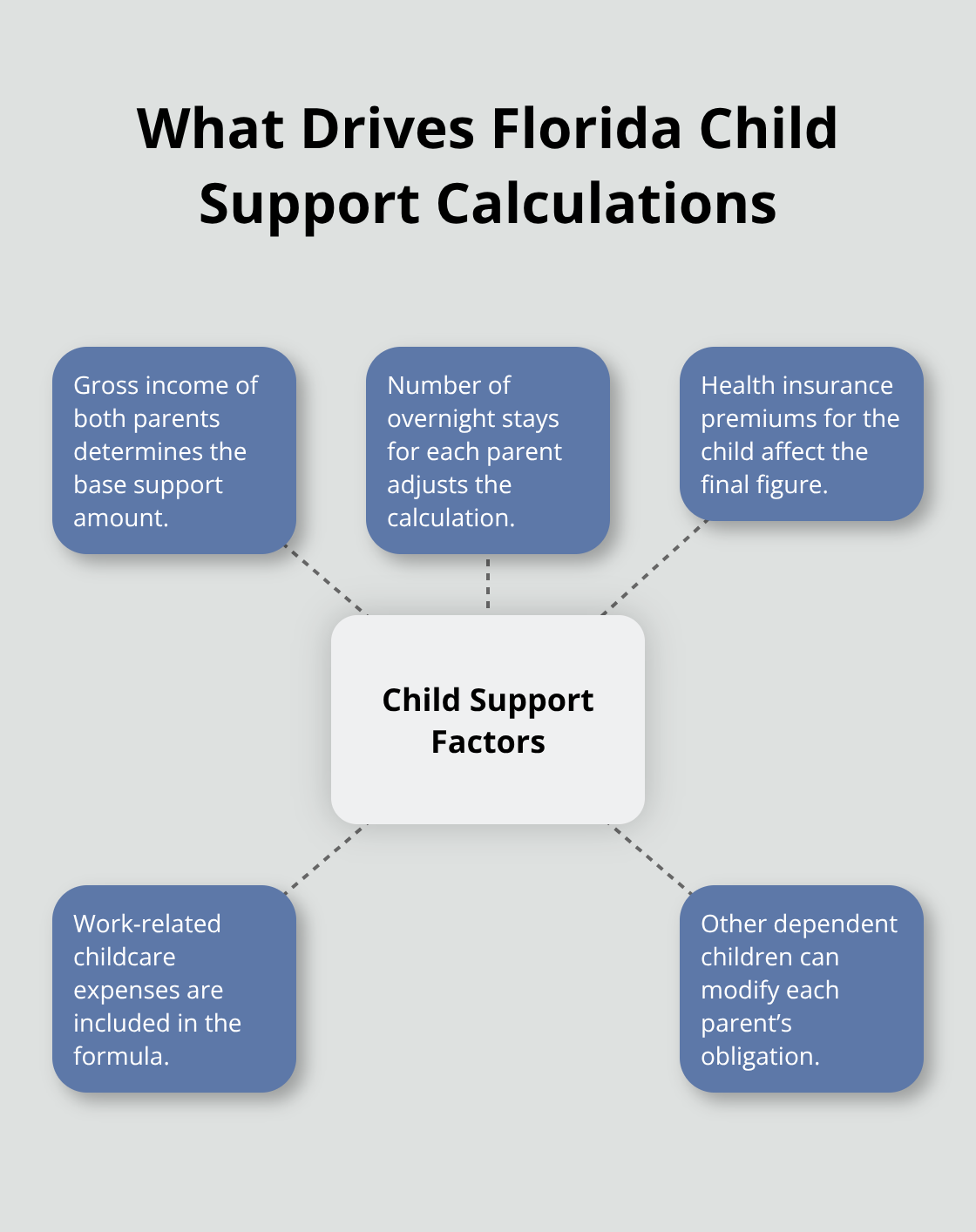
Child support in Florida is calculated using a specific formula based on both parents’ gross income and the number of overnight stays each parent has with the child. The Florida Department of Revenue provides an online child support calculator that shows you the preliminary amount before any adjustments, but the final number depends on factors like health insurance costs, childcare expenses, and whether either parent has other dependent children. Support generally terminates when the child turns 18, unless the child is still in high school, in which case it continues until graduation or age 19, whichever comes first.
After your divorce is final, substantial changes in circumstances such as job loss, significant income increases, relocation more than 50 miles away, or substantial changes in the child’s needs give either parent grounds to request modification of custody or support orders through the court. Brevard County Circuit Court retains continuing jurisdiction over these matters indefinitely. If your ex-spouse stops paying child support or violates the parenting plan, the court has enforcement tools available, and we at Harnage Law PLLC can help you navigate modification requests or enforcement actions when circumstances change after your divorce is finalized.
Final Thoughts
The divorce process Melbourne Florida demands attention to financial disclosures, mandatory mediation, property division, spousal support calculations, and custody arrangements that reshape your life. Understanding each phase from filing requirements through final decree reduces uncertainty and helps you make informed decisions rather than reactive ones. The timeline varies significantly based on whether your case settles or proceeds to trial, but most uncontested divorces in Brevard County finish within three to four months while contested cases extend well beyond a year.
Legal representation matters because the stakes are genuinely high-a 2022 Florida Bar Association study showed that attorney involvement in asset division reduces post-divorce disputes by approximately 30 percent, and this benefit extends to custody arrangements and support calculations as well. The difference between a poorly drafted settlement and a comprehensive one often surfaces years later when circumstances change and you need to modify orders or enforce them. Courts retain continuing jurisdiction over child support and custody indefinitely, meaning disputes can resurface whenever substantial life changes occur.
Your next step involves gathering financial records, identifying all marital assets and debts, and scheduling a consultation with an attorney who understands both the technical requirements and the human dimensions of divorce. Contact Harnage Law PLLC to discuss your situation and develop a strategy tailored to your circumstances and goals.