
Melbourne Family Law Attorney: What to Expect in Your First Consultation
Our Blog
Melbourne Family Law Attorney: What to Expect in Your First Consultation

Your first consultation with a Melbourne family law attorney sets the tone for your entire case. It’s your chance to ask questions, understand your options, and see if we’re the right fit for your situation.
At Harnage Law PLLC, we want you to walk into that meeting prepared and confident. This guide walks you through what to expect before, during, and after your initial appointment.
What to Bring to Your First Consultation
Show up with the documents that matter. Financial records tell the real story of your case, so bring bank statements from the last three months, tax returns for the past two years, pay stubs, and any investment or retirement account statements. If property is involved, gather deeds, mortgage statements, and recent property valuations. For custody matters, bring school records, medical documentation, and any existing custody agreements or court orders. If you’re dealing with child support or alimony, collect documentation of income sources and existing support arrangements. Don’t worry about organizing everything perfectly-just bring what you have. Disorganized documents work better than missing ones, and we can sort through them together during the consultation.
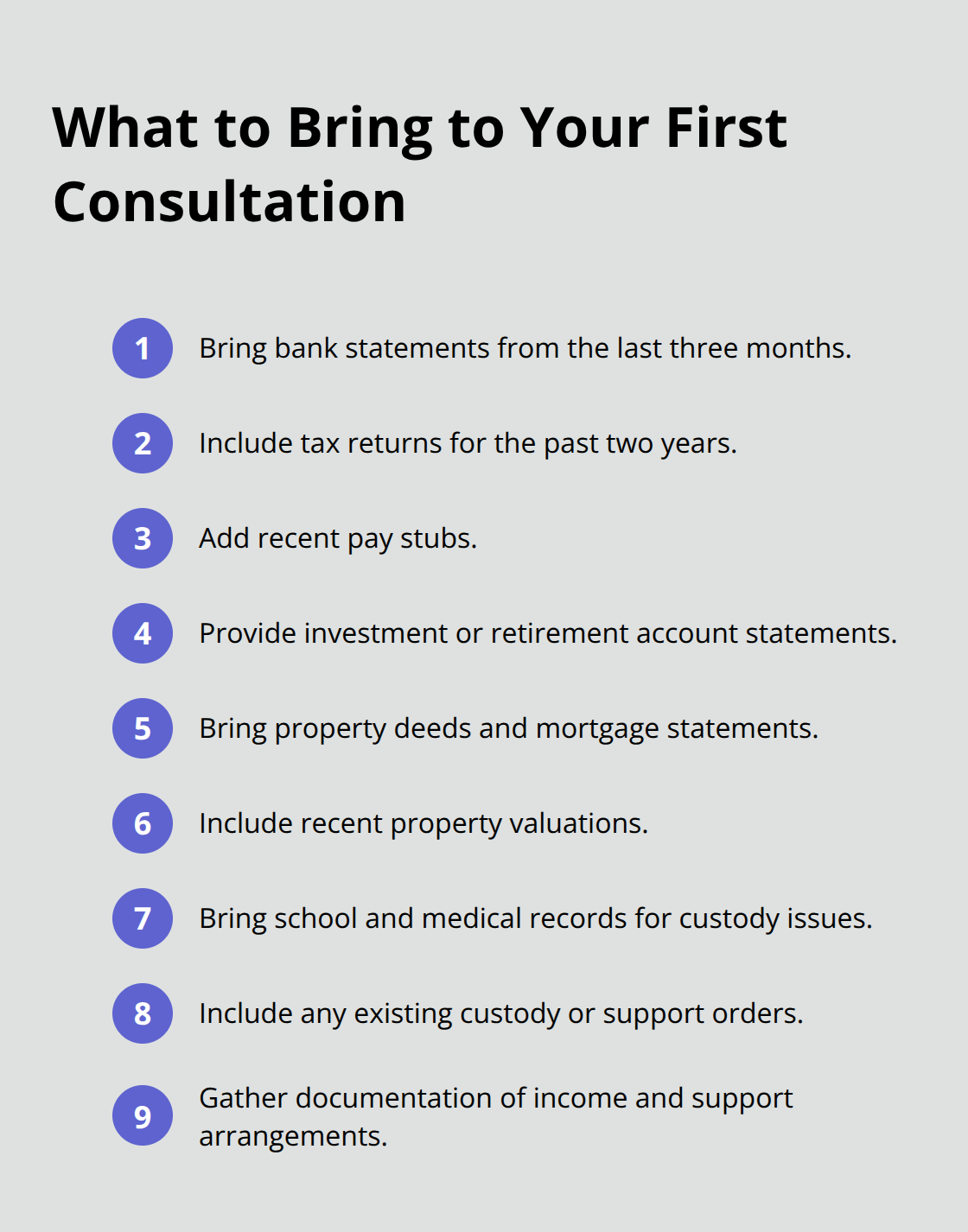
Questions That Move Your Case Forward
Write down specific questions, not vague ones. Instead of asking what happens next, ask what the typical timeline looks like for contested versus uncontested cases in Brevard County, or how the court determines child custody arrangements in your situation. Ask about the actual costs involved-hourly rates, whether flat fees apply to certain services, and what additional expenses like court filing fees or expert reports might run. Ask which approach makes sense for your circumstances: negotiation, mediation, collaborative divorce, or litigation. Ask how the attorney will keep you updated and how often you can expect communication. These concrete questions produce actionable information, not generic answers. Bring the list with you so you don’t forget anything in the moment.
Get Clear on What You Actually Want
Your goals shape everything that follows. State what you want to achieve-whether that’s minimizing legal costs, protecting your relationship with your children, reaching a settlement quickly, or fighting for specific assets. Understand that some goals conflict with others. Pursuing a quick settlement often means compromising on asset division; fighting for every detail typically means higher costs and longer timelines. Courts in Florida won’t grant your case faster just because you want it to be fast, and they won’t award assets based on what feels fair to you personally-they apply specific legal standards. Coming in with realistic expectations about what’s actually possible under Florida law matters far more than hoping for the best outcome. Think through your priorities beforehand so you can have a focused conversation about which path actually serves your situation.
With these preparations in place, you’ll walk into your consultation ready to have a meaningful discussion about your case and the options available to you.
How Your First Consultation Works
We Listen to Your Full Story
The consultation starts with us listening to your situation without judgment. We ask about your marriage, the issues that brought you here, and what triggered the decision to seek legal help now. This isn’t small talk-we need the real story because family law outcomes depend on understanding the full context. We ask about children, assets, income, and whether safety concerns or existing court orders affect your case. We ask direct questions about your spouse’s likely position and whether they know you’re consulting with an attorney. We also ask what you’ve already tried to resolve things on your own. This assessment typically takes 20 to 30 minutes and forms the foundation for everything we discuss next. Don’t sanitize your answers or leave out details you think are embarrassing or irrelevant-those details often matter more than you realize.
We Explain Your Real Options
Once we understand your situation, we walk you through your actual options. Many consultations fail because attorneys present options in vague terms like negotiation, mediation, or litigation without explaining what each path really means for your timeline and costs. We are specific. Negotiation between attorneys typically takes two to four months if both parties cooperate, but can stretch to six months or longer if your spouse drags things out. Mediation costs between $1,500 and $3,500 depending on the mediator’s hourly rate and how many sessions you need-most cases settle in two to three sessions, though contested custody matters sometimes require four or five.
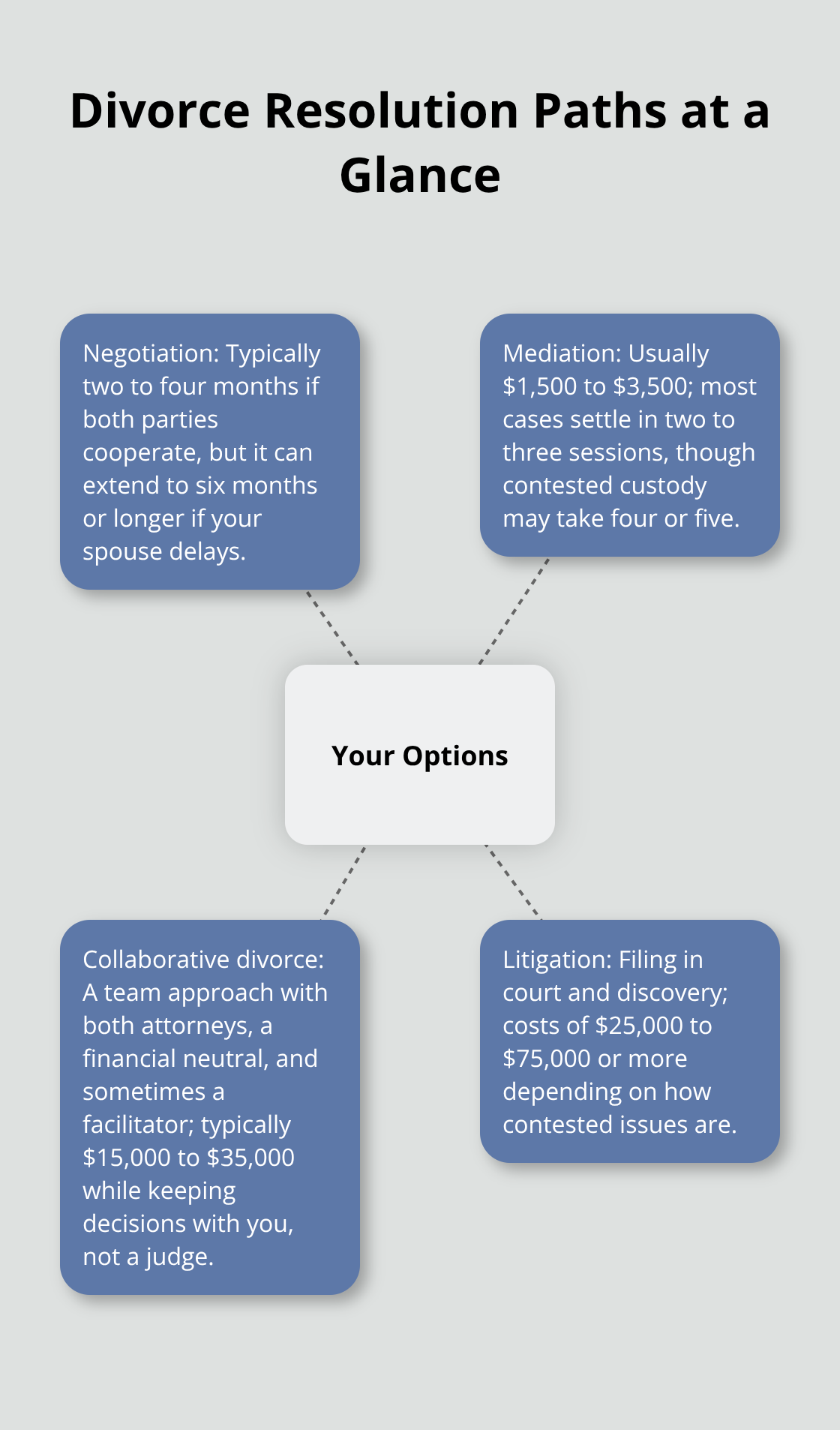
Collaborative divorce involves a team approach with your attorney, your spouse’s attorney, a financial neutral, and sometimes a family facilitator, which typically costs $15,000 to $35,000 but keeps decisions in your hands rather than a judge’s hands. Litigation means filing in court and going through discovery, which costs $25,000 to $75,000 or more depending on how contested the case becomes and how many issues need court resolution.
We Give You Honest Recommendations
We explain which option actually fits your priorities-not which one sounds best in theory. We also discuss the realistic timeline for each path. Uncontested cases can close in 30 days once paperwork is filed, while contested divorces involving custody disputes typically take 12 to 18 months or longer. We tell you our honest recommendation based on your goals and your spouse’s likely behavior, not based on what generates the most billable hours.
We Explain Fees With Complete Transparency
Finally, we explain our fees with complete transparency. We charge hourly rates, and we tell you exactly what that rate is. We explain what tasks cost extra, including court filing fees (typically $400 to $500 in Brevard County), service of process fees ($75 to $150), and expert reports if property valuations or custody evaluations become necessary. We discuss retainer amounts upfront and whether any portion is refundable. We also discuss payment plans if cost is a concern because we’d rather work with you on a manageable schedule than have you represent yourself and make costly mistakes.
With your options, timeline, and costs clearly laid out, you’ll understand exactly what comes next and what to prepare for the steps ahead.
What Happens After Your Consultation
We Assess Your Case and Create Your Action Plan
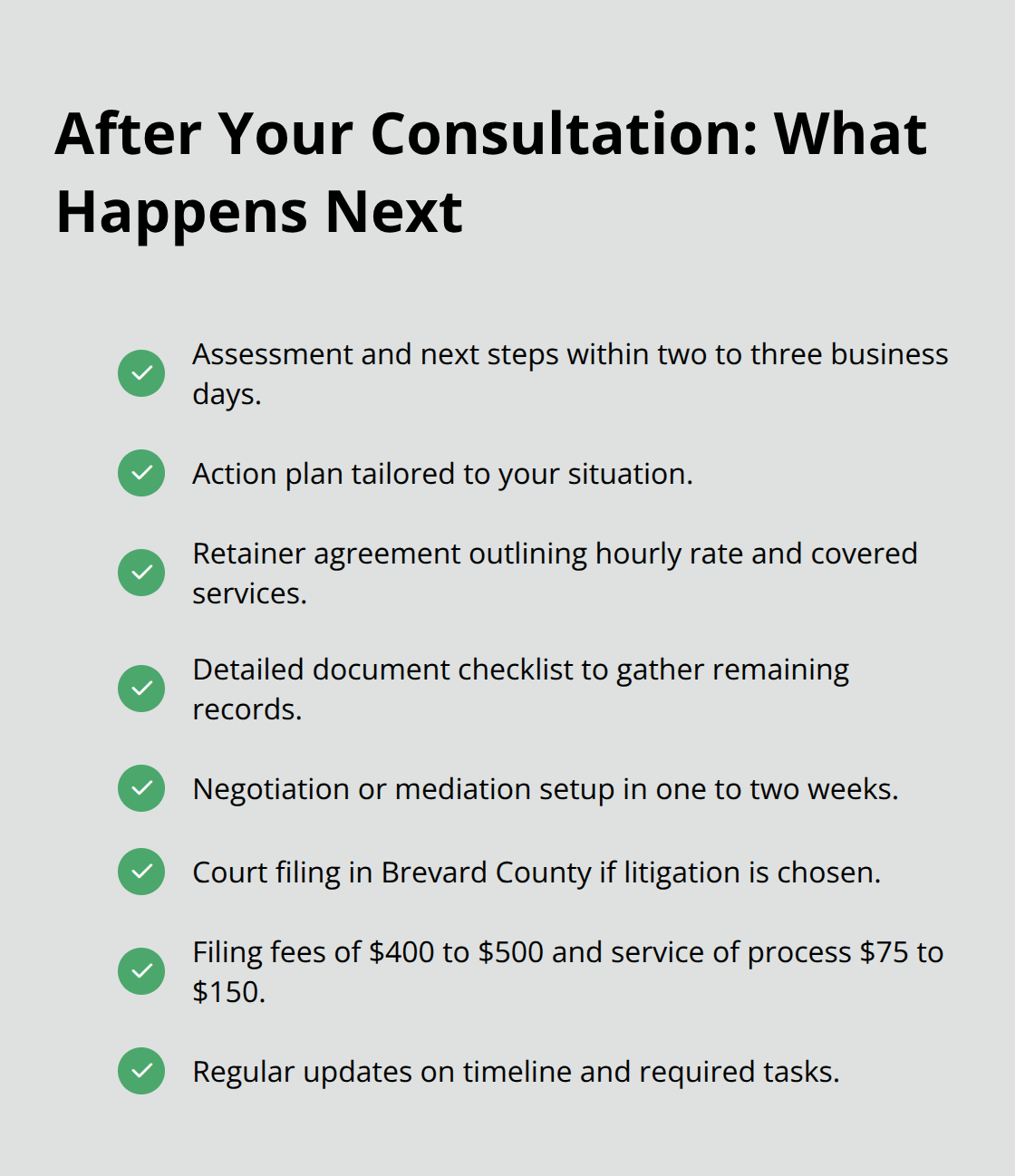
The consultation ends, but your case doesn’t start immediately. We take the information you’ve shared, review the documents you brought or sent, and develop a concrete action plan specific to your situation. Within two to three business days, we contact you with our assessment and next steps. This isn’t a generic follow-up-we outline which approach we actually recommend, why it fits your priorities, and what we need from you to move forward. If we’re not the right fit for your case, we tell you that too.
We Prepare Your Retainer Agreement and Document Checklist
If you decide to hire us, we send you a retainer agreement that spells out our hourly rate, the retainer amount due, and exactly what services that covers. We also send a detailed checklist of documents we still need-financial records, correspondence with your spouse, existing agreements, anything that strengthens your position. You have time to gather these without pressure, but the more complete your file, the faster we work and the lower your overall costs become.
We File Your Case or Begin Settlement Discussions
Once you’ve signed the agreement and paid your retainer, we file your case or start settlement discussions depending on the path you chose. If you’re pursuing negotiation or mediation, we contact your spouse’s attorney or your spouse directly to propose a timeline and exchange initial positions. This typically takes one to two weeks to set up, and you’ll hear from us before any communication happens on your behalf. If litigation is your path, we prepare the petition or response and file it in Brevard County court within the timeframe you’ve approved. Court filing fees run $400 to $500, and service of process costs $75 to $150-we handle these administrative tasks so you don’t have to.
We Keep You Informed Throughout the Process
Throughout this process, we keep you updated on exactly what we’ve done, what we’re waiting for, and what you need to do next. You’ll know your timeline: negotiated settlements typically conclude within two to four months if both parties cooperate, mediation usually wraps up in two to three sessions spread across six to eight weeks, and contested litigation typically runs twelve to eighteen months from filing to trial. These aren’t guarantees-your spouse’s responsiveness, the complexity of your assets, and whether custody is disputed all affect the actual timeline-but you’ll have realistic expectations, not vague hopes.
Final Thoughts
Your first consultation with a Melbourne family law attorney marks the moment you take control of your case. The preparation you complete beforehand-organized documents, specific questions, and clear priorities-transforms that meeting from a vague conversation into actionable information that shapes your entire path forward. You walk out knowing your realistic options, what each costs, and which approach actually serves your situation rather than what sounds best in theory.
Selecting the right attorney matters far more than most people realize because you’re not just hiring someone to file paperwork. You’re hiring someone who assesses your situation honestly, explains your options with real numbers and timelines, and recommends the path that serves your goals (not the one that generates the most billable hours). A strong attorney tells you when your expectations don’t match Florida law and keeps you updated throughout the process so you never wonder what’s happening with your case.
At Harnage Law PLLC in Melbourne, Florida, we handle family law cases with the attention and strategic approach they deserve. We’re transparent about fees, realistic about timelines, and focused on outcomes that work for your situation. Contact us to schedule your initial consultation and start building your action plan.