
How to File for Divorce: Complete Procedure Guide
Our Blog
How to File for Divorce: Complete Procedure Guide
Filing for divorce in Melbourne, Florida involves specific legal requirements and procedural steps that vary from other states. Understanding the procedure for divorce helps you navigate the process with clarity and confidence.
At Harnage Law PLLC, we’ve guided countless individuals through this journey. This guide walks you through each stage, from initial filing requirements to final settlements.
Understanding Divorce Requirements in Melbourne, Florida
Residency and Domicile Requirements
Florida’s residency requirement is straightforward but non-negotiable. You must have lived in Florida for at least six months before filing for divorce, and you need to file in the county where you or your spouse currently resides. For Melbourne residents, that means filing in Brevard County Circuit Court. This residency rule gives Florida courts jurisdiction over your case, and the six-month clock starts from the moment you establish a permanent home here, not from when you first arrive. If you plan to file soon but haven’t met the six-month threshold, waiting is mandatory-filing too early will result in dismissal, costing you time and money.
Legal Grounds for Divorce
Florida recognizes only two legal grounds for divorce. The first is that the marriage is irretrievably broken, which is a no-fault ground and the most common reason cited in divorce filings. The second ground is that one spouse has been adjudged mentally incompetent for more than three years, which rarely occurs in practice. The irretrievably broken standard means neither spouse needs to prove wrongdoing by the other. You don’t need to document infidelity, abuse, or neglect to end your marriage-you simply state that the relationship cannot be salvaged.
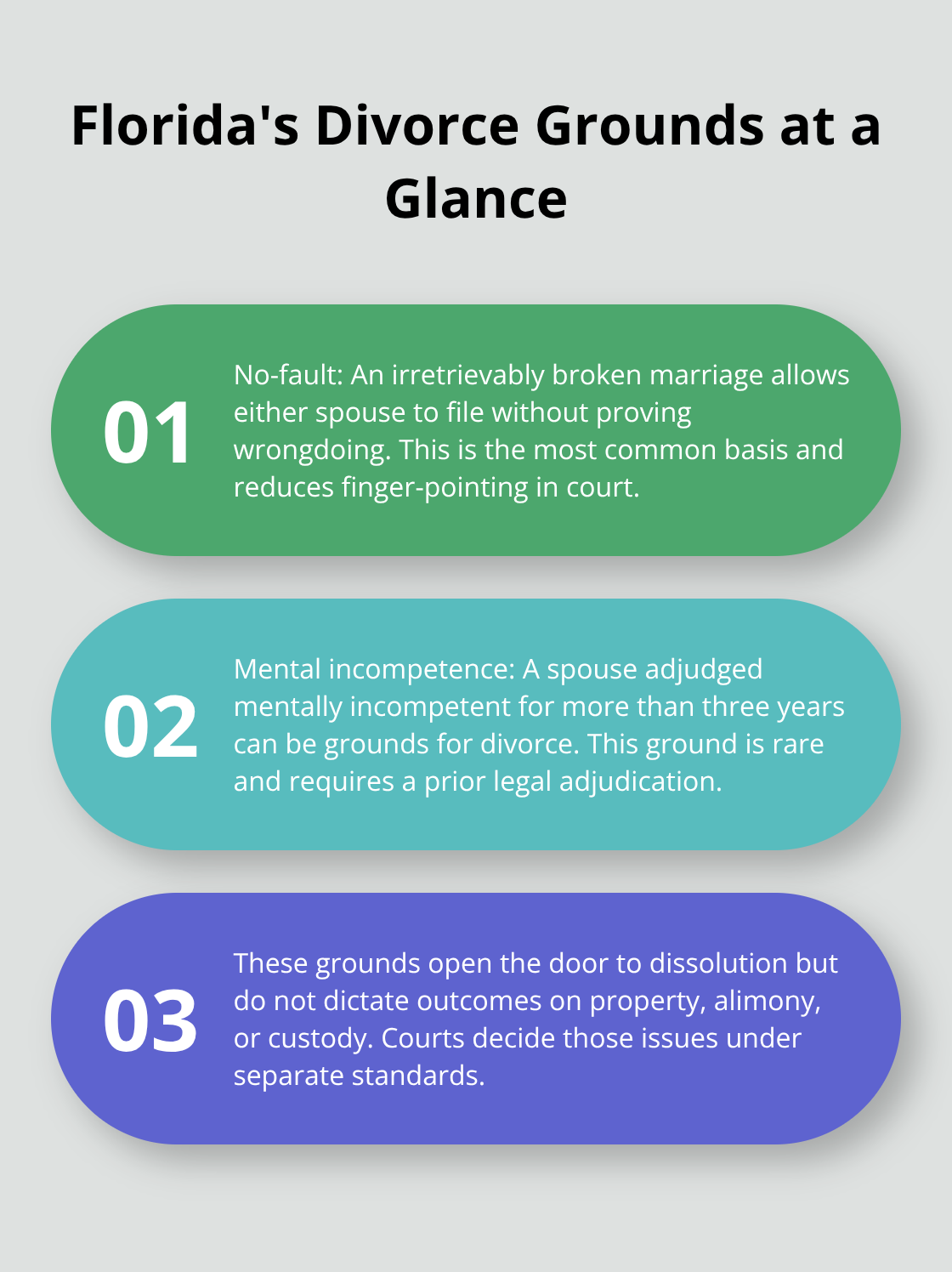
This no-fault approach eliminates finger-pointing in court and typically reduces conflict, though it doesn’t affect how property, alimony, or child custody are determined.
Reconciliation Attempts and Counseling
If children are involved and your spouse contests whether the marriage is irretrievably broken, Florida courts may order marriage counseling and delay proceedings up to three months to explore reconciliation. This protection exists to give families a final opportunity to work through their differences before the court finalizes the dissolution.
Timeline and Waiting Periods
After you file, a minimum waiting period of twenty days must pass before your divorce can be finalized, though most cases take considerably longer. The actual timeline depends on whether the divorce is contested or uncontested. An uncontested divorce, where both spouses agree on all major issues, typically resolves in two to four months. A contested divorce involving disputes over assets, alimony, or custody can extend six months to over a year, particularly if discovery disputes arise or either party requests court hearings on temporary relief orders for child support or exclusive use of the marital home.
Understanding these foundational requirements positions you to move forward with the actual filing process. The next steps involve preparing your petition and navigating the formal filing procedures that Brevard County requires.
Filing Your Petition and Serving Your Spouse
Preparing Your Petition for Dissolution of Marriage
Filing for divorce in Brevard County starts with preparing your Petition for Dissolution of Marriage, a formal document that initiates the case. This petition must include your name, your spouse’s name, and the names and birthdates of any minor children. Florida courts require this information to be entered into the State Case Registry for Title IV-D enforcement purposes, so accuracy matters. The petition states your ground for divorce (irretrievably broken marriage), identifies which county you’re filing in, and outlines what you’re requesting regarding property division, alimony, and child custody. You’ll file this petition with the Brevard County Clerk of Court along with an Attestation Certificate, which certifies that you’ve read the required Administrative Orders governing family law procedures. The filing fee in Brevard County typically ranges from $300 to $500, depending on whether children are involved. Once filed, you cannot modify your petition without court permission, so review it carefully before submission.
Filing With the Clerk of Court
The Brevard County Clerk’s Office provides an information packet and self-help resources to guide you through this stage. Many people choose to use online divorce services or hire an attorney to handle the preparation and filing. When you submit your petition, the Clerk assigns your case a number and schedules initial hearings if necessary. This official filing creates the legal record that establishes your divorce case in Brevard County Circuit Court.
Serving Your Spouse With Divorce Papers
Service of process comes next, and this step is non-negotiable. Your spouse must receive a copy of your petition and summons within a specific timeframe, typically via a process server or certified mail. Florida law requires proper service to give your spouse notice and opportunity to respond. If your spouse cannot be located or refuses service, you may petition the court for alternative service methods, such as publication in a newspaper.
Your Spouse’s Response and the Discovery Process
After service, your spouse has twenty days to file a written answer with the court. If they don’t respond within that window, you may proceed with an uncontested divorce by default. However, if your spouse files an answer and disputes your claims or raises counterclaims about property, support, or custody, the case becomes contested and moves into discovery. During discovery, both spouses must exchange financial information, including tax returns from the last five years, bank statements, retirement account statements, and documentation of all income sources. Florida requires this financial exchange at least seventy-two hours before any hearing, and failure to comply can result in court sanctions.
Moving Toward Resolution Through Mediation
If disputes remain unresolved after discovery, mediation is typically required before trial, except in domestic violence cases where mediation may be waived. This mediation process allows both spouses to work with a neutral third party to reach agreements on contested issues. Once you complete discovery and attempt mediation, you’ll move into the next phase of your divorce, where property division, alimony, and child support arrangements take center stage.
How Florida Courts Split Assets, Support, and Custody
Once discovery concludes and mediation efforts either succeed or stall, you face the financial and custodial heart of your divorce. Florida law approaches property division, alimony, and child support with specific formulas and standards that differ sharply from other states. Understanding how courts calculate these obligations prevents you from accepting unfavorable settlements or overlooking what you’re entitled to receive.
Equitable Property Division
Florida courts divide marital property equitably, not equally, meaning the division must be fair but not necessarily fifty-fifty. Marital property includes anything acquired during the marriage, regardless of whose name appears on the title or account. Separate property-assets you owned before marriage, inheritances, or gifts specifically given to you-remains yours. The court examines the length of the marriage, each spouse’s contribution to acquiring assets, and the economic circumstances of each party when determining what’s equitable.
If you owned a home before marriage but refinanced it jointly during the marriage, that refinancing typically converts part of your separate property into marital property. Courts also consider whether one spouse sacrificed career opportunities to support the family, which can justify an unequal split favoring that spouse. Florida courts expect each spouse to maintain existing marital assets, and judges view emptying joint accounts negatively during property division hearings.
Alimony Calculations and Eligibility
Alimony in Florida depends on multiple factors including the length of the marriage, the standard of living during marriage, each spouse’s earning capacity, and whether one spouse has custody of minor children. Marriages lasting less than ten years typically qualify for short-term alimony, while longer marriages may result in durational or permanent alimony. The court won’t award alimony if both spouses have substantially equal earning capacity and neither sacrificed career development for family responsibilities.
Child Support Guidelines and Income Considerations
Child support calculations in Florida follow statutory guidelines based on combined parental income and time-sharing arrangements. The Florida Statutes establish a presumptive base amount that increases with income and the number of children. For example, if combined parental income is $10,000 monthly and you have two children, the guideline amount is approximately $1,800 monthly before adjustments for health insurance, childcare costs, or substantial time-sharing by the non-paying parent.
Courts must deviate from this guideline only if they document in writing why the guideline amount would be unjust or inappropriate to the specific circumstances. Income includes wages, bonuses, self-employment earnings, rental income, Social Security benefits, disability payments, and unemployment compensation. If your spouse is voluntarily underemployed-working part-time when capable of full-time work-the court may impute income based on their work history and local earnings data from the U.S. Census Bureau. Incarceration does not qualify as voluntary unemployment, so if your spouse is incarcerated, the court typically still assigns an income figure for support calculations.
Child Custody and Time-Sharing Arrangements
Child custody in Florida operates under a best-interests standard with a rebuttable presumption favoring equal time-sharing between both parents. Courts examine each parent’s ability to foster a close relationship with the child, stability in home and school, involvement in the child’s activities, physical and mental health of each parent, the child’s preferences if they’re old enough to express them, and any history of domestic violence or substance abuse.
If one parent has been the primary caregiver, courts often maintain that arrangement unless the other parent demonstrates they can provide equal stability and involvement. Parenting plans must detail the specific time-sharing schedule, including school days, weekends, holidays, and summer breaks, along with provisions for transportation and communication between parents. Health insurance for minor children must be included in the child support order if reasonable in cost; Florida presumes health insurance costs reasonable if they don’t exceed five percent of gross income (though the obligor can be required to provide coverage or reimburse the other parent). The order specifies which parent claims the child as a dependent for tax purposes.
Final Judgment and Court Determination
If you and your spouse cannot reach agreement on any of these issues, the court will hold a final hearing where both sides present evidence and arguments, and the judge issues a final judgment addressing property division, alimony, and custody arrangements.
Final Thoughts
The procedure for divorce in Melbourne, Florida demands careful attention to deadlines, financial disclosure, and court requirements that most people underestimate. Your timeline depends heavily on whether you and your spouse reach agreement on major issues-uncontested divorces typically conclude within two to four months, while contested cases involving disputes over assets, alimony, or child custody extend considerably longer. Florida’s mandatory waiting period, discovery requirements, and mediation rules mean your divorce won’t resolve overnight, so planning ahead and gathering financial documents early prevents delays and reduces stress.
Deciding whether to hire an attorney ranks among the most important choices you’ll make during this process. While some people successfully navigate uncontested divorces without legal representation, the complexity of Florida family law makes professional guidance valuable for most situations (particularly when your spouse has hired an attorney or disputes any major issue). An attorney helps you understand your rights regarding property division, ensures child support calculations follow statutory guidelines, and protects your interests in custody arrangements.
We at Harnage Law PLLC understand that divorce is emotionally and financially taxing, and we provide experienced legal representation for family law cases, including divorce and child custody matters. Contact Harnage Law PLLC to discuss your situation and explore your options.