
How to Get a Divorce Without a Lawyer
Our Blog
How to Get a Divorce Without a Lawyer

Divorce doesn’t always require hiring a lawyer. Many people in Melbourne Florida handle uncontested divorces on their own and save thousands in legal fees.
This guide walks you through the process, from filing paperwork to dividing assets and creating custody agreements. We at Harnage Law PLLC also explain when you should stop and get professional help before things spiral.
Can You Handle a DIY Divorce in Melbourne Florida?
Florida law does not require you to hire a lawyer to file for divorce. According to Florida Statutes, a person is not required to have a lawyer to obtain a divorce. However, the state recognizes only two grounds for divorce: an irretrievably broken marriage or that one spouse has been declared legally incompetent for more than three years. If you meet Florida’s residency requirements-meaning you or your spouse must have lived in Florida for at least six months before filing-you can proceed without legal representation. The catch is that Florida’s divorce process involves strict procedural rules, mandatory financial disclosure, and court-ordered mediation in most cases. Many people underestimate the complexity and end up making costly mistakes that damage their settlement or custody arrangements.
What Types of Divorces Work Without a Lawyer
An uncontested divorce is your only realistic option for a DIY approach. This means you and your spouse have already agreed on asset division, child custody, child support, and spousal support. According to Florida Family Law Rules of Procedure, you must exchange financial information within a set number of days, so both parties need to be transparent about income, debts, and assets before filing. If minor children are involved, Florida requires both parents to complete a parenting class-some courts also require the child to attend. You’ll need to draft a settlement agreement that covers property division, any support obligations, and custody arrangements. If you have no children, no significant assets, and a cooperative spouse willing to sign settlement documents, DIY divorce can work. If disagreements exist on any major issue, the process becomes adversarial and far more difficult to navigate alone.
When You Need Help Immediately
Stop the DIY approach if your spouse contests the divorce, refuses to disclose financial information, or disputes custody or support. Domestic violence situations demand immediate professional intervention-consult the National Domestic Violence Hotline or local law enforcement before proceeding with any self-filed paperwork. Complex asset situations involving retirement accounts, business ownership, rental properties, or significant debt require proper valuation and tax implications that courts scrutinize heavily. If your spouse threatens to hide assets, has a history of financial manipulation, or you suspect fraud, professional representation protects your interests during discovery. Parents with high-conflict custody situations or those seeking to relocate with children should not attempt solo representation. These sensitive family law cases require experienced guidance, especially when complications emerge and the stakes for your family’s future grow higher.
What Forms Do You Need to File in Melbourne Florida
Required Divorce Forms and Documents
Florida’s court system provides official divorce forms through the Florida State Courts website, and you must use them to meet procedural requirements. The mandatory forms include a Petition for Dissolution of Marriage, which initiates your case and outlines basic information about you, your spouse, and any children. You also need a Family Law Financial Affidavit to disclose your income, expenses, assets, and debts. Florida Family Law Rules require both parties to exchange financial information within 45 days after filing. If you and your spouse have reached an agreement, a Marital Settlement Agreement becomes your most important document. This agreement must detail property division, debt allocation, custody arrangements, child support amounts, and any spousal support. Courts take settlement agreements seriously, so missing even one asset or debt category creates problems later. Additionally, if you have minor children, you must submit a Parenting Plan that specifies custody schedules, decision-making authority, and how you’ll handle holidays and school breaks.
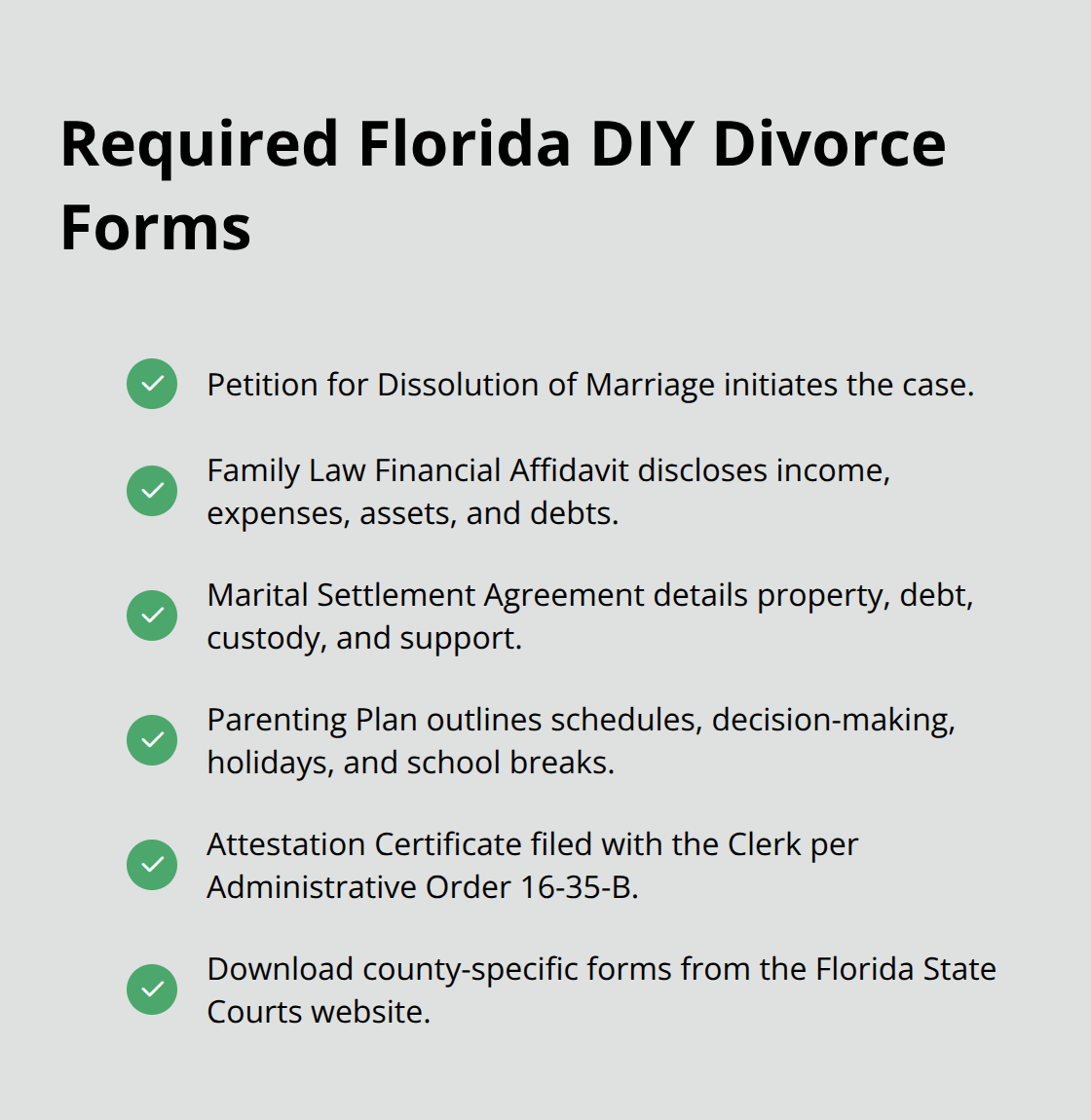
An Attestation Certificate must be read and filed with the Clerk of Court per Administrative Order 16-35-B. Start by visiting the Florida State Courts website to download all required forms for your county-requirements can vary slightly by jurisdiction.
Filing Costs and Court Fees in Melbourne
Filing costs in Melbourne Florida run at minimum $300 to $400 depending on whether you include a settlement agreement. The index number (case number) costs $210 and must appear on every document you file. If you file a settlement agreement separately, add another $35 to your total. These fees cover only court costs and do not include photocopies, notary services, certified mailing, or personal service fees if your spouse won’t accept service voluntarily. The Clerk’s Office in Melbourne accepts filings in person during business hours or through electronic filing if your case qualifies. You’ll prepare two copies of all documents-one for the Defendant and one for your records-then submit them to the Clerk along with your filing fee.
Serving Your Spouse and Completing Service Requirements
After filing, Florida law requires you to serve your spouse with a copy of the Petition and Summons, either through certified mail, a process server, or if your spouse agrees, voluntary acceptance of service. Without proper service, your case cannot proceed. If you face extreme financial hardship, you can request a fee waiver from the court, though approval is not automatic. Many people filing DIY divorces in Melbourne Florida underestimate the importance of getting service correct-improper service can delay your case by months or force you to file again. The Clerk of Court’s office in Melbourne can also provide an information packet with the specific forms and fees for Brevard County, and staff there answer questions about service methods and filing procedures. Once you complete service and file all required documents, the court moves your case forward to the next stage, where property division and custody arrangements take center stage.
Dividing Assets and Creating Custody Plans Without Professional Help
List Every Asset and Debt With Accurate Values
Negotiating asset division in a DIY divorce requires brutal honesty about what you own and what you owe. Florida follows equitable distribution, meaning assets and debts split fairly but not necessarily equally. Start by listing every asset: the marital home, vehicles, retirement accounts, bank accounts, investment accounts, and personal property with significant value. Next, list all debts: mortgages, car loans, credit cards, and personal loans. Assign a realistic value to each item. This is where people make their first major mistake-undervaluing assets to appear cooperative or overvaluing debts to shift burden to their spouse. Courts see through inflated numbers, and if your settlement agreement reaches a judge, you lose credibility immediately.
Handle Retirement Accounts and Real Estate Correctly
For retirement accounts, understand that a 401(k) or pension earned during marriage is marital property, not separate property. Dividing these accounts requires a Qualified Domestic Relations Order, a specific court document that tells the plan administrator how to split the funds without tax penalties. If you skip this step, you’ll face unexpected tax bills or penalties. Real estate presents another complexity. If you own your home jointly, decide whether one spouse keeps it or you sell it and split proceeds. Keeping the home means refinancing to remove the other spouse’s name, which requires loan approval and proof of sufficient income. Many people agree to one spouse keeping the home without addressing the mortgage, then discover months later that the spouse keeping the home cannot qualify for refinancing alone, leaving both parties stuck. For vehicles, check the title and loan status. If a car has a loan, the lender’s name appears on the title, and you cannot simply transfer ownership without paying off the debt or getting lender approval. Create a fair division plan showing each asset, its value, who gets it, and how any shared debt attaches to that asset.
Write a Detailed Parenting Plan With Specific Schedules
A parenting plan without legal representation requires specificity that most people underestimate. A vague agreement saying you’ll have the children on weekends fails in court and creates conflict. Your plan must specify exact pickup and dropoff times, which parent has the child on which days, how holidays split, and how you’ll handle school breaks, summer vacation, and special occasions. If your child attends school in one location and you’re considering moving, address that in writing now rather than discovering later that the other parent objects. Spell out decision-making authority: who decides on medical treatment, school enrollment, religious upbringing, and extracurricular activities. If you share decision-making, define how you’ll handle disagreements-will you mediate, or does one parent have final say on specific categories. Courts scrutinize parenting plans to ensure they serve the child’s best interests, not just parental convenience.
Track Actual Parenting Time Before Finalizing
A plan stating you’ll split time 50-50 sounds fair but creates logistical nightmares if the child attends school in the other parent’s neighborhood. Track actual time in writing for several months before finalizing your agreement. Courts increasingly rely on demonstrated parenting time rather than stated intentions. If one parent works nights and the other works days, a truly equal split might mean the night-shift parent has the child during sleeping hours, which courts view as impractical.
Calculate Child Support Using Florida’s Formula
Child support calculations in Florida use a specific formula based on both parents’ income and the percentage of time each parent spends with the child. The Florida Department of Revenue provides a child support calculator online that shows exactly how much support is owed based on income and custody percentages. Verify both parents’ actual income using tax returns and recent pay stubs, not estimates. Underreporting income to reduce support obligations is fraud, and courts catch it during financial disclosure review. If one parent is self-employed, provide profit and loss statements and business tax returns for the past two years. Support amounts change if either parent’s income changes by more than 10 percent or if custody time shifts significantly, so build in language addressing how you’ll handle modifications without returning to court.
Final Thoughts
A divorce without a lawyer in Melbourne Florida works only when both spouses genuinely agree on all major issues and neither party hides assets or custody concerns. If you’ve negotiated a fair settlement agreement, completed your financial disclosures honestly, and drafted a detailed parenting plan with specific schedules, you can file the paperwork yourself and save thousands in legal fees. The Florida State Courts website provides all required forms, filing fees run between $300 and $400, and the process moves forward if you follow procedural rules carefully.
The moment your spouse contests anything, refuses financial disclosure, or disputes custody arrangements, your DIY approach becomes dangerous. Red flags that demand immediate professional help include domestic violence situations, hidden assets, high-conflict custody disputes, complex retirement accounts or business ownership, and any indication your spouse plans to manipulate the process. Courts scrutinize settlement agreements heavily, and mistakes in asset valuation, debt allocation, or parenting plan language create problems that cost far more to fix later than hiring representation upfront would have cost.
If your situation started as a straightforward divorce without a lawyer but has become contentious, or if you’re uncertain whether your settlement agreement protects your interests, contact Harnage Law PLLC for a consultation. We handle sensitive family law cases in Melbourne Florida, including divorce and child custody matters where complications emerge or conflict escalates. Our attorneys provide personalized attention and strategic counsel to achieve the best possible outcomes when things get complicated.