
How to Get an Amicable Divorce Without Drama
Our Blog
How to Get an Amicable Divorce Without Drama

Divorce doesn’t have to mean months of fighting and legal fees that drain your savings. An amicable divorce is possible when both spouses commit to respectful communication and fair problem-solving.
At Harnage Law PLLC, we’ve guided countless couples through Melbourne, Florida divorces that stayed civil and cooperative. This guide shows you how to protect your finances, your children, and your peace of mind.
How to Talk to Your Spouse Without Making Things Worse
Start Conversations the Right Way
Honest conversation forms the foundation of an amicable divorce, but most couples lack the skills to start one. The moment you mention divorce, defensiveness kicks in. Voices rise. Old arguments resurface. Structured dialogue prevents this spiral. Set a specific time to talk, not during rushed mornings or late nights when stress peaks. Choose a neutral location, ideally not your home where emotional triggers lurk in every corner. A quiet coffee shop or your attorney’s office works better. Keep conversations focused on one topic at a time. If you jump between property division, children, and finances in a single discussion, you’ll lose direction and tempers will flare. Write down what you need to discuss beforehand. This keeps you on track and prevents emotional tangents that derail progress.
Use Language That De-Escalates Conflict
Word choice changes everything in divorce negotiations. Avoid phrases like “you always” or “you never” because they trigger defensiveness immediately. Instead of saying “you never helped with the kids,” try “I felt unsupported with childcare responsibilities.” The second version describes your experience without attacking. Replace accusations with requests. Rather than “you’re being unreasonable about the house,” say “I’d like to discuss how we divide the house fairly.” Research from the American Association for Marriage and Family Therapy shows that couples who use collaborative language during conflict resolution reach agreements 40 percent faster than those who remain adversarial. When one spouse feels unheard, they often stop trying to communicate entirely, which the other partner may misinterpret as indifference.

Bring in a Mediator to Guide the Process
Mediation accelerates progress significantly. A neutral mediator guides conversations, prevents escalation, and helps both spouses hear each other’s actual concerns rather than their defensive interpretations. Mediation in Melbourne, Florida typically costs between $1,500 and $3,000 total compared to contested litigation that routinely exceeds $15,000. This preparation prevents wasted sessions and keeps momentum moving forward. A mediator remains neutral throughout negotiations, helping you both identify creative solutions that work for your family’s specific situation.
With structured conversations and neutral guidance in place, you’re ready to address the financial side of your divorce-the part that often causes the most tension between spouses.
What You Must Know About Dividing Assets and Debts
Money tensions sink more amicable divorces than any other factor. The moment you and your spouse disagree about who keeps the house or how retirement accounts split, civility evaporates. Florida uses equitable distribution, meaning assets and debts acquired during your marriage divide fairly, though not necessarily equally. Inheritances and gifts typically stay separate unless you mixed them into joint accounts, which complicates everything.
Gather and Organize Your Financial Documents
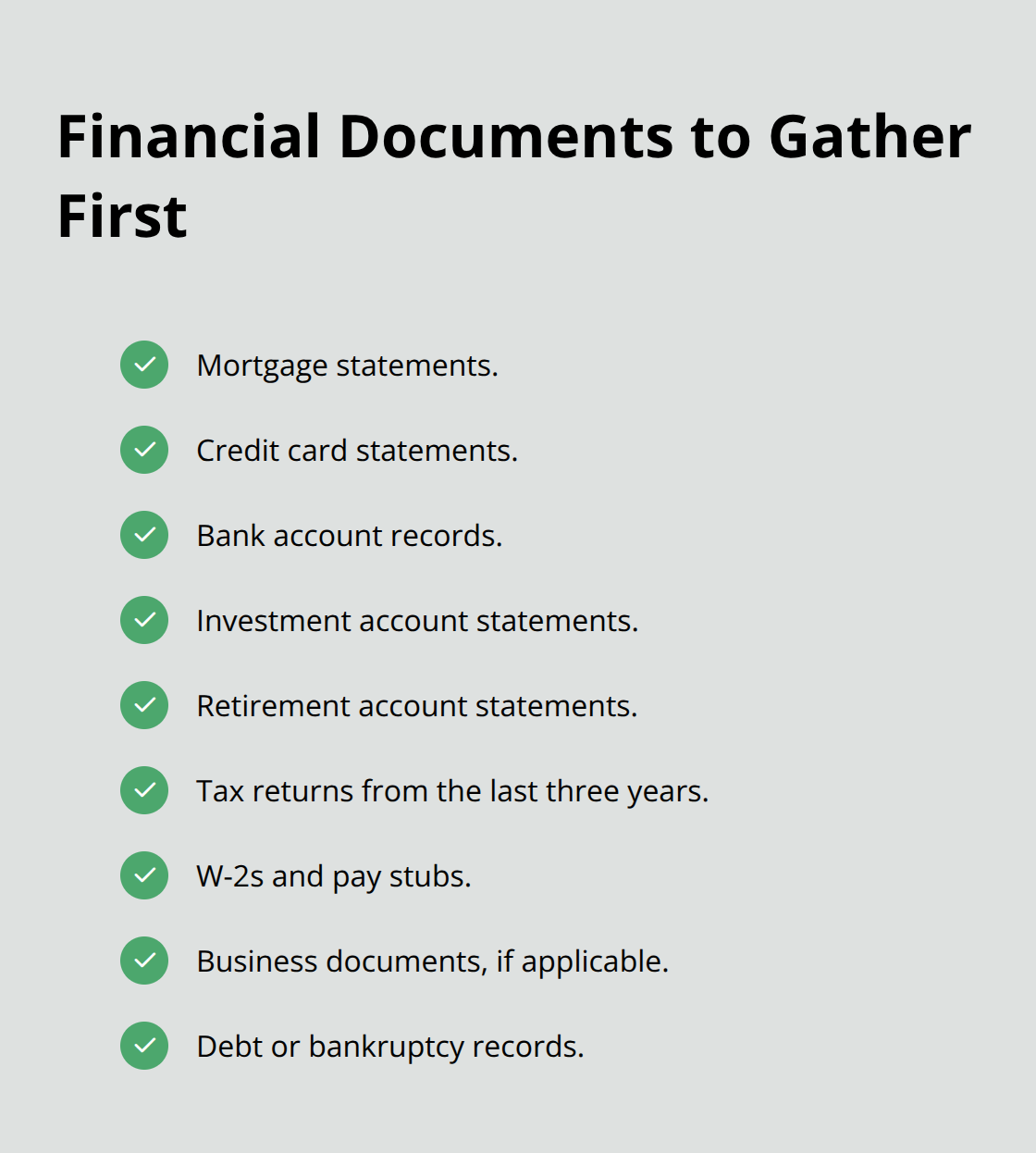
Start by collecting every financial document you own: mortgage statements, credit card statements, bank account records, investment account statements, retirement account statements, tax returns from the last three years, W-2s and pay stubs, business documents if either spouse owns a business, and any debt or bankruptcy records. This inventory takes time but prevents disputes later. Create two copies of everything and exchange them with your spouse to establish transparency. Florida courts require each spouse to file a Financial Affidavit disclosing complete financial information regardless of which divorce path you choose, so gathering documents now simply accelerates the process.
Many couples miss hidden assets because they fail to look for them systematically. Check for life insurance policies, investment accounts in children’s names, cryptocurrency holdings, and deferred compensation plans. These overlooked items often represent significant value that affects the entire settlement.
Understand Tax Implications Before You Divide
Tax implications catch people off guard constantly. Transferring a 401k or IRA without proper documentation triggers immediate tax penalties and income recognition. A Qualified Domestic Relations Order, or QDRO, allows you to divide retirement accounts tax-free, but only if drafted correctly before the divorce finalizes. The IRS doesn’t forgive mistakes here. If either spouse owns a business, valuations become contentious and expensive. Hire a business valuation professional early rather than fighting over competing estimates later, which costs significantly more and extends your divorce timeline.
Create a Fair Division Plan Together
Creating a fair division plan requires honesty about what each spouse actually needs versus wants. One spouse may desperately want the family home while the other prioritizes keeping the investment portfolio intact. These trades often reach settlement faster than fighting over every asset equally. Many couples in Melbourne, Florida benefit from mediation specifically for financial decisions, where a neutral third party helps both spouses understand the long-term implications of their choices.
Property settlement agreements become legally binding documents that courts enforce, so accuracy matters enormously. Hidden assets discovered after your divorce finalizes can reopen cases, creating years of additional litigation. Work with professionals who understand the specific tax and financial rules governing your situation rather than relying on general advice from friends or online sources.
With your finances organized and a fair division plan in place, protecting your children through this transition becomes your next priority-and it requires a different kind of planning altogether.
Keeping Your Children Stable When Everything Changes
Maintain Routines That Signal Safety to Your Child
Children process divorce through behavior, not words. A child who suddenly refuses to eat, clings to one parent, or withdraws from friends signals that their world feels unsafe. Research shows that consistent routines during parental separation significantly reduce anxiety and behavioral problems in children. You must maintain your child’s school schedule, bedtime, meals, and activities exactly as they were before the divorce announcement. If your child attended soccer practice on Tuesdays at 4 p.m., that does not change. If homework happened after dinner, it still does. This predictability tells your child that while your marriage is ending, their daily life remains intact.
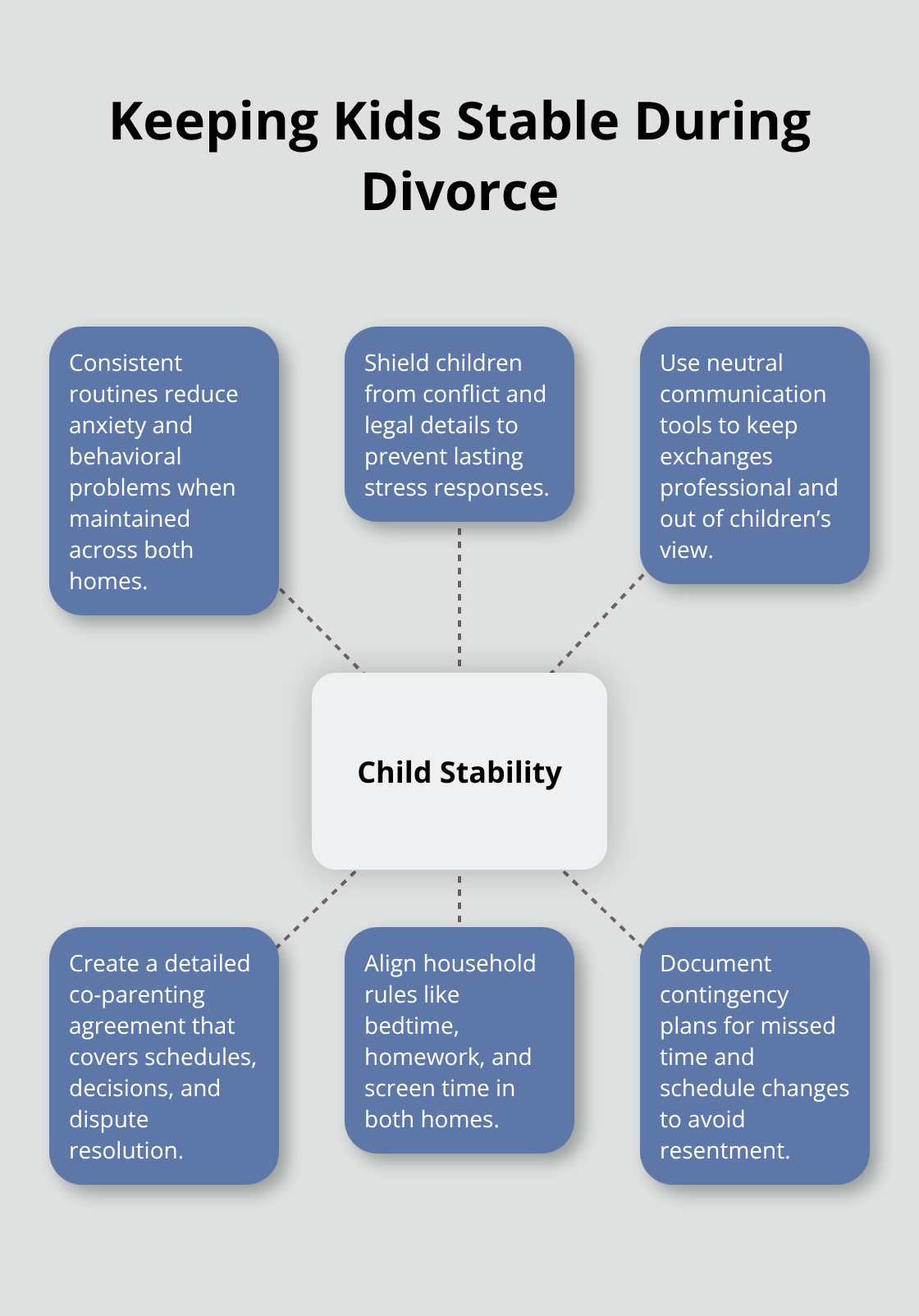
Many parents mistakenly believe that maintaining routines means staying in the same house, but that is false. Routines survive custody transitions when both parents enforce the same bedtime, the same homework expectations, and the same screen time limits. You should document these agreements in your co-parenting plan so neither parent drifts toward different standards during their custody time.
Shield Children from Conflict and Legal Details
Children who witness parental conflict during divorce experience measurable harm. Research from the Journal of Family Psychology found that children exposed to high-conflict divorce showed elevated stress hormones and behavioral problems lasting years after the separation finalized. You must shield your children from legal details, financial arguments, and custody disputes entirely. Your eight-year-old does not need to know about the mortgage dispute or that your ex refused mediation. They do not need to hear you cry about unfair settlement offers or watch you review legal documents at the kitchen table.
You should establish a firm rule: never discuss the divorce, finances, or custody arrangements when children are present or within earshot (this includes car rides, bedtime, and casual conversations that you think they are not listening to-they always are). When children ask why you are divorcing, keep responses simple and honest without blame: “We love you, and that will not change. We’re not going to be married anymore, but we’re both still your parents. This is an adult decision, not something you caused.”
If your child asks to deliver messages between parents or becomes a go-between during custody exchanges, you must stop that immediately. Children forced into mediator roles develop anxiety and feel responsible for their parents’ emotions. Instead, use a neutral communication app like OurFamilyWizard or Talking Parents, where all messages stay documented and professional.
Create a Detailed Co-Parenting Agreement
A cooperative co-parenting agreement transforms how divorced parents interact around their children. This agreement covers far more than custody schedules-it addresses how you handle discipline, medical decisions, school involvement, and what happens when one parent wants to travel with the children. You should specify how you communicate about school issues, whether you both attend school events, and how you handle disagreements about your child’s activities or medical care.
Many parents assume they will figure these details out as they go, then discover mid-year that one parent enrolled the child in a new activity without consulting the other. Courts increasingly favor parenting plans that demonstrate both parents will remain actively involved. If you and your spouse cannot agree on co-parenting terms, mediation specifically for parenting decisions costs far less than litigation and produces plans that actually work because both parents helped create them. The mediator helps you both focus on your child’s best interests rather than winning battles against each other.
Your parenting plan should include what happens if either parent misses scheduled time, how you handle last-minute schedule changes, and what circumstances would warrant modifying the agreement. Written clarity prevents the resentment that builds when one parent feels the other constantly violates unspoken expectations.
Final Thoughts
An amicable divorce in Melbourne, Florida becomes achievable when you commit to structured communication, financial transparency, and your children’s stability. These three practices address the actual sources of conflict rather than hoping civility appears on its own. Court battles consume months or years of your life, cost $15,000 or more, and leave both spouses feeling defeated regardless of who technically wins, while an amicable approach costs a fraction of that amount and preserves the possibility of genuine cooperation after your divorce finalizes.
Your marriage is ending, but your family continues in a different form. Your children still need both parents actively involved, and you will encounter each other at school events, medical appointments, and your children’s milestones for years to come. The tone you set during your divorce determines whether those interactions feel civil or hostile, which makes your choices during this transition matter far more than most people realize.
The team at Harnage Law PLLC guides Melbourne, Florida families through this transition by helping you communicate effectively, divide assets fairly, and protect your children’s wellbeing. Your divorce does not have to destroy your finances, your relationship with your children, or your peace of mind.