
What’s the Difference Between Divorce and Legal Separation?
Our Blog
What’s the Difference Between Divorce and Legal Separation?

Many people in Melbourne, Florida think divorce and legal separation are the same thing. They’re not.
The difference between divorce and legal separation matters more than you might realize. Your choice affects your taxes, insurance, property rights, and how you file paperwork with the state. We at Harnage Law PLLC help families understand which path makes sense for their situation.
What Actually Happens to Your Marriage Status
Divorce Ends Your Marriage Completely
In Florida, legal separation and divorce create fundamentally different legal outcomes, and this distinction shapes everything that follows. A divorce ends your marriage completely. You’re no longer married, your marital status changes on official documents, and you’re free to remarry immediately after the final judgment. A legal separation in Florida doesn’t exist as a formal court process, which means you can’t file for one with the court. Instead, you and your spouse can live apart while remaining legally married, using a postnuptial agreement to address property, support, and custody issues if you want written protections.
How Property Division Works Differently
The financial and property consequences differ sharply between these paths. In a divorce, Florida courts divide all marital property and assign debts through a final decree. Once that happens, your finances are permanently separated and clearly defined. With a separation arrangement, you can leave property ownership untouched entirely or divide it through a postnuptial agreement, but without court involvement, enforceability becomes problematic if your spouse later refuses to follow the agreement.
Custody and Child Support Require Court Orders
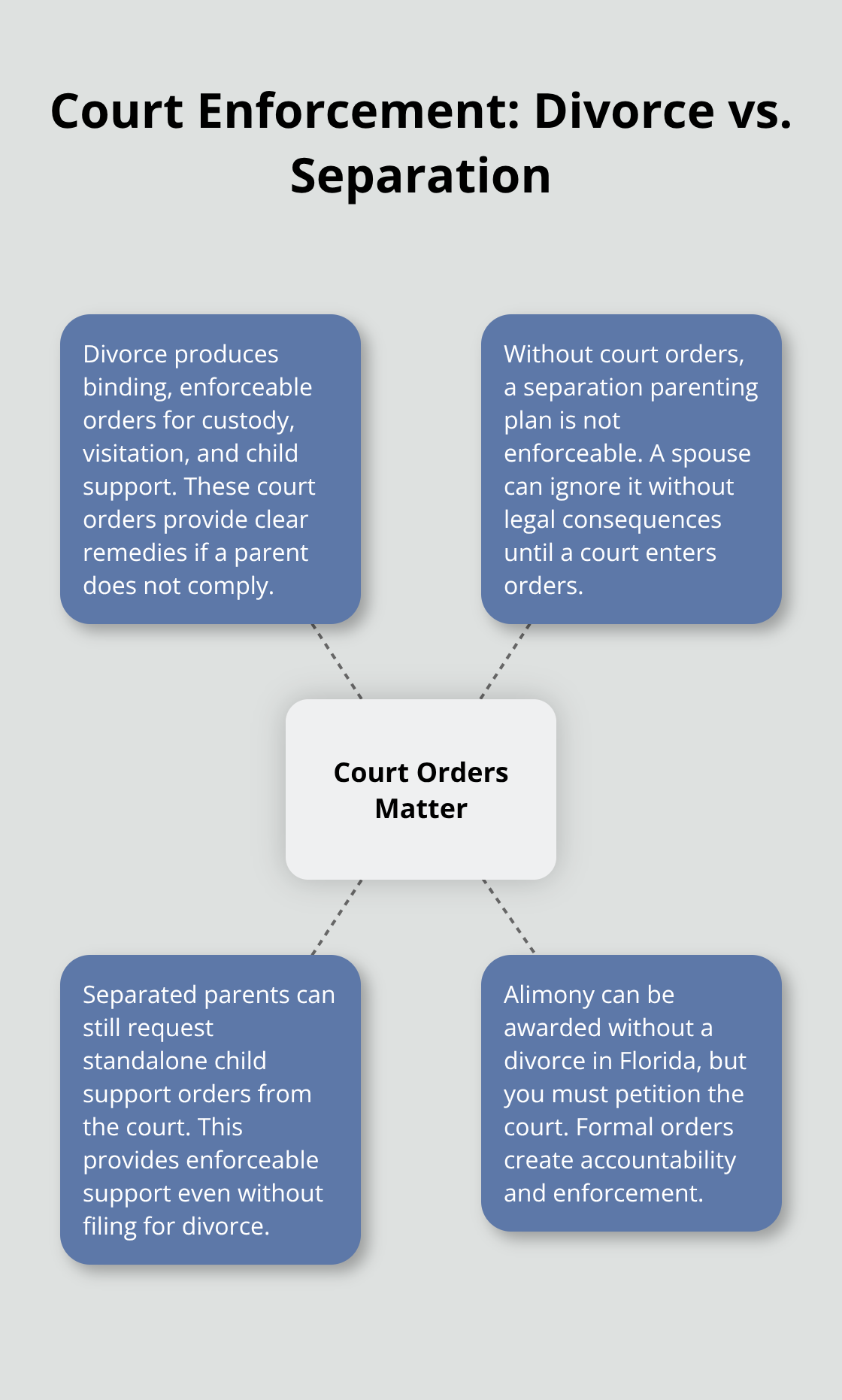
Custody and child support work differently too. In divorce, a judge issues final orders on custody, visitation, and child support that are binding and enforceable. If you separate without court orders, any parenting plan you draft together lacks court enforcement power, meaning your spouse could ignore it without legal consequences. Florida courts can still issue standalone child support orders for separated couples with children, and alimony is possible even without divorce, but you must request these orders from the court separately.
The Real Cost of Unclear Agreements
The CDC reported that the average cost of divorce runs about $15,000, and that figure doesn’t capture the hidden costs of ongoing disputes over custody or support that emerge when agreements lack court backing. Choosing divorce provides finality and clear enforcement mechanisms. Choosing separation in Florida leaves you managing an ongoing legal relationship with someone you no longer want to be married to, without the court’s formal structure to back up your agreements. Understanding these enforcement differences becomes critical when you consider whether separation or divorce actually protects your family’s interests.
Why Separation Still Makes Sense in Melbourne, Florida
Separation without divorce remains practical in specific circumstances, even though Florida doesn’t recognize formal legal separation. You can live apart while remaining legally married and use a postnuptial agreement to establish binding terms on property, custody, and support. This approach works when your situation involves religious conviction, cultural values, or genuine uncertainty about permanence. Some people hold beliefs that discourage divorce but accept living separately with legal protections in place. Others genuinely don’t know whether reconciliation might happen in the future and want to preserve that option without the finality of divorce.
Religious and Personal Reasons Drive Real Decisions
These aren’t theoretical reasons-they drive real decisions for families in Melbourne, Florida who prefer separation as a deliberate choice rather than a stepping stone to divorce. Your faith tradition or personal values may make divorce unacceptable while separation feels morally acceptable. Cultural backgrounds sometimes carry strong stigma around divorce that separation avoids. The ability to live apart while maintaining marital status gives you space to honor your beliefs while protecting your independence.
Health Insurance Coverage Stays Intact
The financial mechanics of separation often prove decisive. Your spouse remains on your health insurance plan during separation, whereas most insurers terminate coverage immediately after divorce is finalized. This matters significantly if your spouse has pre-existing conditions or ongoing medical treatment. Coverage gaps can cost thousands of dollars in out-of-pocket expenses that separation prevents.
Tax Filing Status and Military Benefits Preserve Thousands
Federal tax filing status changes when you divorce-you shift from married filing jointly to single status-but during separation you can continue filing jointly if that reduces your combined tax burden. Military spouses face particular advantages with separation. Military benefits tied to marital status, including commissary access, medical coverage, and housing allowances, continue during separation but terminate upon divorce. A spouse married to a service member for at least 20 years who was married during at least 20 years of military service qualifies for direct military benefits, but only if the marriage remains intact.
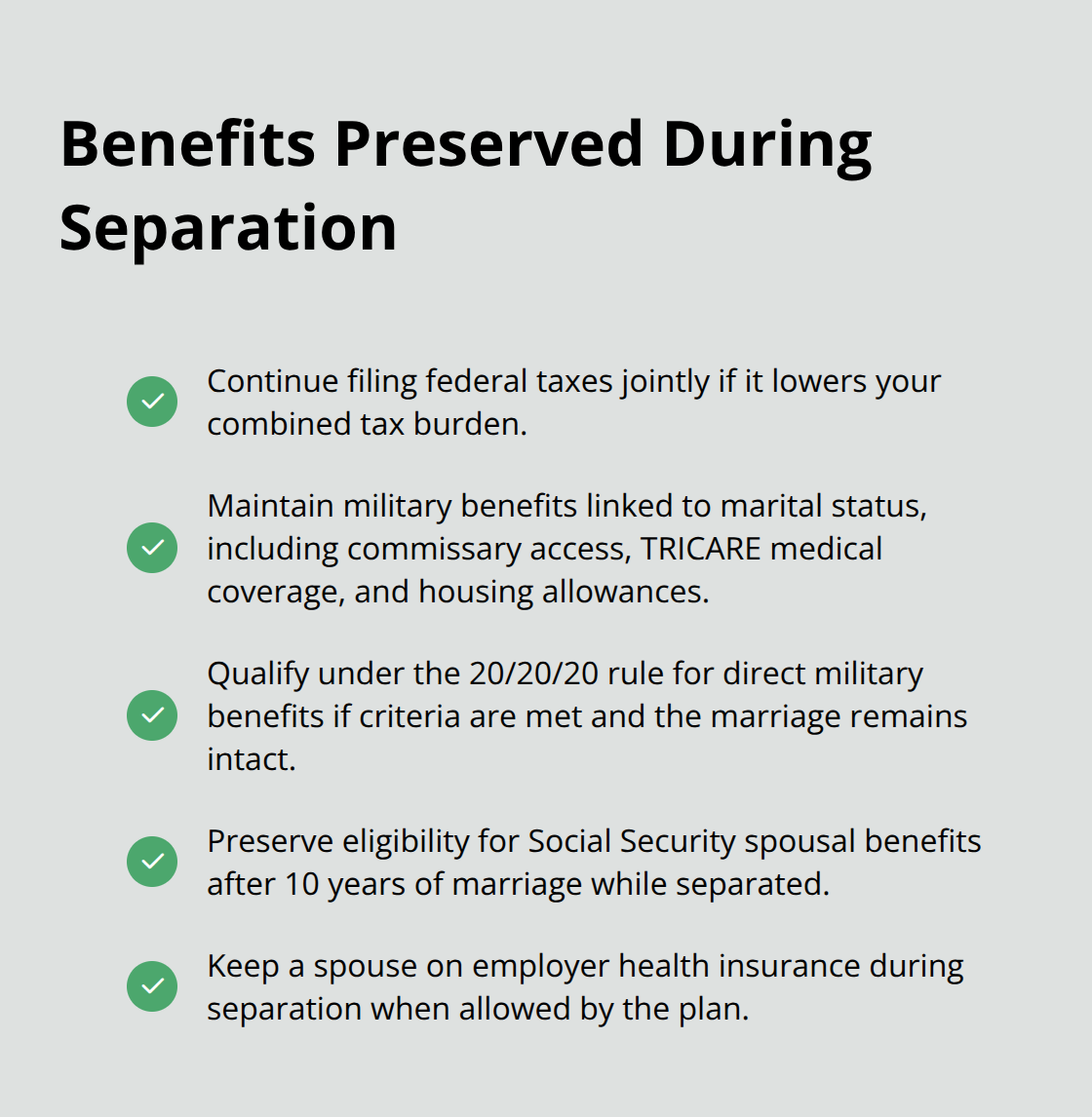
Social Security spousal benefits also remain available during separation if you’ve been married for at least 10 years, whereas remarriage after divorce ends eligibility entirely.
Financial Breathing Room Without Permanent Shifts
These financial protections aren’t trivial-they can represent thousands of dollars annually in retained benefits. If you manage tight finances, separation preserves insurance coverage and tax advantages while you figure out your next step. The practical reality is that separation in Melbourne, Florida gives you legal breathing room to address immediate concerns without triggering the permanent financial shifts that divorce creates. Understanding how to formalize these protections through a postnuptial agreement becomes your next critical step.
How Florida Divorce Works in Practice
Meeting Florida’s Residency and Filing Requirements
Filing for divorce in Melbourne, Florida requires meeting specific state requirements that many people misunderstand. You must be a Florida resident for at least six months before filing, and you need grounds for divorce. Florida recognizes no-fault divorce, meaning you don’t need to prove your spouse did anything wrong-you simply state that the marriage is irretrievably broken. This no-fault approach eliminates the need to gather evidence of infidelity or misconduct, which saves time and money compared to states requiring fault-based grounds. You file a Petition for Dissolution of Marriage in the circuit court where you or your spouse lives, pay the filing fee (which ranges from $300 to $500 depending on your county), and serve your spouse with the documents.
Uncontested Versus Contested Divorce Timelines
If you and your spouse agree on all major issues-property division, custody, support-you can file an uncontested divorce, which moves significantly faster than contested cases. Florida law requires a mandatory waiting period of 20 days after your spouse receives service before the court can finalize your divorce, but this is just the legal minimum. An uncontested divorce where both parties have signed a settlement agreement typically finalizes within 4 to 8 weeks after filing, assuming no complications arise. Contested divorces stretch far longer-often 6 months to 2 years-because the court must hold hearings on disputed issues like custody arrangements, property division, and alimony.
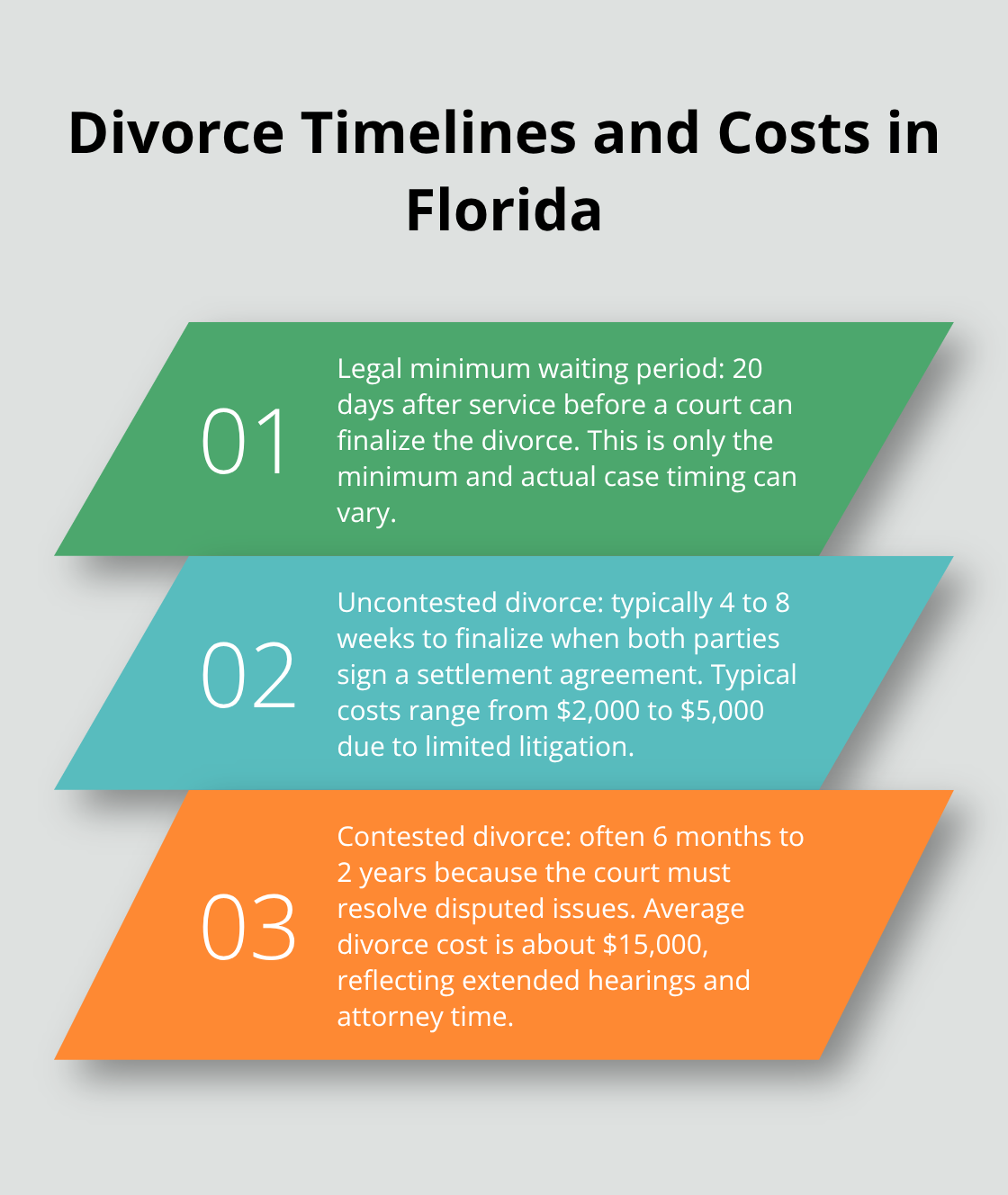
The CDC data shows the average divorce costs approximately $15,000, but uncontested divorces typically run $2,000 to $5,000 because you avoid extended court battles and attorney time spent on litigation.
How Florida Courts Divide Property and Assets
Property division in Florida follows equitable distribution principles, meaning the court divides marital property fairly but not necessarily equally. The court considers factors including the length of the marriage, each spouse’s contribution to acquiring property, and the economic circumstances of each party. Courts exclude separate property-assets owned before marriage or inherited during marriage-from division entirely. This distinction matters significantly because it protects your individual assets from the division process.
Child Custody Decisions Center on the Child’s Best Interests
Child custody decisions in Florida center exclusively on the child’s best interests. The court evaluates each parent’s ability to provide a stable home, the child’s relationship with each parent, the child’s preference if old enough to express one, and any history of domestic violence or substance abuse. Florida courts prefer shared parental responsibility when both parents are capable, meaning both parents participate in major decisions about education, healthcare, and religion.
Child Support Calculations Follow Florida’s Income Shares Model
Child support calculations follow Florida’s income shares model, where the court considers both parents’ gross monthly income, the number of overnights each parent has with the child, and childcare expenses. This formula-based approach removes much of the guesswork from support determinations and creates consistency across cases. Understanding how the court applies these factors to your specific income and custody arrangement helps you anticipate what support obligations will look like.
Final Thoughts
The difference between divorce and legal separation in Melbourne, Florida shapes your financial future, custody arrangements, and legal obligations for years to come. Divorce provides finality-your marriage ends, your finances separate permanently, and you can remarry immediately. Separation in Florida means you stay legally married while living apart, using a postnuptial agreement to establish binding protections without court involvement.
Religious beliefs, cultural values, or financial benefits like health insurance coverage often make separation the right choice for families in Melbourne, Florida. Divorce makes sense when you want court-enforced custody and support orders, permanent property division, and freedom from ongoing legal ties to your spouse. The choice between these paths determines whether you gain closure or preserve options for reconciliation.
Contact Harnage Law PLLC to discuss your situation with an attorney who evaluates whether separation or divorce protects your family’s interests. Bring information about your assets, income, and custody concerns if you have children, and the consultation will clarify which path matters most to you.