
Contested vs Uncontested Divorce: What’s the Difference?
Our Blog
Contested vs Uncontested Divorce: What’s the Difference?

Divorce in Melbourne Florida takes two very different paths depending on whether you and your spouse agree on the major issues. A contested versus uncontested divorce determines not just how long your case takes, but also how much it costs and what happens in court.
We at Harnage Law PLLC help families navigate both scenarios. Understanding which path applies to your situation is the first step toward moving forward.
When Spouses Cannot Agree on Divorce Terms
A contested divorce happens when you and your spouse cannot reach agreement on one or more major issues. This is not a judgment about your relationship or your ability to communicate in normal circumstances. It simply means that on property division, child custody, support payments, or another key matter, your positions differ enough that a judge must decide. According to data from the American Academy of Matrimonial Lawyers, approximately 90% of divorce cases settle before trial, but the 10% that proceed to contested litigation involve disputes serious enough that settlement negotiations failed.
What Makes a Case Contested
The most common contested issues include child custody and parenting time, division of marital assets and debts, child support amounts, alimony or spousal support, and valuation of complex assets like retirement accounts or a family business. Some cases become contested because one spouse hides financial information, refuses to negotiate in good faith, or because domestic violence or safety concerns make cooperation impossible. Other cases involve genuinely different views on what constitutes a fair division of a home worth $400,000 or a retirement account with $500,000 in accumulated savings.
A contested divorce means the court must intervene to resolve disagreements. This triggers a formal legal process: you file a petition, your spouse files a response, both sides exchange financial documents and evidence through discovery, temporary hearings may occur for urgent issues like custody or support, mediation or settlement conferences happen to attempt resolution, and if no agreement emerges, the case goes to trial. Each step requires attorney time, court filing fees, and preparation work. Contested cases require a Case Information Statement that details all assets, liabilities, income, and expenses, plus a Custody and Parenting Time Plan if children are involved. These documents demand careful attention because incomplete or inaccurate filings delay resolution and increase costs.
Timeline and Financial Reality
A contested divorce in Melbourne Florida typically takes six months to two years, depending on case complexity and court calendar availability. Litigation costs average $15,000 to $50,000 or more per side when attorney fees, court costs, and expert fees accumulate. In high-net-worth cases involving business valuation or significant retirement assets, costs can exceed $100,000. An uncontested divorce, by contrast, often resolves within two to four months at a fraction of that cost.
The financial burden extends beyond attorney fees. Contested cases may require you to hire financial experts to value a business, mental health professionals to evaluate custody arrangements, or appraisers to assess real property. Each expert adds $2,000 to $5,000 or more to your case expenses. Anyone facing a contested divorce should understand these realities upfront so you can make informed decisions about settlement opportunities as the case progresses.
The path forward depends on whether you and your spouse can still communicate and negotiate, even if disagreements exist on specific issues.
What Makes an Uncontested Divorce Work
Agreement on All Major Issues
An uncontested divorce requires both spouses to agree on every major issue before filing with the court. This means you must reach consensus on how to divide marital assets and debts, where children will live and how parenting time is shared, who pays child support and in what amount, and whether one spouse receives alimony. If even one significant issue remains unresolved, the divorce becomes contested and triggers the formal court process described earlier. The difference is substantial: an uncontested divorce avoids litigation entirely.
The Settlement Agreement Process
You and your spouse work with attorneys or a mediator to draft a Marital Settlement Agreement that outlines all terms. Once both parties sign and notarize this document, you submit it to the Melbourne Florida court for review. The judge examines the agreement to confirm it is fair and legal, then issues a final divorce order. No trial occurs. No judge makes decisions for you. This path works best when both spouses can communicate respectfully, share financial information openly, and genuinely want to avoid the expense and hostility of litigation.
How Couples Reach Agreement
Attorneys, mediators, or collaborative divorce professionals help you reach agreement through direct negotiation, mediation with a neutral third party, or collaborative divorce where specially trained lawyers and financial professionals guide the process. Mediation proves particularly effective because mediators help identify common ground without the adversarial pressure of court. A typical mediation involves five to eight sessions spread over several weeks. Each spouse pays roughly half the mediator’s fee, which averages $200 to $400 per hour, making total mediation costs often under $5,000 compared to $15,000 to $50,000 for contested litigation.
Speed and Cost Advantages
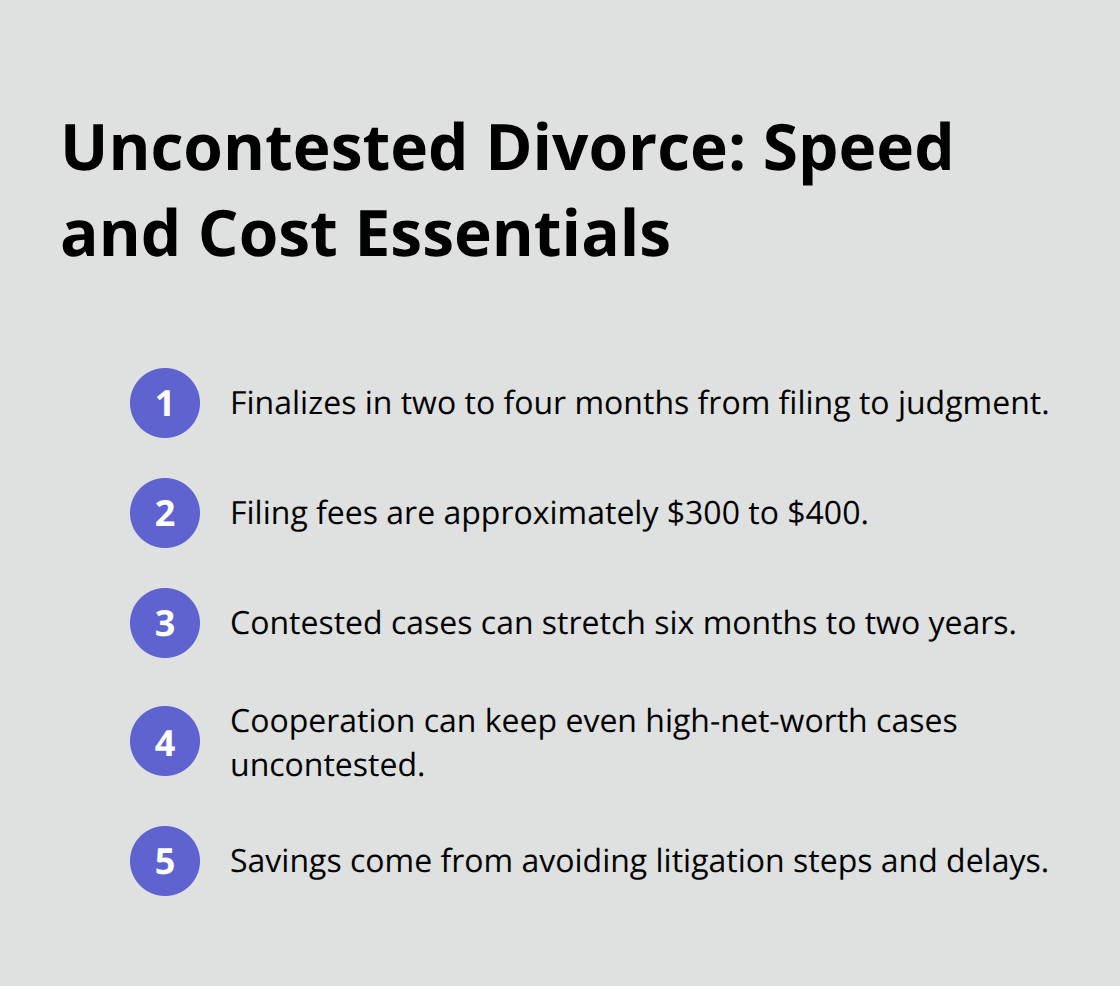
An uncontested divorce in Melbourne Florida typically finalizes within two to four months from filing to final judgment, whereas contested cases stretch six months to two years. Filing fees run approximately $300 to $400, plus attorney time to prepare documents and ensure accuracy. When both spouses cooperate, even high-net-worth divorces involving significant retirement accounts or real property can proceed uncontested if you agree on valuation and division methods upfront.
The speed and cost savings make uncontested divorce compelling, but the foundation must be genuine agreement and willingness to negotiate in good faith.
Whether your situation fits the uncontested path depends on your specific circumstances and your spouse’s willingness to cooperate. The next section examines how Melbourne Florida courts handle both contested and uncontested cases, and what role mediation and settlement negotiations play in each scenario.
How Melbourne Florida Courts Process Your Divorce
Contested Divorce Procedures in Melbourne Florida
Melbourne Florida courts handle contested divorces through structured procedural steps that resolve disagreements systematically. After you file your petition and your spouse files a response, both parties exchange financial documents and evidence during discovery, a mandatory process that typically lasts two to three months. The court then schedules a case management conference where a judge or court staff member reviews the case status and may order you to attend mediation. Florida Statute 61.052 requires that all contested cases with children include a custody mediation component before trial, and many courts also mandate economic mediation for property and support disputes.
If mediation fails to produce a settlement, temporary hearings may occur to address urgent matters like emergency custody or child support while the case proceeds. These hearings happen within weeks of your request and allow the judge to make temporary orders that stay in effect until trial. The discovery process generates substantial paperwork: a Case Information Statement detailing every asset, liability, income source, and expense; financial affidavits; bank statements; tax returns; and retirement account statements. Failure to disclose information accurately can result in sanctions, delayed proceedings, or a judge ruling against you for hiding assets.
Many contested cases settle during discovery or at settlement conferences because both sides gain clarity on their actual financial position and the strength of their arguments. If settlement does not occur, your case proceeds to trial where a judge decides all remaining disputed issues, typically within six to twelve months from the initial hearing depending on court backlog.
The Streamlined Uncontested Path
Uncontested divorces follow a streamlined path that bypasses most court machinery. You and your spouse work with attorneys or a mediator to draft a Marital Settlement Agreement that covers all major issues, then file it with the court along with a Petition for Dissolution. The judge reviews the agreement to confirm it is fair and legal, and if satisfied, signs a final divorce judgment within two to four weeks. No temporary hearings occur because you have already reached agreement. No discovery is required because both parties have already negotiated and disclosed financial information voluntarily. The filing fee is approximately $300 to $400, and your total attorney time is minimal compared to contested litigation.
How Mediation Transforms Your Case
Mediation serves as the bridge between contested and uncontested paths and fundamentally changes how your case unfolds. A neutral mediator does not decide any issue; instead, the mediator facilitates negotiation between you and your spouse in separate sessions and joint sessions, helping you identify common ground and creative solutions. Mediation costs typically run $200 to $400 per hour, with each party paying roughly half, making a complete mediation process cost $3,000 to $5,000 total.
Research from the Florida Supreme Court shows that mediated settlements resolve 75% to 85% of cases that enter the process, dramatically reducing the number of cases that proceed to trial. When mediation succeeds, your case converts from contested to uncontested, you formalize the agreement into a Marital Settlement Agreement, and the court finalizes your divorce without trial. Mediation also preserves privacy because mediation sessions are confidential, whereas court trials are public record, meaning your financial details, custody disputes, and personal matters become part of publicly accessible court files.
Custody Mediation and Parenting Plans
If you have children, custody mediation is mandatory in Melbourne Florida contested cases, and many parents find that working with a mediator produces more workable parenting plans than a judge’s ruling. You maintain control over the outcome rather than having a judge impose a schedule based on limited courtroom testimony. This collaborative approach often leads to arrangements that both parents can sustain long-term, reducing future disputes and protecting your children from ongoing conflict.
Final Thoughts
The choice between a contested versus uncontested divorce shapes everything about your case: how long it takes, what it costs, and how much control you retain over the outcome. An uncontested divorce resolves in two to four months for $300 to $400 in filing fees plus modest attorney costs, while a contested divorce stretches six months to two years and runs $15,000 to $50,000 or more per side. Beyond finances, uncontested divorces preserve privacy, reduce emotional strain on your family, and allow you and your spouse to make decisions together rather than having a judge impose them.
Many cases that start contested settle through mediation or negotiation once both parties understand their actual financial position and the strength of their arguments. This means your situation is not necessarily fixed at the outset-settlement opportunities may emerge as discovery progresses and you gain clarity on the issues. Contested divorces become necessary when one spouse refuses to negotiate, hides assets, or when safety concerns demand court intervention, but they exact a steep price in time, money, and family stability.
Legal representation protects your rights regarding child custody, property division, and long-term financial security from the start. Contact Harnage Law PLLC to discuss your divorce situation and determine the right path forward for your family.