
Child Support Payments Florida: A Clear Guide to Payments and Enforcement
Our Blog
Child Support Payments Florida: A Clear Guide to Payments and Enforcement

Child support payments in Florida follow specific rules that affect thousands of families in Melbourne and across the state. Understanding how these payments work, what you owe, and how to handle changes is essential for parents navigating family law.
We at Harnage Law PLLC created this guide to break down Florida’s child support system into straightforward steps. Whether you’re paying support, receiving it, or need to modify an existing order, you’ll find practical information here.
How Florida Calculates Your Child Support Amount
Income and the Financial Affidavit
Florida’s child support calculation starts with one number: your net monthly income from the Florida Financial Affidavit. This income figure includes wages, salary, bonuses, commissions, business income, rental income, and other regular sources of money. The state does not use gross income or arbitrary percentages of your paycheck. Instead, Florida law requires courts to apply a specific guidelines table based on the combined net income of both parents and the number of minor children involved.
The Standard Needs Table
For one child, the basic monthly obligation ranges from $61 per month at the lowest income levels up to percentages of combined income above $10,000 monthly. For six children, the obligation increases significantly across the same income brackets. The Florida Department of Revenue publishes the exact standard needs table that courts must follow, and these amounts change as your income changes. If you earn more this year than last year, your obligation typically increases. If you lose income, it can decrease. This is not theoretical-it is a direct mathematical relationship between what you earn and what you owe.
Time-Sharing and the 150 Percent Multiplier
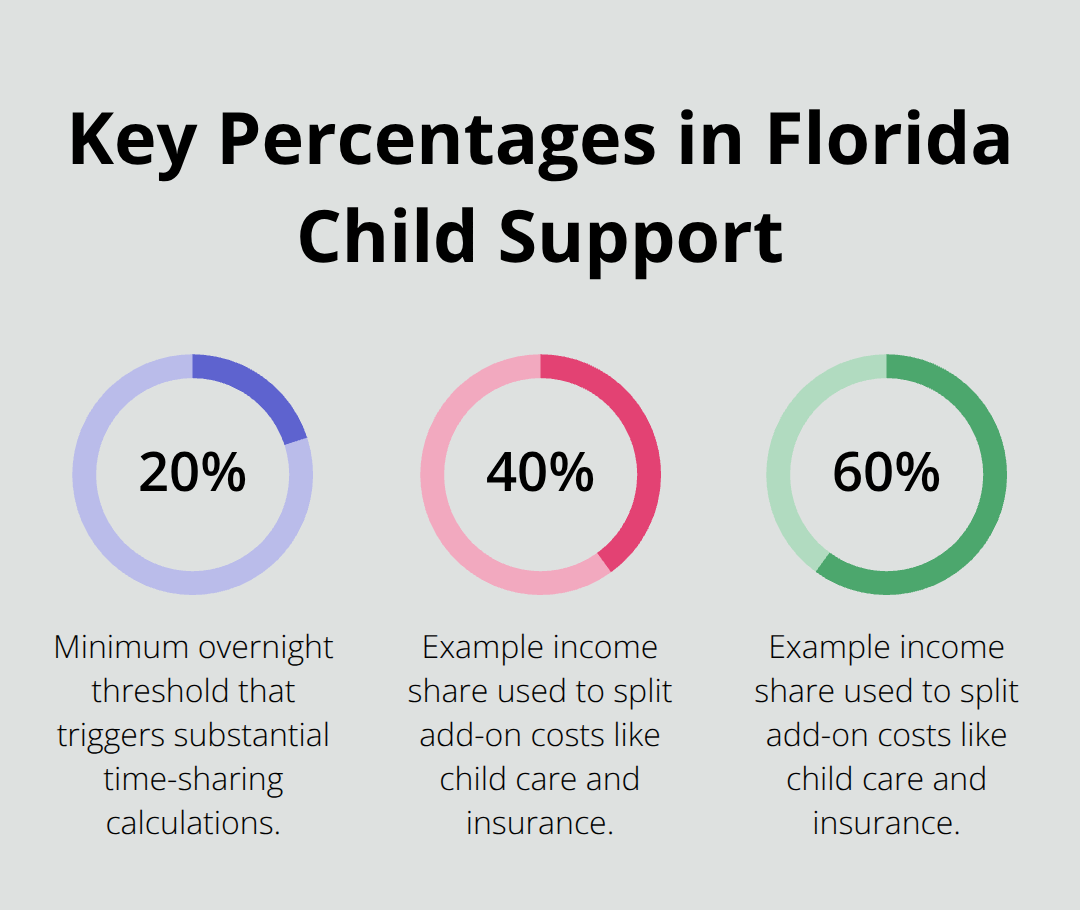
Substantial time-sharing arrangements alter this calculation dramatically. When both parents spend at least 20 percent of overnight stays with the children (roughly 73 overnights per year each), Florida multiplies the basic monthly obligation by 150 percent before dividing it between parents according to their income percentages. This means a father earning $4,000 monthly and a mother earning $6,000 monthly would each owe more than they would under standard custody arrangements.
Additional Support Costs
Additional costs layer on top of the basic obligation: 100 percent of licensed child care expenses, the full monthly cost of the child’s health insurance, and uncovered medical expenses. These additional support costs are split between parents based on their income percentages. If you already pay $800 monthly in child care and $150 in insurance, those amounts get allocated based on whether you earn 40 percent or 60 percent of the household income.
Deviations from Guidelines
Courts in Melbourne, Florida apply these calculations uniformly, though judges can deviate from guideline amounts if they provide written reasons. High medical expenses, private school costs, or special needs can justify amounts above the standard table, but the deviation must be documented in the court order. Once the court establishes your obligation amount, the next step involves understanding how you actually make those payments and what happens if you fall behind.
Child Support Payment Methods and Enforcement in Florida
Payment Options Available to Florida Parents
Florida’s State Disbursement Unit processes all child support payments, and parents in Melbourne have multiple ways to send money. The smartest move uses fl.smartchildsupport.com or the eServices portal, both of which charge zero fees and post payments within two business days. You’ll need your depository number, a 13-digit code that combines your county code with your case number. If you live in Brevard County, your depository number starts with 12, followed by the 11-digit portion of your court case number. Walmart MoneyCenter accepts cash payments for a $2 fee, processing in one to two business days. PayKidz offers electronic check payments with a $5 fee or credit card payments with a 3.5% fee, posting in two to four days depending on method. Phone payments through the Florida SDU at 1-877-769-0251 take two to three business days and require either your 10-digit child support case number or your nine-digit court case number plus Social Security number. Money transfer services through Amscot or MoneyGram work but can take up to seven days and charge variable fees based on the amount transferred. Text-based payments also exist with a 3.5% fee, though you must respond to authorize each transaction. The Florida SDU distributes funds directly to the receiving parent, not through your employer, so money moves from your chosen payment method straight to the other parent’s account or prepaid card if they use smiONE.
Income Withholding as the Primary Enforcement Tool
Income withholding stands as Florida’s primary enforcement mechanism when payments fall behind. Your employer receives a notice and deducts child support directly from your paycheck before you see the money, sending it to the SDU automatically. If you change jobs, the court order follows you, and your new employer must withhold the same amount. This automatic deduction prevents missed payments and removes the burden of remembering to pay each month.
Consequences That Escalate Quickly
Non-payment triggers a cascade of consequences that accelerate rapidly. The Florida Child Support Program issues past-due notices and can suspend your driver license, professional license, and recreational licenses within months of non-payment.
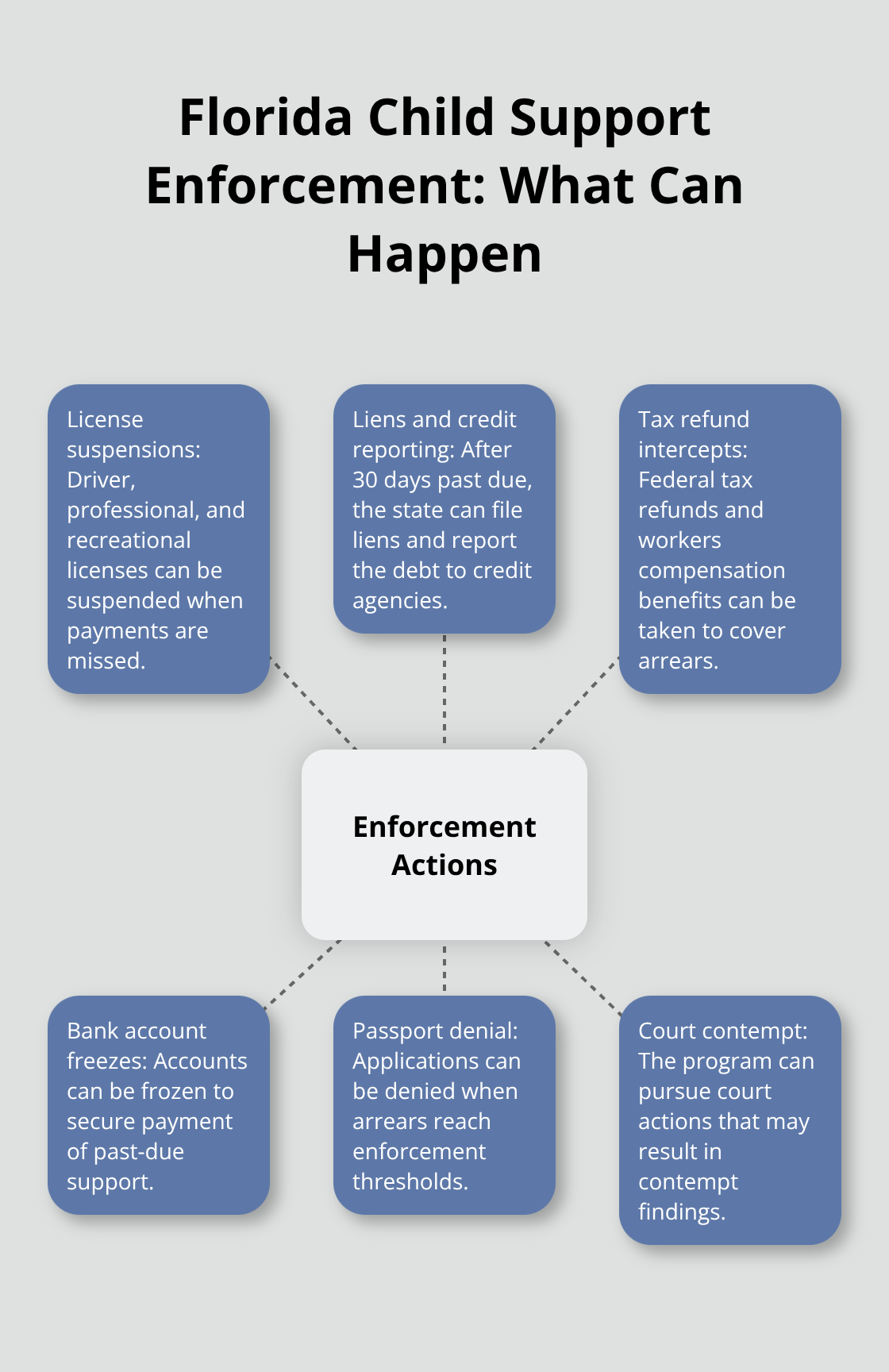
After 30 days past due, the state can file liens against your motor vehicles and boats, report the debt to credit agencies, and intercept your federal tax refunds and workers compensation benefits. The program can also freeze bank accounts, deny passport applications, and pursue court actions that result in contempt of court findings. These enforcement actions compound over time, making early intervention far more effective than waiting for the state to act.
Taking Action Before Enforcement Arrives
If you cannot pay because of job loss or reduced income, contact the SDU immediately to request a Payment Agreement, which lets you pay the past-due amount over time and reduces immediate enforcement. The program provides job placement and training resources through its Resources for Parents page to help you find work and meet your obligations. Waiting until enforcement action arrives guarantees worse outcomes than proactively addressing payment problems early. Courts in Melbourne handle these cases regularly, and parents who communicate with the SDU before falling significantly behind preserve their licenses and avoid the compounding damage of liens, credit destruction, and court involvement. When circumstances change substantially, the path forward involves understanding how to modify your existing support order rather than simply managing enforcement consequences.
Modifying Child Support Orders in Melbourne, Florida
When Life Changes Materially
Substantial changes in income, custody arrangements, or the child’s needs create legitimate reasons to modify child support orders in Florida. The state recognizes that life rarely stays static, and courts allow modifications when circumstances justify them. A parent who loses employment, receives a significant raise, or experiences a major shift in time-sharing arrangements has grounds to petition the court. The Florida Department of Revenue handles modifications for cases already in the system, while parents can also file directly with the court in Melbourne if circumstances have changed materially since the original order.
Material change means the modification would result in a support amount that differs by at least 10 percent from the current obligation, or a change in custody that affects time-sharing percentages. If you earned $60,000 when the order was established and now earn $75,000, that income increase triggers modification eligibility. Similarly, if you previously had the child 10 percent of the time and now have 25 percent due to a custody adjustment, you qualify to request changes.
Gathering Documentation and Filing Your Petition
The process begins with documentation: recent pay stubs, tax returns, and written custody schedules showing the new arrangement. Courts in Brevard County and across Florida require concrete proof, not estimates or verbal agreements about what might change. Filing a modification petition in Melbourne costs filing fees ranging from $150 to $300 depending on whether you use the Department of Revenue or file directly with the court, though parents without resources can request fee waivers. The petition must clearly state what has changed and provide supporting documentation.
Temporary Versus Permanent Modifications
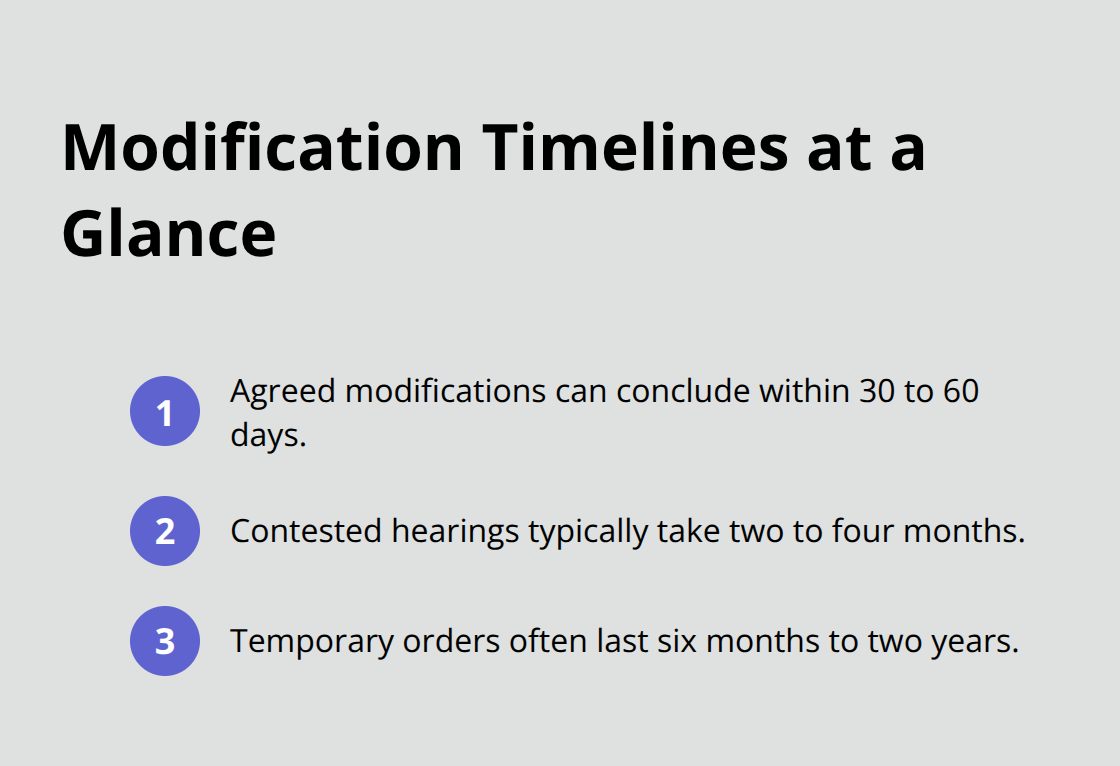
Temporary modifications exist for situations that are genuinely short-term, such as a parent returning to school or recovering from a medical condition with an expected end date. Courts order temporary modifications for a specific duration, typically six months to two years, after which the original amount resumes unless the paying parent requests another modification before expiration. Permanent modifications remain in effect until the child turns 18, the parents agree to change them, or another material change occurs. Most parents requesting modifications seek permanent changes because temporary orders create uncertainty and require revisiting the issue repeatedly.
What Happens During the Court Process
If the other parent agrees to the modification, the process moves quickly, sometimes concluding within 30 to 60 days. Contested modifications require a hearing before a judge, which typically takes two to four months depending on court scheduling in your county. During the hearing, both parents present evidence of their current income, custody time, and any special circumstances affecting the child’s needs. The judge applies the same guidelines calculation used for the original order, plugging in the new numbers to determine the modified amount.
Avoiding Critical Payment Mistakes
One critical mistake parents make involves continuing to pay the old amount while a modification is pending. Florida law requires you to keep paying the current court-ordered amount until the judge issues a new order, even if you believe you owe less. Stopping payments or reducing them before modification approval triggers enforcement action and damages your credibility with the court. If the modification is eventually approved retroactively to an earlier date, you receive credit for overpayments, but the court will not look favorably on parents who unilaterally changed their payment amounts. When circumstances change substantially, addressing the modification process promptly protects your financial interests and maintains your standing with the court.
Final Thoughts
Florida’s child support system operates on clear mathematical principles, but navigating payment methods, enforcement consequences, and modification requests requires understanding how these pieces fit together. The guidelines table determines your obligation based on net income and custody time, payment options range from fee-free online methods to cash at Walmart (each with different processing times), and enforcement mechanisms like income withholding activate quickly when payments fall behind. Proactive communication with the Florida SDU proves far more effective than waiting for consequences to mount.
Life changes through job loss, income increases, or shifts in custody arrangements, and the law recognizes these transitions through modification requests. Courts require documentation and material changes before approving modifications, and the process moves faster when both parents agree on the new amount. The critical mistake many parents make involves continuing old payment amounts while modifications are pending or stopping payments without court approval.
Your situation may involve straightforward child support payments in Florida under standard custody, complex calculations with substantial time-sharing, or disputes over modification eligibility. If you face questions about your obligations, need to modify an existing order, or are dealing with enforcement action, contact Harnage Law PLLC for strategic counsel tailored to your situation.