
Child Support Guidelines Florida: How Rates Are Calculated in Your Area
Our Blog
Child Support Guidelines Florida: How Rates Are Calculated in Your Area
Child support calculations in Florida follow a specific formula, but the final amount depends on your income, custody arrangement, and other factors unique to your situation. If you live in Melbourne, Florida, local guidelines shape what you’ll owe or receive.
We at Harnage Law PLLC help families understand child support guidelines Florida and how they apply to their circumstances. This guide walks you through how payments are calculated, what affects the amount, and how to modify orders when life changes.
How Florida Calculates Your Child Support Amount
Florida’s child support formula starts with one fundamental principle: both parents share financial responsibility based on their income. The Florida Department of Revenue administers this system statewide, and the calculation method remains consistent whether you live in Melbourne or any other Florida county. The process begins with gross income, which includes wages, salaries, bonuses, rental income, Social Security benefits, disability payments, and investment earnings. From this gross amount, you subtract mandatory deductions including federal and state taxes, FICA contributions, health insurance premiums for yourself (not the children), and court-ordered support for other children. This produces your net monthly income, which forms the foundation of the entire calculation.
Combined Income Determines Responsibility Percentages
You combine your net income with the other parent’s net income to establish your combined available monthly income. If one parent earns $4,000 net monthly and the other earns $2,500 net monthly, the combined available income is $6,500. Each parent’s financial responsibility percentage is then calculated by dividing their individual net income by the combined total and multiplying by 100. The $4,000 earner carries roughly 61 percent responsibility while the $2,500 earner carries roughly 39 percent.
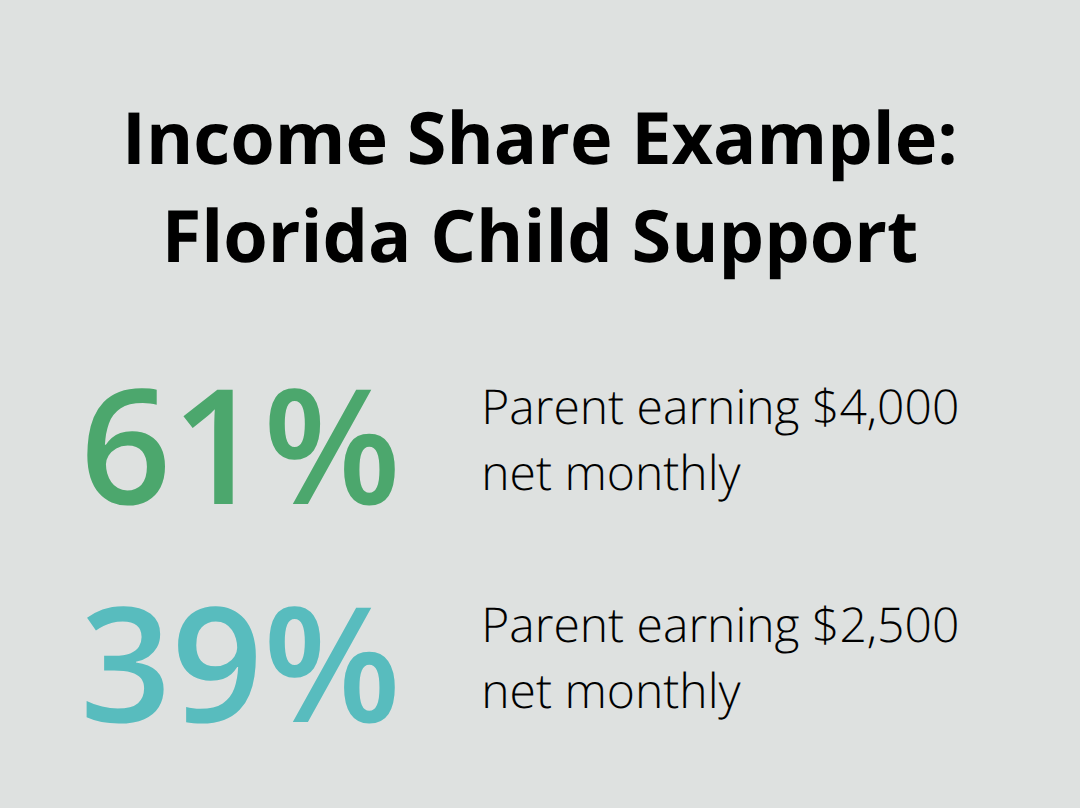
This income-based split forms the backbone of Florida’s approach to child support.
Time-Sharing Changes Everything
The number of overnight visits with each parent dramatically affects the final amount. If both parents have the child for 73 or more nights per year (at least 20 percent of overnights), Florida increases the base obligation by 50 percent to account for two separate households. Without substantial time-sharing, the standard calculation applies directly. The actual base monthly obligation depends on your combined income and the number of children; for two children with a $6,500 combined monthly income, the primary obligation reaches approximately $1,819 according to Florida’s guidelines. This base amount splits between parents according to their income percentages. Healthcare costs, childcare expenses, and out-of-pocket medical costs are added separately and allocated proportionally to each parent’s income share. If one parent pays $500 monthly for childcare, that cost gets divided according to responsibility percentages.
Deviations Require Written Justification
Judges can deviate from the guideline amount, but Florida law limits deviations to approximately 5 percent without substantial written justification. Larger deviations demand clear documentation of why the guidelines don’t fit your specific situation. Common deviation factors include the financial resources of both parents, the standard of living the child enjoyed before separation, each parent’s earning potential, the child’s special needs or educational requirements, and any tax consequences of the support award. A judge must explain their reasoning in the court order itself. This means the default calculation serves as the starting point for virtually every case, and departing from it requires concrete evidence and judicial explanation rather than subjective preference.
Understanding how these calculations work helps you anticipate what a court might order in your case. Local factors in Melbourne, Florida, and across different counties can influence how judges apply these guidelines to your specific circumstances.
Child Support Rules in Melbourne, Florida and Across the State
Florida’s Statewide Formula Applies Uniformly
Florida’s statewide guidelines mean the calculation formula remains identical whether you live in Melbourne, Brevard County, or any other jurisdiction across the state. The Florida Department of Revenue administers child support uniformly, and judges in every county apply the same income shares model, the same time-sharing multipliers, and the same guidelines worksheet. This consistency protects parents from arbitrary variations based on location. However, uniformity in formula does not mean uniformity in outcomes. Local court culture, judicial interpretation, and how judges apply discretionary factors create meaningful differences in final orders.
How Local Judges Interpret the Guidelines
A judge in one county might approve a deviation more readily than a judge in another, even when the factual circumstances appear similar. The specific judge assigned to your case matters significantly. Some judges strictly adhere to the guideline calculation and resist deviation requests unless overwhelming evidence supports departure. Others view the guidelines as a starting point and adjust more liberally when they believe circumstances warrant adjustment. In Melbourne and across Brevard County, you need to understand both the universal formula and the local judicial tendencies that shape how that formula gets applied in practice.
Relocation Triggers Fresh Review and Potential Changes
If you move from Melbourne to Tampa or from Jacksonville to Miami, your child support order remains valid until a judge modifies it, but the new county’s courts gain jurisdiction over any future modification requests. This matters because modification triggers a fresh review of your entire situation, and the new judge may interpret deviation factors differently than the original judge did. A roughly 15 percent or greater change in income qualifies as a substantial change in circumstances that justifies modification in Florida courts. Similarly, significant changes in parenting time or custody arrangements open the door to recalculation.
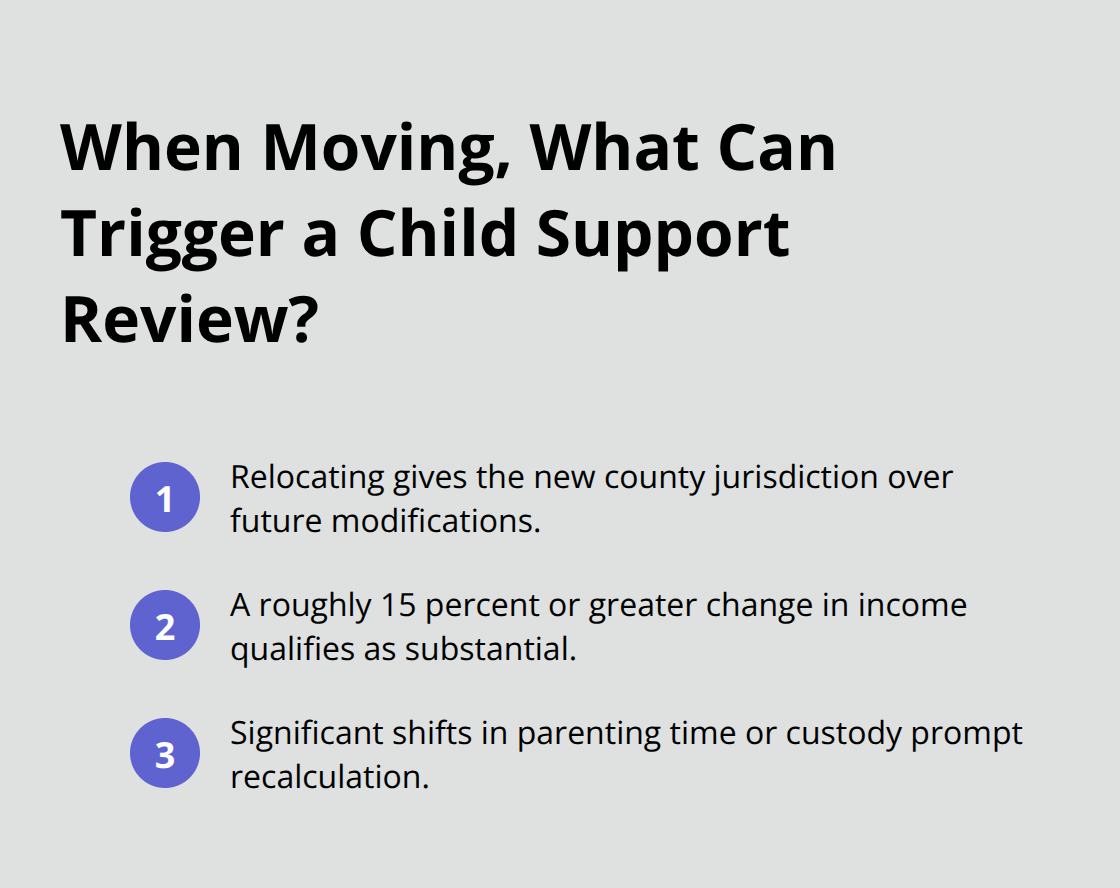
Documentation Proves Substantial Changes
When you move and circumstances change simultaneously, the new jurisdiction’s court applies the statewide formula to your updated financial and custodial situation, potentially producing a different result than your original order even though the guidelines themselves never changed. Documentation becomes critical in relocation scenarios. Pay stubs, tax returns, and proof of parenting time changes must clearly establish the magnitude of change. These records form the foundation of any modification petition you file in your new county.
Understanding how local courts apply the statewide formula prepares you for what happens when you modify an existing order or when your circumstances shift significantly enough to warrant court review. The next section examines the specific steps you must take to request a modification and what documentation the court requires to approve changes to your current child support obligation.
Modifying Your Child Support Order in Melbourne, Florida
Florida courts allow modification whenever a substantial change in circumstances occurs, and a 15 percent or greater shift in either parent’s income qualifies as substantial. The Florida Department of Revenue reported collecting over 1.1 billion dollars in child support payments in 2022, reflecting the scale of enforcement across the state. If you earn significantly less due to job loss or illness, or if the other parent’s income has increased substantially, you have grounds to petition the court for recalculation. Changes in parenting time carry equal weight. If you previously had the child fewer than 73 nights per year but now have substantially more overnights, or vice versa, that shift triggers the time-sharing multiplier and produces a different obligation.
Filing Your Modification Petition
The modification process requires you to file a petition with your local court, typically Brevard County if you live in Melbourne, and serve the other parent with notice. Within 45 days of filing, both parties must complete a financial affidavit using Florida Form 12.902(b) or 12.902(c) depending on income level. These forms demand precise documentation of your current net monthly income, including all deductions. Pay stubs covering recent months, tax returns from the past two years, and proof of benefits or other income sources become your evidence. The court will not accept vague claims about income changes. You need concrete proof showing exactly what changed and by how much.
Gathering Documentation That Courts Accept
Documentation quality determines whether a judge approves your modification request. Attach recent pay stubs showing your actual current earnings, not hypothetical future income. If you changed jobs, provide offer letters and employment agreements. If you lost income, include termination letters or documentation of reduced hours. For parenting time changes, use a calendar or parenting app showing actual overnight stays, not just the parenting plan.
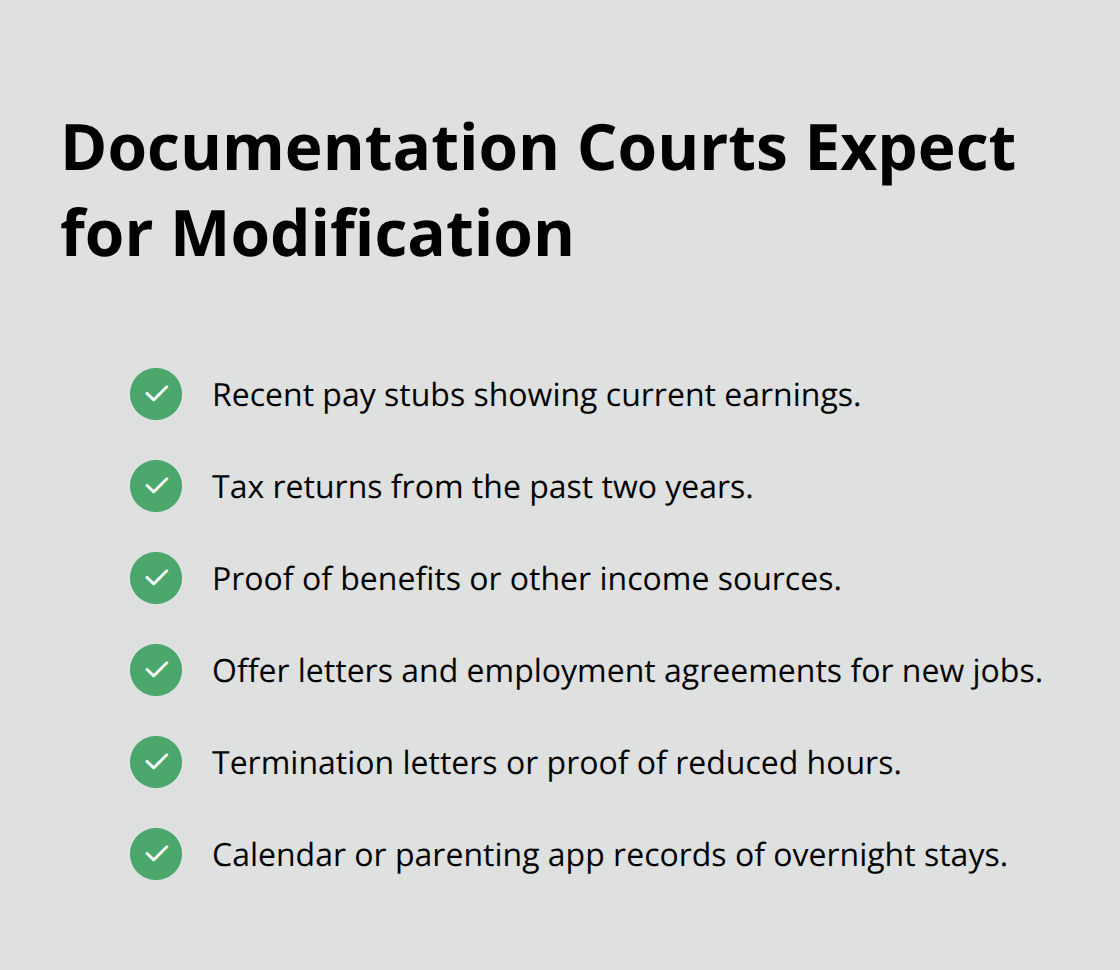
Courts verify that claimed changes genuinely occurred and meet the substantial change threshold. A 10 percent income reduction falls short; a 15 percent reduction clears the bar. If income or custody circumstances changed months ago, courts question why you delayed filing. Act promptly once substantial changes occur.
What Happens at the Modification Hearing
The modification hearing gives both parents opportunity to present evidence and dispute the claimed changes. If the other parent contests your modification request, the judge will weigh the documentation you both present. A contested modification typically requires a full hearing where the judge questions both parents about income, expenses, and custody arrangements. Uncontested modifications move faster because both parties agree the change warrants adjustment and often agree on the new amount. Even if you reach a private settlement with the other parent on a new child support amount, a judge must approve it. Courts will not enforce private agreements that deviate significantly from the guidelines without judicial approval and written justification for the deviation.
Final Thoughts
Florida’s child support guidelines formula rests on three pillars: your income, the other parent’s income, and how much time each parent spends with the child. The statewide calculation method ensures consistency across Melbourne and every other Florida county, but the real-world outcome depends on accurate financial documentation and honest reporting of parenting time. A 15 percent income change or significant shift in custody arrangements gives you grounds to modify an existing order, and courts expect you to act promptly when substantial changes occur.
The guidelines themselves provide a predictable framework, yet judges retain discretion to deviate when circumstances warrant adjustment. Understanding both the formula and how local judges apply it positions you to anticipate what a court might order in your case. Many parents attempt to navigate these calculations alone using online tools, but those estimates cannot account for all factors a judge considers (your specific situation involves nuances that generic calculators miss).
We at Harnage Law PLLC handle sensitive family law cases including child support matters in Melbourne and across Florida. Contact Harnage Law PLLC to review your situation and learn what the child support guidelines Florida mean for your specific case. The sooner you understand your obligations or rights, the sooner you can move forward with confidence.