
Alimony Guidelines Florida: How Spousal Support Is Calculated
Our Blog
Alimony Guidelines Florida: How Spousal Support Is Calculated

Spousal support in Florida isn’t calculated the same way everywhere. The state has specific guidelines and factors that judges consider when determining what one spouse owes the other.
At Harnage Law PLLC, we help people understand how alimony guidelines in Florida work and what to expect during their divorce. This guide walks through the calculation methods, types of support available, and the factors that shape these decisions.
How Florida Courts Calculate Alimony
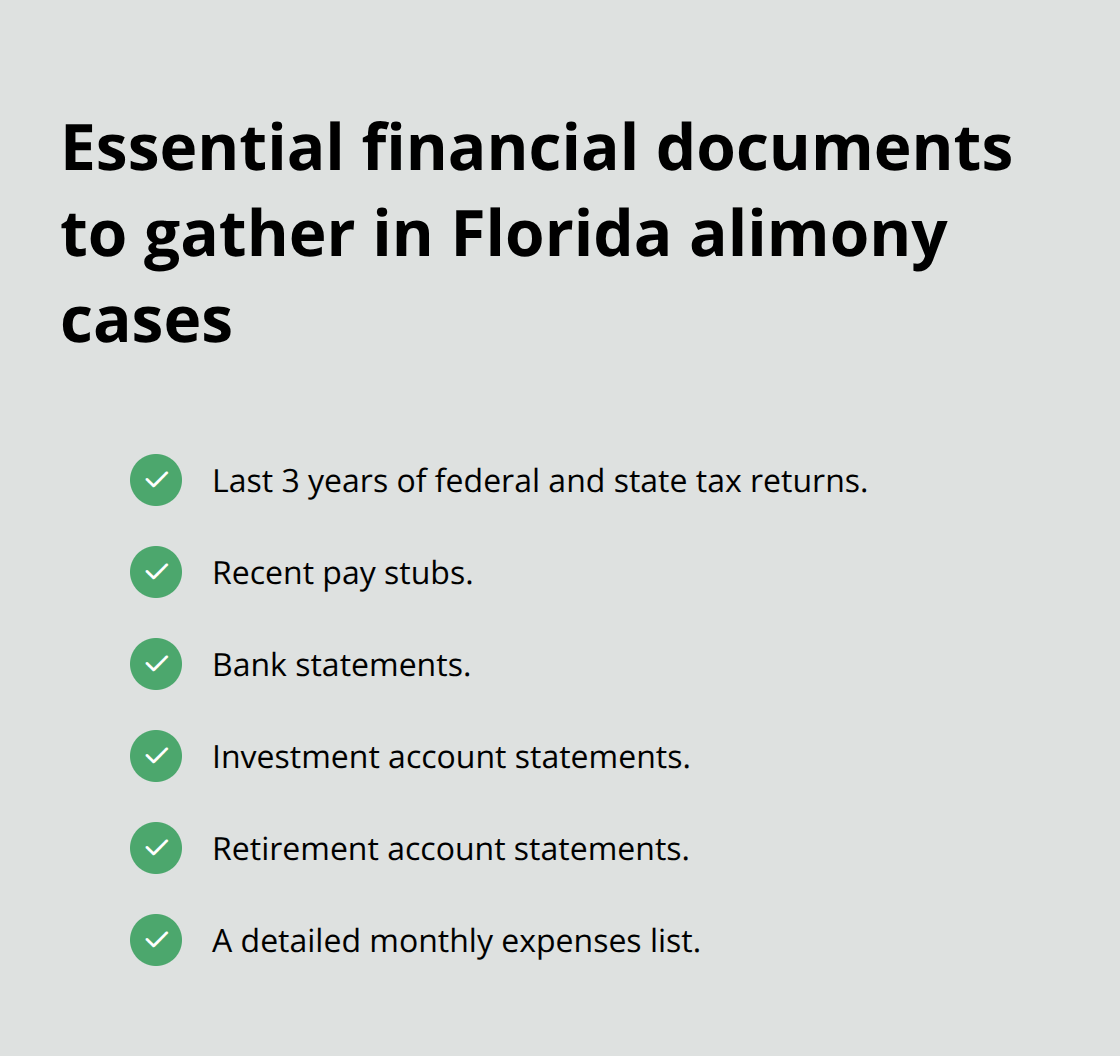
Florida courts don’t use a simple formula to calculate alimony. Instead, judges evaluate your financial situation thoroughly before deciding what one spouse owes the other. The first step is always determining whether a need exists and whether the paying spouse has the ability to satisfy that need. Courts examine each party’s financial affidavit to identify surpluses or deficits-essentially, whether one spouse has leftover income after covering reasonable living expenses while the other falls short. This is why comprehensive financial documentation matters from day one. You should collect your tax returns from the past three years, recent pay stubs, bank statements, investment accounts, retirement account statements, and a detailed list of monthly expenses. Courts also consider all income sources, not just salary. This includes bonuses, rental income, investment returns, and business earnings.
The American Association of Matrimonial Lawyers suggests using 30% of the paying spouse’s gross annual income minus 20% of the receiving spouse’s gross annual income as a reference point, though Florida judges aren’t bound by this guideline.
What Marriage Length Really Means
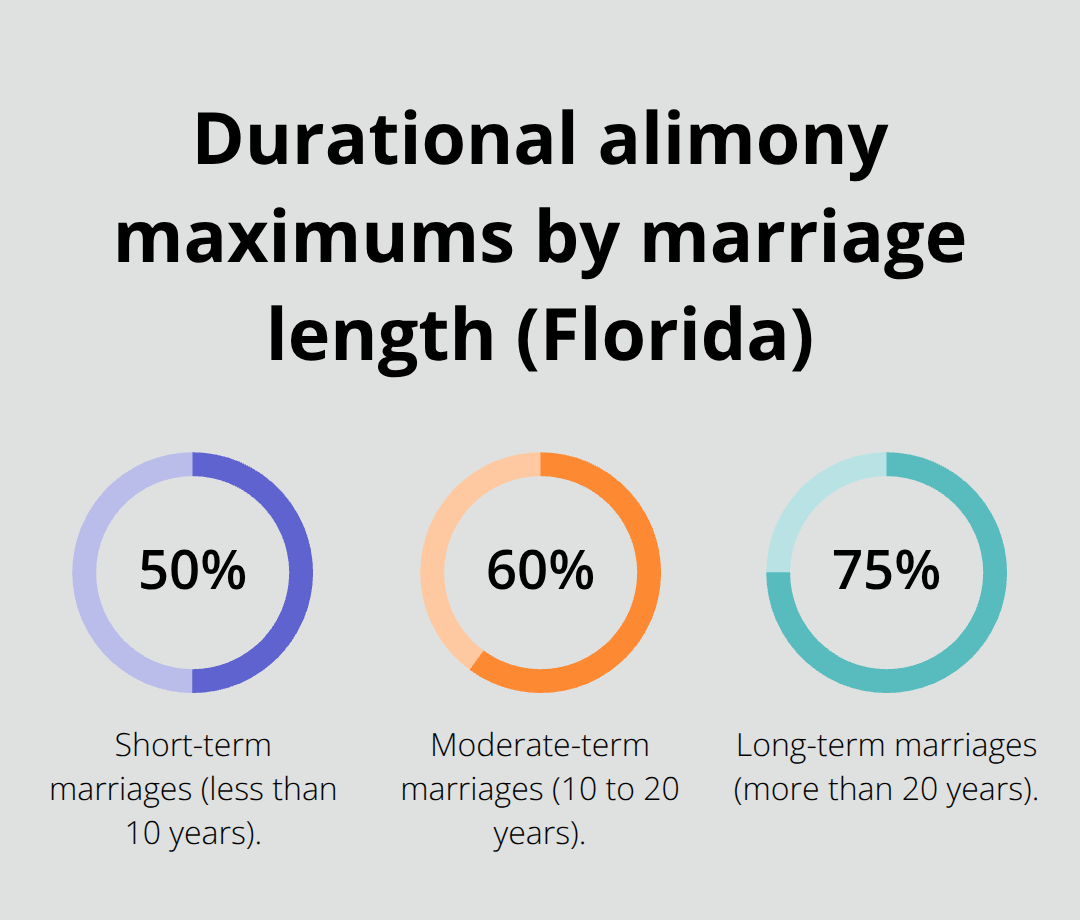
The duration of your marriage directly affects both the amount and type of alimony you’ll receive or pay. Florida categorizes marriages as short-term (less than 10 years), moderate-term (10 to 20 years), or long-term (more than 20 years). For durational alimony, which replaced permanent alimony after July 1, 2023, the maximum award length ties to marriage length-50% for short-term marriages, 60% for moderate-term, and 75% for long-term marriages. This means a 15-year marriage could justify up to 9 years of support, while a 25-year marriage could extend to roughly 19 years. Courts cannot award durational alimony for marriages lasting fewer than 3 years.
The standard of living you maintained during the marriage sets the baseline for what courts consider reasonable post-divorce needs. If you lived comfortably with two homes and regular travel, courts recognize that maintaining a comparable lifestyle requires financial support. However, receiving substantial marital assets-real estate, retirement accounts, or investment portfolios-significantly reduces alimony awards since those assets provide ongoing income and security.
The 35% Income Cap and Real Limits
Florida imposes a hard cap on alimony: the total monthly payment cannot exceed 35% of the difference between both spouses’ net monthly incomes unless exceptional circumstances exist. If the paying spouse earns $8,000 monthly and the receiving spouse earns $2,000, the difference is $6,000, meaning the maximum alimony would be $2,100 per month. This ceiling prevents courts from awarding support that would leave the paying spouse with significantly less net income than the recipient. Courts must issue written findings explaining their calculations and reasoning, which protects both parties and creates accountability. The tax treatment changed dramatically for divorces finalized after January 1, 2019-alimony is no longer deductible for the payer or taxable income for the recipient. This fundamentally shifts negotiations since the paying spouse no longer receives a tax benefit, making the actual cost of support higher than it was under the old rules. Understanding these calculations early helps you assess whether settlement offers are reasonable or whether you need additional documentation to support your position.
Moving Into Alimony Types
The calculation methods courts use form the foundation for determining which type of alimony applies to your situation. Florida offers four distinct categories of spousal support, each with different purposes, durations, and rules that shape how much you’ll pay or receive and for how long.
Types of Alimony Available in Florida
Florida’s 2023 alimony reform eliminated permanent support and created four distinct categories, each designed for different situations and timelines.
Temporary Alimony During Divorce Proceedings
Temporary alimony kicks in during divorce proceedings when one spouse needs immediate financial support before the case concludes. Courts award this type quickly because the divorce itself hasn’t finished yet, and one spouse may have no income while the other continues earning. The amount and duration depend entirely on how long your case takes to resolve. If your divorce finalizes in six months, temporary alimony lasts six months. If litigation stretches to two years, temporary support continues until the final judgment. This type serves a single purpose: keeping the lower-earning spouse afloat during the process. Once your divorce is final, temporary alimony ends immediately and gets replaced by whatever permanent arrangement the court orders.
Bridge-the-Gap Alimony for Short-Term Transitions
Bridge-the-gap alimony handles short-term transitions and cannot exceed two years under Florida law. This category works best for spouses who need help adjusting to single life but don’t require long-term support. A spouse returning to the workforce after years of homemaking might use bridge-the-gap alimony to cover living expenses during the first 18 months while rebuilding a career. The critical advantage: bridge-the-gap payments are non-modifiable, meaning the amount stays fixed regardless of income changes. If you’re the paying spouse and receive a promotion, you cannot increase alimony obligations. If you’re the receiving spouse and lose your job, you cannot request higher payments. This immutability makes bridge-the-gap alimony attractive for settlement negotiations because both parties know exactly what to expect without future court battles. Bridge-the-gap terminates immediately upon remarriage or death of either party, which matters significantly for longer-term planning.
Rehabilitative Alimony and Skill Development
Rehabilitative alimony supports spouses pursuing education, training, or skill development to achieve self-sufficiency within five years maximum. Florida requires a court-approved rehabilitative plan detailing specific goals, timelines, and educational milestones. A spouse completing a nursing certification program might receive rehabilitative alimony for three years while attending classes and gaining licensure. The plan must be realistic and measurable. Courts won’t approve vague goals like gaining better job skills; instead, they require concrete objectives such as completing an accredited vocational program or earning a professional certification.
Durational Alimony and Marriage Length
Durational alimony provides fixed-period support tied to marriage length rather than indefinite payments. Short marriages under ten years justify support lasting no more than 50% of the marriage duration. A seven-year marriage supports up to 3.5 years of durational alimony. Moderate-term marriages spanning 10 to 20 years allow support up to 60% of the marriage length, so a 15-year marriage could receive nine years of durational alimony. Long-term marriages exceeding 20 years permit support up to 75% of the marriage length, meaning a 30-year marriage could justify 22.5 years of durational alimony. These are maximums, not automatic grants. Courts retain discretion to award shorter periods based on individual circumstances. Durational alimony ends on death or remarriage of the recipient, and the amount cannot exceed 35% of the net income difference between spouses unless exceptional circumstances apply.
How Alimony Type Affects Your Financial Future
The alimony category that applies to your situation determines whether support lasts months, years, or decades. Each type carries distinct rules about modification, termination, and payment amounts. Temporary alimony offers no long-term security since it ends with your divorce. Bridge-the-gap provides certainty through its non-modifiable structure but lasts at most two years. Rehabilitative alimony requires active participation in education or training, with courts monitoring compliance against your approved plan. Durational alimony ties directly to your marriage length, creating predictable timelines that both spouses can plan around. Knowing which category the court will likely award helps you assess settlement offers and understand what financial obligations or support you’ll face after divorce. The next section examines the specific factors that judges weigh when deciding not just which type applies, but also the actual dollar amounts involved in your alimony award.
Factors That Influence Alimony Decisions
Age and Health Status Shape Support Amounts
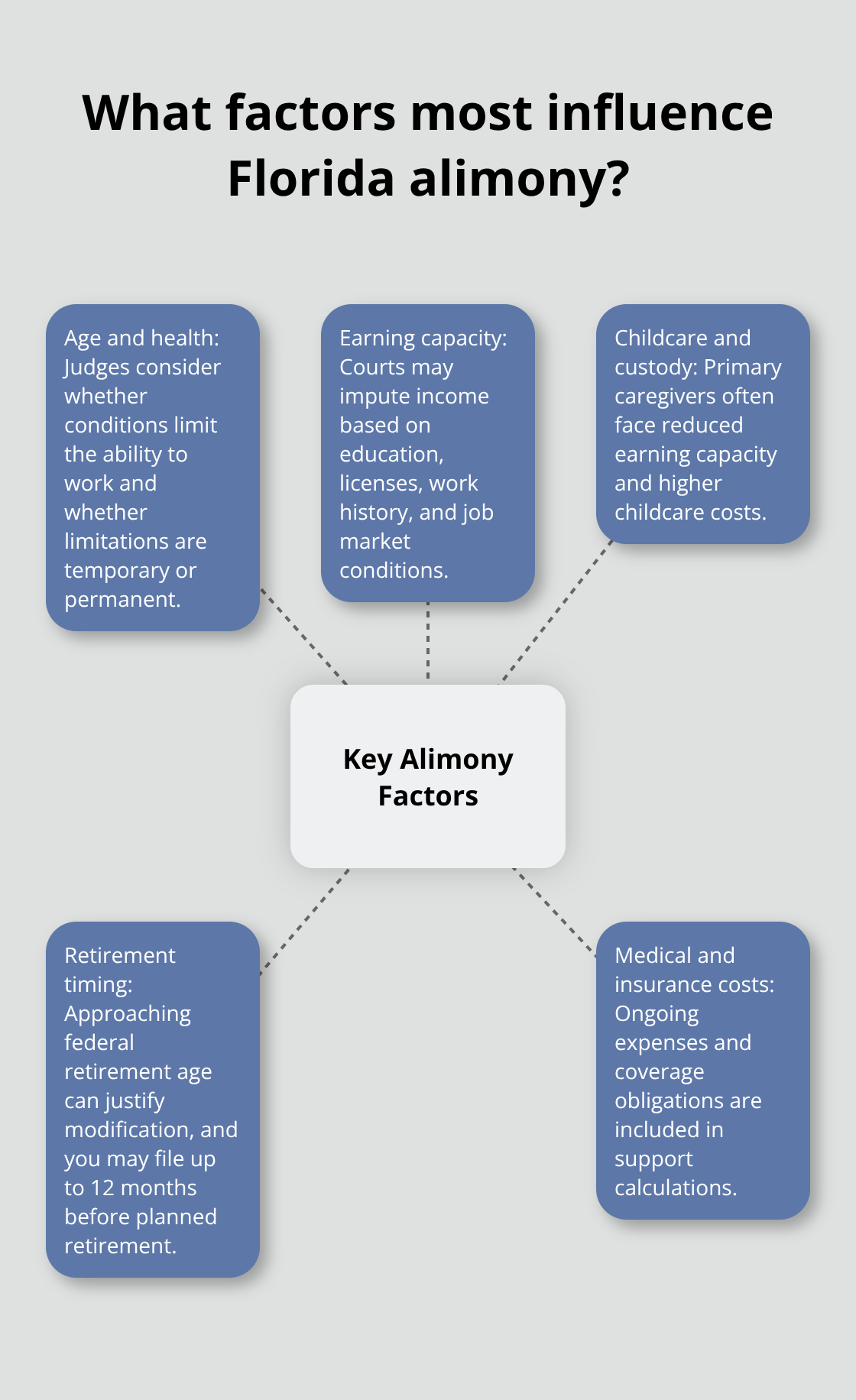
Age and health status directly shape alimony decisions because courts assess whether either spouse can realistically work or modify their earning capacity over time. A 58-year-old spouse with arthritis faces different employment prospects than a 35-year-old in perfect health, and judges account for this difference when calculating support amounts and duration. Courts examine medical records, disability documentation, and physician statements to determine whether health conditions are temporary or permanent. If you seek alimony and have a documented chronic illness, bring medical evidence showing how your condition limits your ability to earn income. If you pay alimony and developed a serious health condition after the divorce, this constitutes grounds for modification under Florida law. The court also considers whether either spouse approaches retirement age-Florida recognizes federal retirement age (typically 67) as a legitimate reason to modify or terminate alimony. If you plan to retire within five years, document your retirement timeline now because courts may allow you to file for modification up to 12 months before your intended retirement date. Health insurance costs matter too; if you maintain coverage for the recipient or have significant ongoing medical expenses, judges factor these into the alimony calculation. Courts will not award alimony that ignores realistic medical costs for aging spouses.
Earning Potential Versus Actual Income
Earning potential and actual income are separate considerations that courts weigh carefully. A spouse with a law degree who works part-time earns less than their capacity, and judges often impute income based on what they could earn rather than what they actually earn. This means underemployment or intentional income reduction does not automatically reduce your alimony obligation. Courts examine educational background, professional licenses, work history, and job market conditions for your field to determine realistic earning capacity. If you left the workforce to raise children and now lack recent work experience, prepare a concrete plan showing how you will rebuild income-vocational assessments, job training timelines, and realistic salary expectations matter. The court will scrutinize whether you make genuine efforts to return to work or whether you deliberately limit your income to reduce alimony obligations.
Custody and Childcare Responsibilities
Child custody and childcare responsibilities significantly reduce earning capacity because a parent caring for young children cannot work full-time. Florida courts recognize this by adjusting alimony calculations when one spouse has primary custody of minor children. A parent with custody of three children under age eight will struggle to maintain full-time employment, and judges account for this reality. If you share custody 50/50, courts expect both parents to maintain comparable earning capacity and may award lower alimony amounts. Document your childcare costs and actual time spent on child-related responsibilities because these directly impact how much earning capacity the court attributes to you. The court cannot ignore that childcare responsibilities consume time and money that could otherwise go toward income generation.
Final Thoughts
Florida alimony guidelines require careful analysis of income, marriage length, health status, and earning capacity. The calculations courts use aren’t arbitrary-they balance the recipient’s genuine need against the paying spouse’s realistic ability to provide support while maintaining their own financial stability. Understanding which alimony type applies to your situation matters because temporary support ends with your divorce, bridge-the-gap remains fixed for up to two years, rehabilitative alimony requires an approved education plan, and durational alimony ties directly to how long you were married.
Your specific circumstances-whether you have custody of children, face health limitations, or approach retirement-significantly impact the final award amount and duration. Courts won’t ignore these realities when calculating support. The tax changes for post-2019 divorces also matter because alimony no longer provides a deduction for the paying spouse, making the actual cost substantially higher than under previous rules.
Navigating alimony guidelines Florida requires more than understanding the general framework. You need someone who can analyze your financial documents, assess your earning capacity realistically, and anticipate how judges in your county typically rule on similar cases. We at Harnage Law PLLC handle sensitive family law cases including divorce and spousal support matters, and we offer personalized attention to help you understand your rights and obligations. Contact us to discuss how alimony guidelines apply to your specific case and what you can realistically expect moving forward.