
Date of Separation Florida: Key Milestones in Your Divorce Timeline
Our Blog
Date of Separation Florida: Key Milestones in Your Divorce Timeline

When you file for divorce in Florida, the date of separation becomes one of the most important dates in your entire case. This single date affects how assets get divided, what you owe or receive in support, and countless other financial decisions.
At Harnage Law PLLC, we’ve seen how confusion about separation dates costs people thousands of dollars. Understanding what counts as separation under Florida law protects your rights from day one.
What Counts as Separation Under Florida Law
Florida courts define the date of separation as the moment when one spouse decides to end the marriage and communicates that intent to the other spouse. This isn’t about moving out or filing paperwork-it’s about the specific day one person tells their spouse the relationship is over. Florida Statute 61.052 doesn’t require you to live apart to establish separation, which surprises many people. The statute focuses on intent and communication, not geography.
Clients often assume separation requires living in different homes. That misconception costs them dearly when courts calculate asset division or support obligations. The actual date matters because Florida law treats all marital assets accumulated before separation differently than those acquired after. A spouse who waits weeks or months to move out while continuing to accumulate debt or income can significantly impact the financial outcome.
How Courts Pinpoint Your Separation Date
Florida courts look for concrete evidence of when separation actually occurred. They examine emails, text messages, letters, and conversations where one spouse expressed the intent to end the marriage. If you told your spouse on March 15 that you wanted a divorce, that’s your separation date-even if you didn’t leave until April.
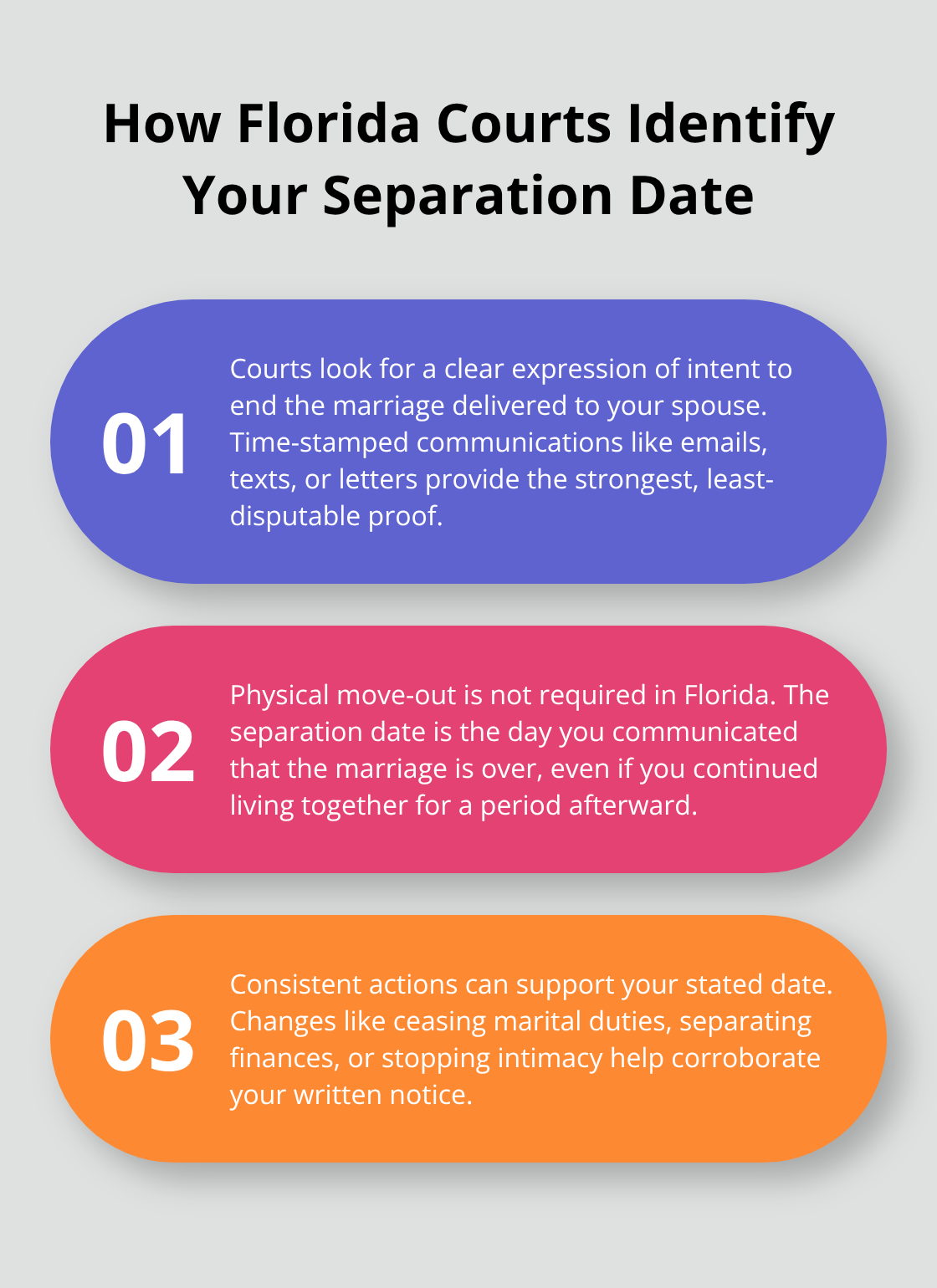
Courts also consider whether the couple stopped having sexual relations, separated finances, or ceased performing marital duties as supporting evidence of separation intent. The problem is that many people don’t document this moment clearly. Courts have rejected cases where spouses claimed separation dates without any written proof, pushing the separation date forward to when the divorce was actually filed. This matters significantly because every month of delay means more marital property accumulation and more support obligations.
Send a written communication-an email or letter-stating your intent to separate. This single action protects your interests by creating undeniable proof of when the marriage ended in your mind.
Understanding Florida’s Actual Separation
Florida recognizes actual separation, not legal separation. Many states offer legal separation as a formal court process, but Florida eliminated that option decades ago. This means you cannot file for legal separation and then wait indefinitely before divorce. Instead, you either remain married or you file for divorce.
The separation date becomes relevant only once you file for divorce, making it a retroactive calculation rather than a formal legal status. This distinction matters because some people delay filing for divorce while living separately, thinking they have legal separation protection. They don’t. If your spouse incurs debt or sells property after you’ve separated but before you file for divorce, you may still be liable for those actions (depending on the circumstances).
The time between actual separation and filing for divorce can work for or against you. If your spouse’s income increases during this period, you might claim a higher alimony obligation. If their income drops, they might argue for reduced support. The precision of your separation date affects financial calculations and court filings in ways that extend far beyond the initial filing.
Why Documentation Matters Now
The moment you decide to separate, start creating a paper trail. Courts won’t accept vague recollections or verbal claims about when separation occurred. Written records-emails, text messages, letters, or even dated journal entries-establish the exact moment you communicated your intent to end the marriage.
This documentation becomes your protection against disputes over the separation date. Your spouse might claim separation happened months later than you stated, which would shift asset division and support calculations in their favor. Having contemporaneous written evidence eliminates that argument entirely. The cost of creating this documentation (a few minutes to send an email) pales in comparison to the thousands of dollars at stake when courts recalculate your financial obligations based on a disputed separation date.
Understanding your separation date and protecting it with clear documentation sets the foundation for every financial decision that follows in your divorce case.
How Your Separation Date Reshapes Your Financial Obligations
The Financial Dividing Line in Your Divorce
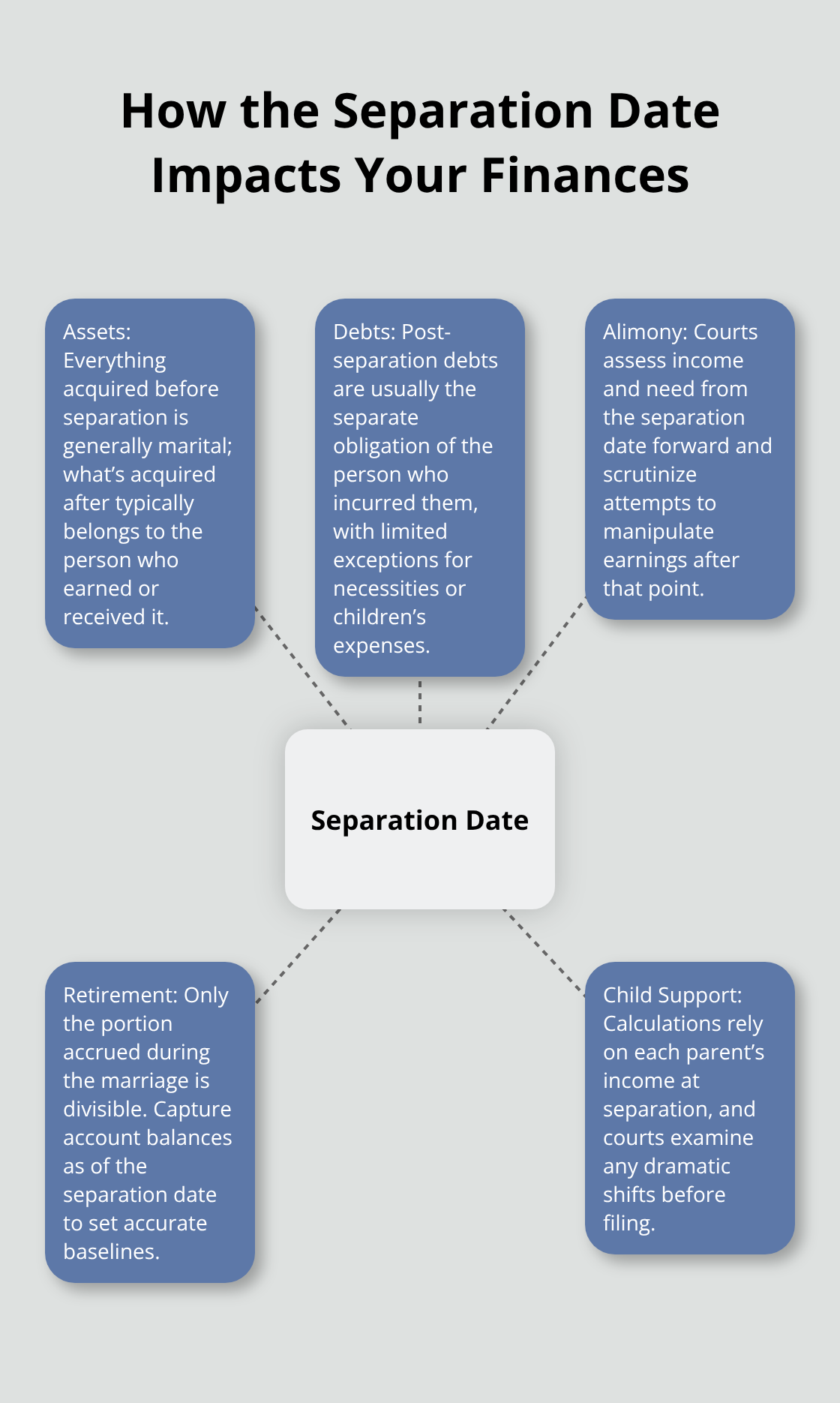
The separation date acts as the financial dividing line in your divorce case, and Florida courts treat it with absolute precision. Everything you and your spouse accumulated before separation counts as marital property subject to division, while assets acquired after separation typically belong to whoever earned or received them. This distinction creates enormous financial consequences that most people underestimate. If you separate on January 15 but don’t file for divorce until August, seven months of income, retirement contributions, and asset appreciation fall into the marital estate. A spouse earning $5,000 monthly adds $35,000 in marital income during those seven months, potentially increasing the other spouse’s claim to alimony or child support.
Debts and Liabilities After Separation
The separation date also determines which debts are marital obligations. If one spouse runs up $20,000 in credit card debt after separation, that debt may belong to them alone rather than becoming a shared liability. Florida courts have consistently ruled that debts incurred after the separation date are the separate obligation of whoever incurred them, with limited exceptions for necessities or children’s expenses. This protection works both ways-your spouse cannot hold you responsible for their post-separation spending, and you cannot claim their debts as marital property.
Alimony and Income Calculations
Alimony calculations depend directly on the separation date because courts measure income and financial need from that point forward. If your spouse claims they need spousal support, Florida law considers their income and expenses from the separation date onward. A spouse who reduces their income after separation but before divorce filing cannot use that reduced income to justify higher alimony claims. Courts examine financial records from the separation date to establish baseline income levels that resist manipulation.
Retirement Accounts and Asset Division
Retirement accounts present particularly complex situations because the separation date determines which portion of a 401(k) or pension is marital property. A spouse with a $400,000 retirement account who worked 20 years total but separated after 15 years of marriage typically sees only the $300,000 accumulated during the marriage treated as divisible. The remaining $100,000 stays separate. This calculation requires precise documentation of account values on the separation date, making early action essential. Obtain account statements within days of separation to establish baseline values that protect your interests when courts eventually divide these assets.
Child Support and Parental Obligations
Child support obligations similarly hinge on the separation date, with courts calculating support based on each parent’s income at separation and any changes afterward. The income figures from your separation date become the foundation for support calculations, and courts scrutinize any dramatic income shifts that occur between separation and divorce filing. Understanding how your separation date locks in these financial obligations helps you prepare for the support amounts you’ll owe or receive.
The next section examines how to document your separation date with evidence that courts will accept without question.
Protecting Your Separation Date With Documentation
Create Written Proof Immediately
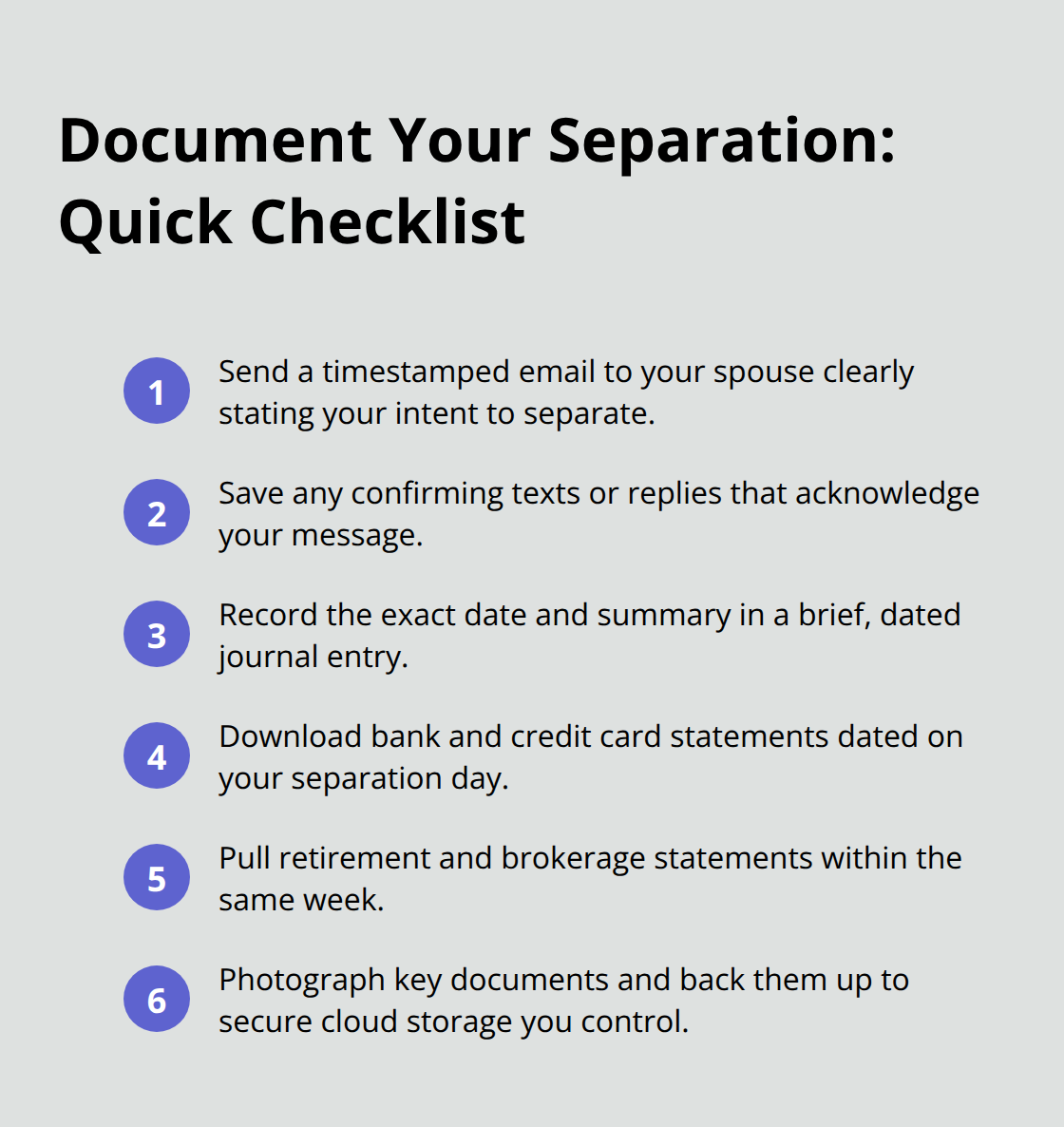
The moment you decide to separate, you need to create written proof of that decision. Courts in Florida will not accept vague recollections or your word alone about when separation occurred. Florida Statute 61.052 requires concrete evidence that one spouse communicated the intent to end the marriage to the other spouse on a specific date. Email works exceptionally well for this purpose because it creates a timestamped record that courts cannot dispute. Send your spouse a message stating clearly that you intend to separate and end the marriage. Keep it straightforward: “I am separating from you effective [date] and intend to pursue a divorce.” This single email becomes your foundational documentation.
Text messages also work if they contain the same clear intent, though emails provide stronger evidence because they’re harder to dispute regarding timing and content. Do not wait weeks to document this decision. The longer you delay, the more vulnerable your separation date becomes to challenge. Your spouse can argue that separation occurred much later than you claim, which shifts asset division and support calculations in their favor.
Understand the Financial Cost of Delay
A spouse earning $6,000 monthly adds $36,000 in marital income for every six months of delay between your actual separation intent and when you document it. That difference directly impacts alimony calculations and child support obligations. The cost of creating this documentation (a few minutes to send an email) pales in comparison to the thousands of dollars at stake when courts recalculate your financial obligations based on a disputed separation date.
Gather Financial Statements Within Days
Beyond the initial notification, gather financial documentation within days of separation. Obtain statements for all bank accounts, investment accounts, retirement plans, and credit cards showing balances as of your separation date. These statements establish baseline values that protect you when courts eventually divide assets. Many people delay this step and later discover that account values have shifted significantly, making it harder to prove what belonged to whom.
Courts accept bank statements, brokerage statements, retirement account statements, and credit card statements as evidence of financial conditions on your separation date. Keep these documents organized chronologically and store copies in a secure location separate from your home. If your spouse has access to your records, they might destroy or alter documentation. Photograph important documents and store digital copies on cloud storage that only you can access.
Document Conversations and Changes
Maintain a dated record of any conversations about separation, financial decisions made after separation, or changes in your living arrangements. You do not need to write extensively. A simple dated note stating what occurred and when is sufficient. Courts understand that people going through separation often do not maintain perfect records, but they expect you to preserve what you create or receive contemporaneously.
The separation date you establish today becomes the financial foundation for every calculation that follows in your divorce case, making this documentation investment essential to protecting your interests.
Final Thoughts
Your date of separation in Florida determines the financial outcome of your entire divorce case, affecting asset division, support obligations, and retirement account splits in ways that most people underestimate. The difference between establishing your separation date in January versus March can mean tens of thousands of dollars in calculations that courts will not reconsider once they finalize your case. Courts demand written proof, financial statements, and contemporaneous records that establish exactly when you communicated your intent to separate, rejecting vague recollections or verbal claims about when your marriage ended.
Taking action immediately after separation protects your interests far more effectively than waiting weeks or months to document what happened. Send an email to your spouse stating your intent to separate, gather financial statements showing account balances on your separation date, and create dated records of conversations and decisions made afterward. These steps cost almost nothing but prevent disputes that could cost thousands of dollars when courts recalculate your financial obligations based on a contested separation date.
We at Harnage Law PLLC handle sensitive family law cases including divorce and child custody matters, providing personalized attention to protect your rights throughout this process. Contact Harnage Law PLLC to discuss your divorce case and protect your financial interests from this moment forward.