
Divorce Mediation Melbourne FL: A Path to Amicable Resolution
Our Blog
Divorce Mediation Melbourne FL: A Path to Amicable Resolution

Divorce mediation in Melbourne FL offers a practical alternative to courtroom battles. Instead of fighting it out before a judge, you and your spouse work with a neutral mediator to reach agreements on your own terms.
We at Harnage Law PLLC see mediation resolve disputes faster and at a fraction of the cost of traditional litigation. This approach gives you control over the outcome rather than leaving decisions to the court.
How Mediation Actually Works in Melbourne FL
The Mediator’s Role in Keeping Discussions on Track
A mediator in Melbourne FL does not make decisions for you or judge who is right or wrong. Instead, the mediator acts as a neutral facilitator who keeps conversations on track and helps you and your spouse identify common ground. During mediation sessions, you sit with your spouse and the mediator, either together or in separate rooms depending on what works best for your situation. The mediator asks questions, listens to both perspectives, and suggests ways forward that satisfy both parties.
This approach works because neither of you feels pressured by a courtroom setting or forced into a judge’s decision. The American Bar Association confirms that mediation reduces time to resolution and overall costs compared to traditional litigation. The mediator will not offer legal advice, so you should consult with a family law attorney separately to understand your rights and options before and during the process.
How Sessions Unfold Over Time
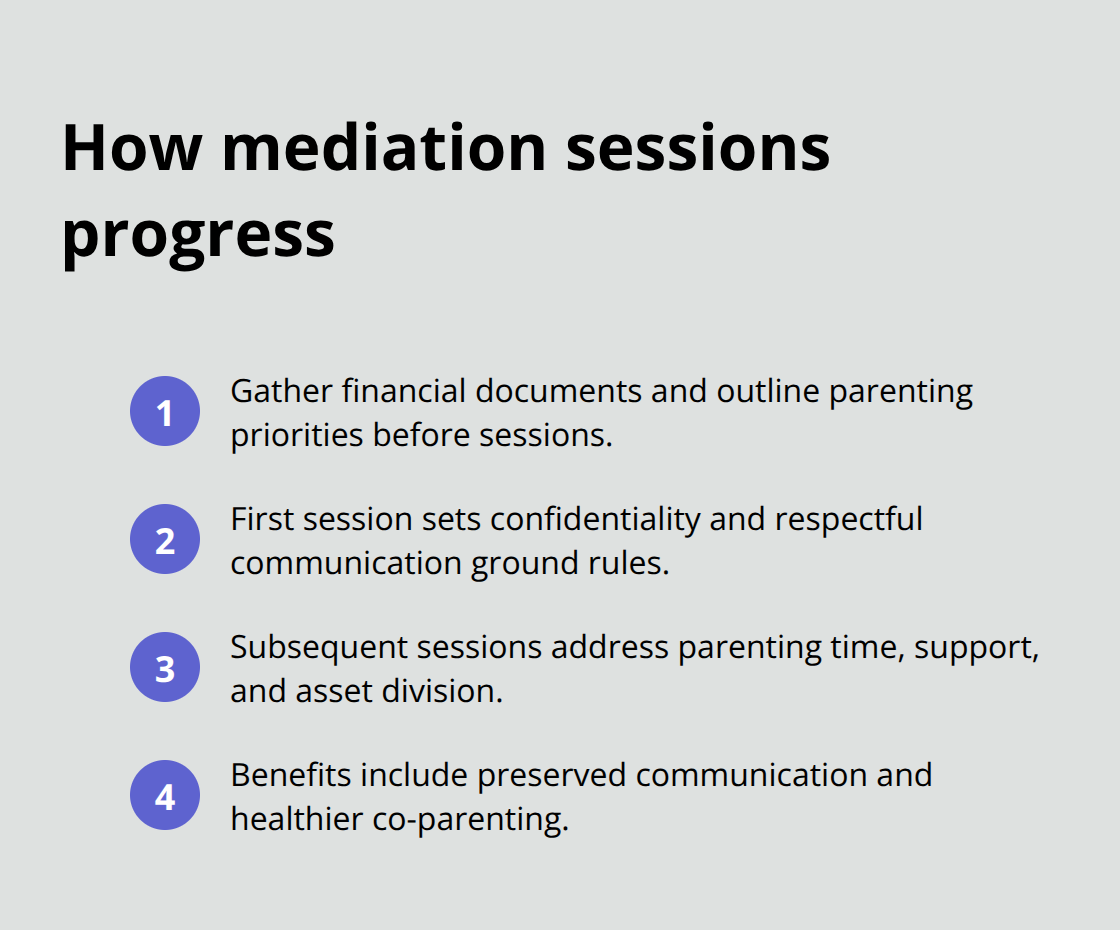
The mediation process typically unfolds over several sessions that span weeks or months. First, you must prepare financial documents like income statements, asset lists, debt records, and property details. You also draft a preliminary parenting plan if children are involved and identify which issues are negotiable and which are non-negotiable.
During the first session, the mediator explains confidentiality rules and sets ground rules for respectful communication. Subsequent sessions tackle specific topics: parenting time and custody arrangements, child support calculations, spousal support, and asset division. The Mayo Clinic and American Bar Association both note that mediation helps preserve open communication and supports healthier co-parenting relationships after divorce.
What Happens When You Reach Agreement
Unlike court litigation, where a judge makes binding rulings after hearing arguments and evidence, mediation gives you control over every agreement. You decide what happens to your home, retirement accounts, and custody schedules. If you reach full agreement, you draft a Settlement Agreement that the court incorporates into a final judgment.
If you hit a stalemate on certain issues, you can continue mediation with a different mediator, pursue litigation on unresolved matters, or revisit mediation later. The key difference is that litigation is adversarial and public, while mediation is collaborative and confidential (meaning what you discuss stays private unless a settlement is signed or required by law).
Moving Forward with Specific Issues
Now that you understand how mediation operates in Melbourne FL, the next step involves preparing for the actual topics you’ll address. Property division, child custody, and support arrangements each require specific preparation and strategy.
Why Mediation Costs Far Less Than Court
The Real Price of Litigation in Florida
Divorce litigation in Florida drains your wallet quickly. Court battles involve filing fees, discovery costs, expert witnesses, and attorney hourly rates that stack up over months or years. The American Bar Association reports that mediation reduces overall costs compared to traditional litigation, and this difference is substantial when you look at real numbers. A contested divorce can easily run $15,000 to $50,000 or more per spouse once you factor in depositions, motions, and trial preparation. Mediation typically costs a fraction of that amount because sessions are shorter, fewer professionals are involved, and you avoid the expensive machinery of court proceedings.
How Mediation Fees Compare to Court Costs
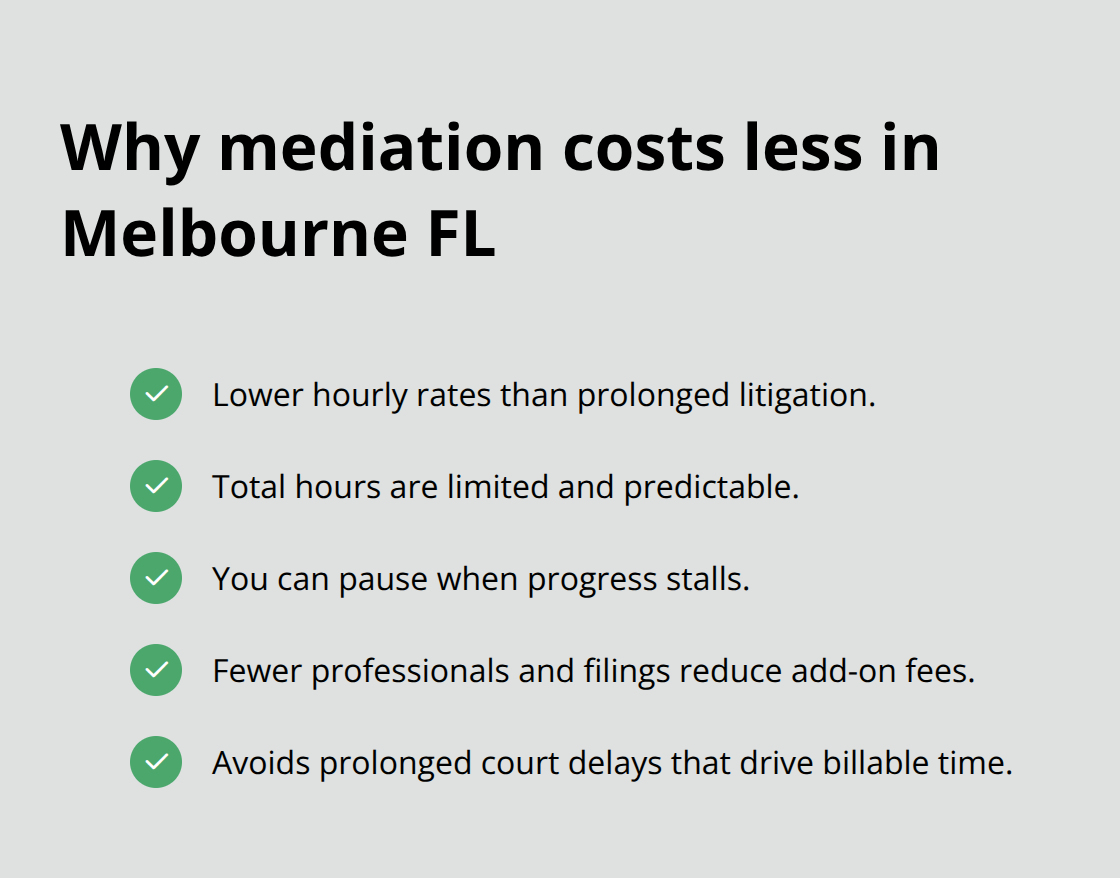
In Melbourne FL, mediators charge hourly fees or per-issue rates, often ranging from $150 to $400 per hour depending on experience and credentials. A complete mediation might take 10 to 20 hours across several sessions, putting your total cost in the $1,500 to $8,000 range. You control how many sessions you need and can pause mediation if you reach agreement on key issues, then resume later if new disputes arise. This flexibility means you stop paying when progress stalls, rather than continuing to rack up legal bills while waiting for a court date that might be months away.
Speed Saves Money in Mediation
Time is money in divorce, and mediation delivers both savings simultaneously. Court litigation stretches across six months to two years depending on court backlogs and case complexity, while mediation typically concludes in two to four months. During that extended court process, you pay attorneys to file motions, respond to discovery requests, and prepare for trial appearances. Florida’s court system handles thousands of family law cases annually, and judicial schedules are packed, meaning delays are routine. Mediation sessions fit into your calendar and the mediator’s availability, letting you move at a predictable pace.
You Control the Outcome, Not a Judge
You also retain complete authority over settlement terms instead of accepting whatever a judge decides. A judge does not know your family’s unique needs, your child’s specific routines, or your financial priorities the way you do. Mediation lets you craft agreements on parenting schedules that match your work patterns and your child’s school calendar, child support amounts based on actual household expenses, and property divisions that reflect what each of you truly values. If you reach agreement, you draft a Settlement Agreement and file it with the court, bypassing the trial process entirely. This control transforms mediation from a cost-saving tactic into a way to build divorce terms that actually work for your life rather than fitting into a judge’s predetermined framework.
With costs and timelines clarified, the next critical factor is understanding which specific issues mediation handles most effectively and how to prepare for each one.
What Mediation Actually Resolves
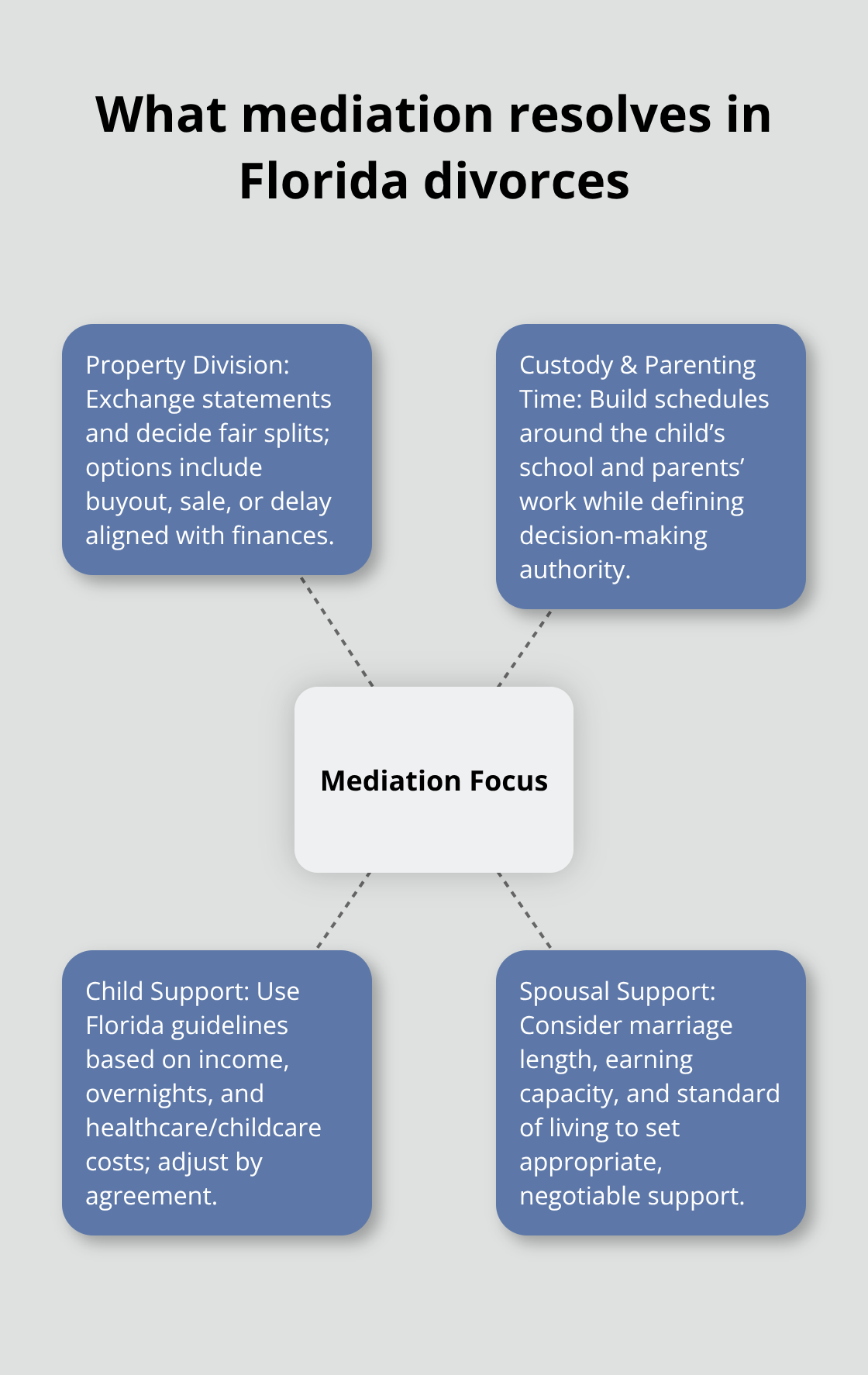
Mediation in Melbourne FL handles the three heaviest issues in any divorce: how you split assets, who spends time with the children, and who pays whom after separation. Each of these topics demands specific preparation and realistic expectations about what mediation can accomplish. The mediator does not value your home, calculate child support, or decide custody-you and your spouse do that together with the mediator’s guidance. This distinction matters because it means you need solid financial information and clear priorities before you walk into the first session.
Property Division Requires Hard Numbers
Property division is where mediation shines because it forces both of you to gather actual documentation instead of guessing. You need bank statements, mortgage documents, retirement account statements, business valuations if applicable, and debt records. Florida has no personal income tax, which simplifies certain financial settlements and tax considerations compared to other states. When you sit down with your mediator, you present these documents and discuss how to split them fairly. Some couples split everything 50-50, while others assign specific assets to each person based on who needs them most. Your home typically represents the largest asset, and you have several options: one spouse keeps it and buys out the other’s equity, you sell it and split proceeds, or you delay the sale until children finish school. The mediator helps you weigh these choices against your financial situation and post-divorce housing needs.
Real estate holdings, vacation properties, and business interests appear frequently in divorce mediation because Florida’s economy includes significant real estate and business sectors, meaning many couples own multiple properties or operate small businesses. If you own a business, you will need a professional valuation, and the mediator can help you decide whether one spouse purchases the other’s share or you sell the business and split the proceeds. Retirement accounts like 401(k)s and IRAs require careful handling because dividing them incorrectly triggers taxes and penalties; your family law attorney should review any retirement division before you finalize settlement terms.
Custody and Parenting Time Demand Honest Conversation
Child custody mediation works best when both parents genuinely prioritize the child’s stability, routines, schooling, and extracurriculars. The mediator asks detailed questions about your work schedules, your child’s school calendar, activities, and special needs, then helps you design a parenting schedule that actually works. Some couples split time 50-50, others use 60-40 or 70-30 arrangements, and some create unique schedules with weekday and weekend splits or school-year and summer variations. If language or cultural considerations exist, request a mediator with multilingual capabilities to address these nuances clearly.
The mediator also discusses decision-making authority: some parents share all major decisions about education, healthcare, and religion, while others assign one parent sole authority over certain areas. This conversation prevents future conflicts because you document exactly who decides what. If one parent has concerns about the other’s ability to provide safe care, mediation can address those concerns directly, though serious abuse or substance abuse issues may require court involvement instead. Mediation supports healthier co-parenting relationships after divorce, which benefits your child far more than a judge’s custody order. You also establish child support obligations during this phase, calculated using Florida’s guidelines based on both parents’ income, custody time, and the child’s needs.
Support Calculations Rely on Income Documentation
Spousal support and child support in Florida follow statutory guidelines, but mediation lets you negotiate amounts above or below those guidelines if both parties agree. Child support calculations start with both parents’ gross income, the number of overnights each parent has, and the child’s healthcare and childcare costs. Florida’s guidelines produce a baseline number, and you can agree to pay more if one parent earns significantly less or pay less if both parents earn similar amounts and share custody equally. Spousal support depends on the length of the marriage, each spouse’s earning capacity, the standard of living during marriage, and each spouse’s contributions to the marriage (short marriages typically produce no alimony, moderate marriages may produce time-limited support, and long marriages often produce permanent support unless circumstances change significantly).
The mediator helps you calculate these obligations accurately using income statements, tax returns, and expense records. If either spouse’s income is inconsistent or difficult to verify, the mediator may recommend hiring a financial professional to analyze the numbers. Once you agree on support amounts, those obligations appear in your Settlement Agreement and become enforceable through the court system. If either spouse’s income changes materially after divorce, you can modify support orders, but mediation-reached agreements tend to hold up better because both parties negotiated them voluntarily rather than receiving them from a judge.
Final Thoughts
Divorce mediation in Melbourne FL offers a straightforward path forward when your marriage ends. You avoid the adversarial courtroom environment, maintain control over your settlement terms, and resolve disputes in a fraction of the time and cost of litigation. The mediator facilitates honest conversations about property division, custody arrangements, and support obligations, allowing you and your spouse to build agreements that actually reflect your family’s needs rather than accepting a judge’s ruling.
You save thousands of dollars in legal fees and court costs, typically completing the process in two to four months instead of waiting six months to two years for a trial date. You preserve confidentiality throughout the process, protecting your family’s privacy and sensitive financial information from public court records. Most importantly, mediation supports healthier co-parenting relationships after divorce because you negotiate directly with your spouse instead of fighting through attorneys in an adversarial system.
Start by gathering your financial documentation: income statements, asset lists, debt records, and property details. Contact a family law attorney to understand your rights and options before entering mediation, and ask about mediators with experience in Florida family law and familiarity with local court practices. We at Harnage Law PLLC handle sensitive family law cases including divorce and child custody, and we can guide you through the mediation process or represent your interests if disputes arise-reach out to our Melbourne, Florida office to discuss your situation and explore whether mediation is the right choice for your divorce.