
Domestic relations Melbourne Florida: Understanding Your Family Law Rights
Our Blog
Domestic relations Melbourne Florida: Understanding Your Family Law Rights
Family law decisions shape your future and your children’s lives. Whether you’re facing divorce, custody disputes, or support modifications, understanding your rights under Florida law is the first step toward protecting what matters most.
At Harnage Law PLLC, we help families navigate domestic relations in Melbourne, Florida with clarity and confidence. This guide walks you through the core principles, property division rules, and custody arrangements that affect your case.
Understanding Florida Family Law and How It Affects Your Rights
The Foundation of Florida Family Law
Florida family law operates on principles that differ significantly from other states, and those differences directly affect your rights. The state treats family matters through the lens of what courts call the child’s best interests, which means judges have broad discretion to make decisions that prioritize your children’s welfare over parental preferences. Florida Statute § 744.301(1) establishes that unmarried mothers hold automatic custody at birth, while unmarried fathers must establish paternity to gain any legal rights. This distinction matters immediately if you’re unmarried. The Florida Department of Health reports that 46.1% of births in 2022 were to unmarried mothers, with Hillsborough County at 46.6%, showing how common this situation is in the state.
If you’re an unmarried father, the Good Dad Act (2023) allows you to acknowledge parental responsibility voluntarily, but this document alone doesn’t grant custody or visitation rights. You need a court order for those protections. The state distinguishes between legal custody (who makes major life decisions about education, medical care, and residence) and physical custody (where the child primarily lives), and courts can award these separately. One parent might make decisions while the other provides primary care, creating complexity that requires careful navigation.
How Brevard County Courts Structure Family Disputes
The Brevard County Circuit Court Family Division handles all domestic relations matters, including divorce, custody modifications, child support enforcement, and protective injunctions. The court recognizes that relocation presents a significant issue in family law, requiring court approval if either parent wants to move more than 50 miles away once custody rights are established. Court-ordered parenting plans form the foundation of all custody arrangements in Florida, outlining time-sharing schedules and decision-making authority.
Child support calculations follow Florida’s guidelines, which consider both parents’ income and the child’s needs. The court can modify these orders when circumstances change substantially. The Department of Revenue manages approximately 30,000 child support cases across Florida, demonstrating the scale of enforcement the state handles. If a parent violates a court order by denying access or wrongfully relocating, the courts treat this as contempt, which carries serious consequences.
What Alternatives to Trial Exist in Brevard County
The Brevard County courts offer alternatives to litigation through mediation and arbitration, which many families find less adversarial and more cost-effective than full trials. These processes allow you to resolve disputes outside the courtroom while still maintaining court oversight of final agreements. Understanding that these courts prioritize children’s stability and ongoing relationships with both parents helps you approach negotiations realistically. The next section examines how Florida courts divide property and protect your financial interests during divorce proceedings.
How Florida Courts Divide Property in Divorce
Equitable Distribution: What It Means for Your Assets
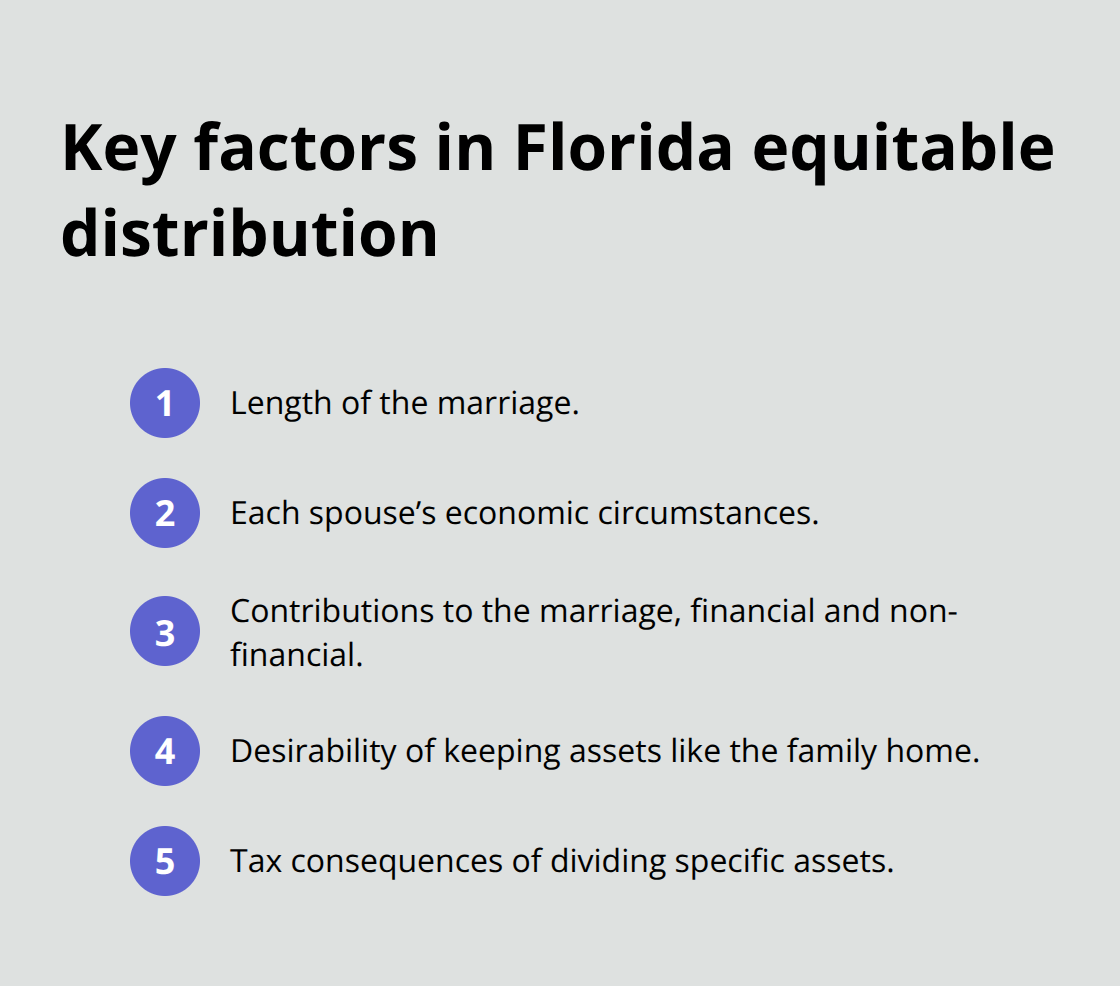
Florida courts divide marital property using equitable distribution, which does not mean equal but rather fair based on each spouse’s contributions and circumstances. The state considers property acquired during the marriage as marital assets subject to division, while property owned before marriage or received as a gift or inheritance remains separate property. Courts examine factors including the length of the marriage, each spouse’s economic circumstances, contributions to the marriage (both financial and non-financial), the desirability of retaining assets like the family home, and tax consequences of dividing specific assets.
A spouse who left the workforce to raise children or support the other’s career has a stronger claim to a larger share of marital assets because Florida recognizes those contributions as economically valuable. The court also considers whether one spouse deliberately wasted or hid marital assets, which can shift the division in the other spouse’s favor.
How Courts Evaluate Your Specific Circumstances
Understanding these factors matters because they directly affect how much you retain after divorce. Many divorces settle before trial, and knowing how a judge would likely divide your assets gives you realistic negotiating power. Courts prioritize fairness over strict equality, meaning your individual situation-not a standard formula-determines the outcome. If you contributed significantly to your spouse’s education or career advancement, the court may award you a larger portion of the marital estate. Similarly, if you sacrificed your own earning potential for family responsibilities, Florida law recognizes that sacrifice as a valuable contribution worthy of compensation through asset division.
Protecting Your Financial Information During Separation
The practical reality of asset division requires documentation from the moment you separate. Collect bank statements, investment accounts, retirement statements, property deeds, and mortgage documents dating back to your marriage start date. If you suspect your spouse is hiding assets, request discovery through your attorney, which compels disclosure of financial information. Courts can sanction spouses who fail to disclose assets honestly. Retirement accounts like 401(k)s and pensions require special attention because they need a Qualified Domestic Relations Order to divide them properly without triggering early withdrawal penalties.
Real Estate and the Family Home Decision
Real estate division often presents the biggest challenge; you must decide whether one spouse keeps the home and buys out the other’s share or whether you sell and split proceeds. Keeping the family home means you must qualify for refinancing alone and cover ongoing mortgage, taxes, insurance, and maintenance costs. Consider your long-term financial stability before choosing to retain the property. Property division finalizes in your divorce decree, and modifying it afterward is extremely difficult, so getting it right from the start is essential.
Moving Forward With Child Support and Custody Considerations
Once you understand how Florida divides property, you must address how child support calculations interact with asset division. The court considers both parents’ income and the child’s needs when determining support obligations, and these figures can influence overall settlement negotiations. Your property division agreement and child support order work together to create your complete financial picture after divorce, making it important to view them as interconnected rather than separate issues.
Custody and Child Support in Florida
How Florida Courts Award Custody Arrangements
Florida courts award custody arrangements based entirely on what benefits the child, not what parents prefer. The state recognizes two primary forms: legal custody, which grants decision-making authority over education, medical care, and major life choices, and physical custody, which determines where the child primarily resides. Most Florida courts now favor shared parental responsibility, meaning both parents make decisions jointly unless abuse, substance abuse, or domestic violence history makes this arrangement unsafe. Courts evaluate stability of each parent’s home, the strength of parent-child relationships, parental mental and physical health, and willingness to encourage the child’s contact with the other parent.
Time-Sharing Schedules and Parenting Plans
Time-sharing schedules flow from parenting plans that specify exactly how many days and nights each parent spends with the child. A common arrangement involves one parent having primary physical custody with the other receiving overnight visitation, though many families negotiate 50-50 splits. The Brevard County Circuit Court Family Division enforces these arrangements strictly; violating a court-ordered parenting plan constitutes contempt of court with real legal consequences.
How Florida Calculates Child Support Obligations
Child support calculations follow Florida’s statutory guidelines, which factor both parents’ gross monthly income and the number of overnights each parent spends with the child. The state assumes that each parent should contribute proportionally to their income toward the child’s living expenses, education costs, healthcare, and childcare. Florida’s Department of Revenue manages roughly 30,000 child support cases statewide, giving you insight into how systematically the state pursues enforcement. If you earn $5,000 monthly and your ex earns $3,000, you’ll likely pay a higher percentage of support obligations.
Deviations From Guidelines and Modification Petitions
Courts can deviate from guidelines if the calculation produces an unjust result given your specific circumstances, such as significant medical expenses, private school costs, or substantial assets. Modifications become available when circumstances change substantially-job loss, remarriage creating new dependents, or significant income increases all trigger grounds for adjustment. You cannot simply stop paying because you disagree with the amount; you must file a modification petition with the court. If you fall behind, enforcement becomes aggressive, including wage garnishment, license suspension, and potential jail time for willful non-payment.
Connecting Property Division to Support Obligations
The interaction between your property division settlement and child support calculations matters significantly; courts consider both together when determining your complete financial obligation post-divorce. Your property division agreement and child support order work together to create your complete financial picture after divorce, making it important to view them as interconnected rather than separate issues.
Final Thoughts
Florida family law shapes decisions that affect your family’s stability, finances, and relationships for years to come. The principles outlined in this guide-from equitable property distribution to child support calculations to custody arrangements based on your child’s best interests-form the foundation of how courts handle domestic relations in Melbourne, Florida. Understanding these rules gives you realistic expectations about outcomes and stronger negotiating power if your case settles before trial.
The most important takeaway is that Florida courts prioritize your child’s welfare above all else, which means custody and support decisions center on what arrangement serves your child best, not what feels fair to you as a parent. Property division follows equitable distribution principles that recognize both financial and non-financial contributions to your marriage, potentially shifting assets significantly based on your individual circumstances. Modifications to custody and support orders remain available when substantial changes occur in your life, giving you flexibility as situations evolve.
Knowing these rules matters, but applying them to your specific situation requires careful analysis of your assets, income, parenting arrangements, and long-term goals. We at Harnage Law PLLC provide legal representation for families facing divorce, custody disputes, and support modifications throughout Melbourne and Brevard County, and we encourage you to contact us today to discuss your family law matter.