
Family Law Blog Tips You Can Implement Today
Our Blog
Family Law Blog Tips You Can Implement Today

Family law disputes create stress that clouds your judgment. When you’re managing custody arrangements, financial records, and legal obligations, small mistakes can cost you thousands.
We at Harnage Law PLLC have seen how organization and clear communication protect families during their most difficult moments. The family law blog tips in this post are practical strategies you can start using today to strengthen your position and reduce conflict.
How to Organize Your Family Law Documents
Building a solid paper trail transforms chaos into clarity during family law disputes. Financial records, text messages, emails, and handwritten notes scattered across devices and drawers create confusion when you need evidence most. A structured system prevents critical information from disappearing and gives you immediate access to facts that support your position.
Create Separate Folders for Each Category
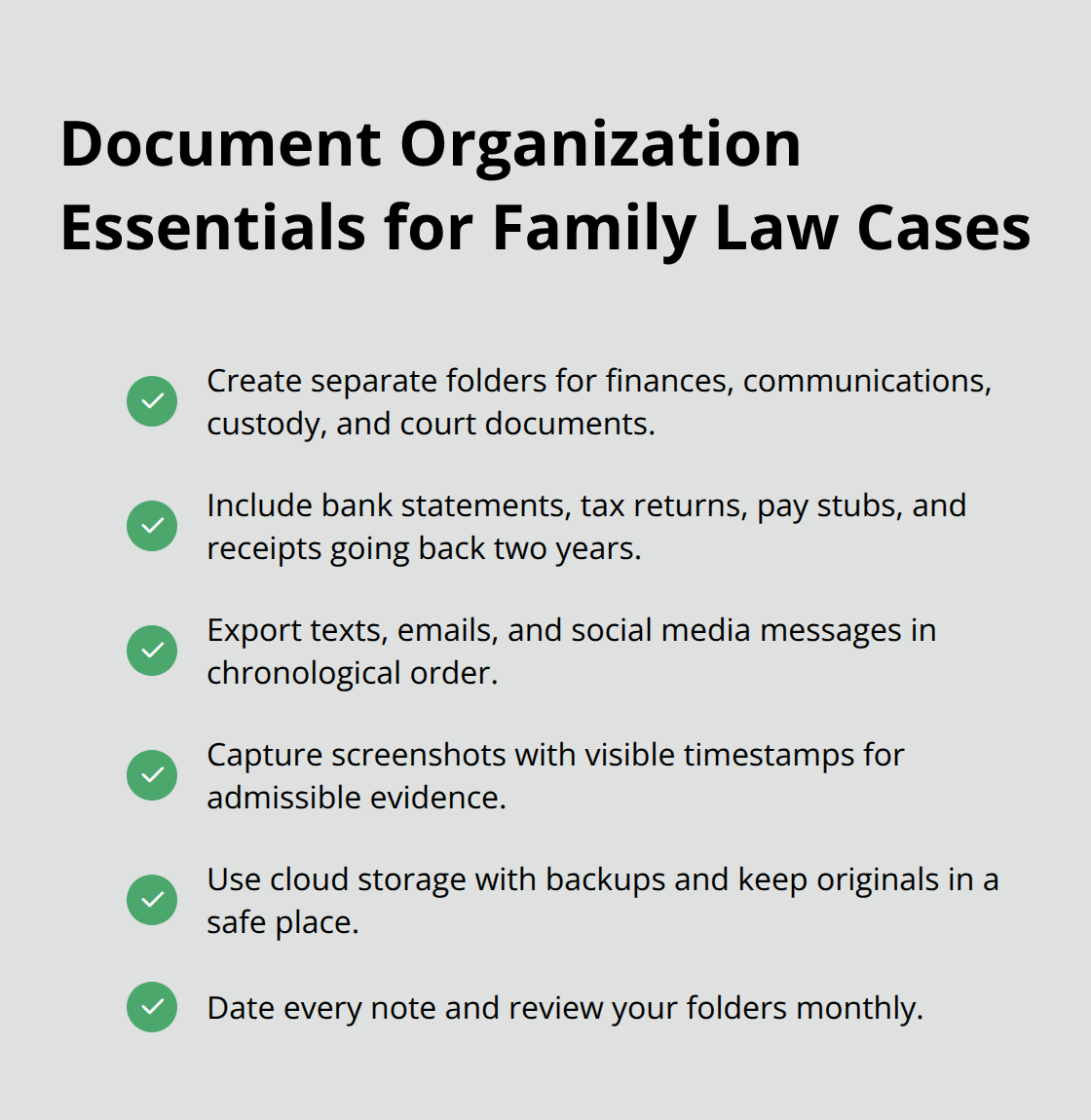
Start by creating separate digital folders for each category: financial records, communications, custody agreements, and court documents. Within your financial folder, include bank statements, tax returns, pay stubs, and expense receipts dated at least two years back. For communications, export and organize text messages, emails, and social media exchanges chronologically. Most phones allow you to take screenshots with timestamps, which courts recognize as valid evidence.
Handwritten notes matter too. When conversations happen in person or over the phone, document the date, time, participants, and what was discussed immediately afterward. Courts value contemporaneous notes because they show you recorded information as events unfolded, not months later when memory fades.
Use Cloud Storage for Protection and Access
Cloud storage services like Google Drive or Dropbox protect your documents from loss and let you access files from any device. Create a backup system so you never lose critical evidence. Physical documents should go into labeled folders organized by year and category. When you receive court orders, agreements, or legal notices, photograph them immediately and upload copies to your cloud storage before placing originals in a safe deposit box.
Communication records require special attention. Save all text messages, emails, and instant messages related to custody, support, or shared expenses. Most family law cases involve disputes about what was said and when. Written records eliminate the he-said-she-said problem entirely. If your co-parent sends a text about missed support payments or changes to pickup times, that message becomes evidence. Courts in Florida examine these records regularly because they provide objective facts without interpretation.
Date Everything and Maintain Your System
Date everything you create or receive. When you write notes about a conversation or interaction, include the full date, time of day, and who was present. This consistency makes your records powerful in court. Keep your organizational system simple enough that you can maintain it without frustration (a system you abandon after two months helps no one). Check your folders monthly to ensure new documents get filed correctly.
If you share custody or support responsibilities, your documentation becomes the foundation for any legal action. Your effort now saves time and money later. Once your records are organized, the next step involves how you communicate with your co-parent and when to bring legal counsel into those conversations.
How to Talk Without Making Things Worse
Written Communication Creates a Paper Trail
Clear communication during family disputes sounds simple until emotions spike. The moment tension rises, most people either shut down completely or say things they regret. Research from the American Psychological Association shows that high-conflict co-parenting situations involve frequent miscommunications, with approximately 60% of disputes escalating because of how information was delivered rather than what was actually discussed.

This matters because every conversation with your co-parent becomes potential evidence in court. Text messages, emails, and documented exchanges get introduced as exhibits. Your tone, word choice, and timing all send messages beyond the literal content. Written communication creates an automatic filter-when you type instead of speak, you pause and reread before sending anything inflammatory.
Courts in Florida examine communication patterns regularly because they reveal who prioritizes the children’s stability and who prioritizes winning arguments. If your messages show respect and focus on logistics, judges notice. If they show contempt or attempts to manipulate, judges notice that too.
Start With Text and Email for Everything
Use text or email for anything related to custody, support, or shared expenses. Save phone calls for genuine emergencies only. When you must talk directly, keep conversations short and focused on one topic. Document what was discussed immediately afterward in writing, then send a follow-up message summarizing the agreement or next steps. This prevents later disputes about what was actually said.
Your written record becomes the foundation of your case. Courts recognize that people communicate differently when they know their words will be preserved. This shift in behavior often leads to more respectful exchanges and fewer misunderstandings.
Third-Party Communication Platforms Reduce Conflict
Some conversations require a buffer between you and your co-parent. When tensions run high or past interactions have turned hostile, direct communication fails. Third-party communication apps like OurFamilyWizard or Talking Parents specifically address this problem. These platforms timestamp everything, prevent hostile language through built-in filters, and create organized records that courts recognize as legitimate evidence. The cost runs approximately 10 to 20 dollars monthly, and the investment pays off immediately by reducing conflict and creating an objective record.
Know When Legal Counsel Must Step In
Knowing when to involve legal counsel separates families who resolve disputes from families who destroy themselves in court. If your co-parent ignores agreements, threatens custody changes, or makes accusations affecting your ability to spend time with your children, contact an attorney before responding. Do not engage directly. Do not try to resolve it yourself through angry messages. Your attorney drafts responses that protect your position without escalating conflict.
Many people think involving a lawyer means the situation has become adversarial, but the opposite is true. Strategic legal involvement early prevents situations from becoming adversarial later. When your co-parent sends threatening messages about taking the children or refusing support, that requires immediate legal review, not an emotional response from you. Understanding what your rights actually are under Florida law determines whether you respond appropriately to these threats.
What Florida Family Law Actually Requires
How Florida Courts Prioritize Your Child’s Interests
Florida family law operates under specific statutes that govern custody, support, and property division, and understanding these requirements protects you from costly mistakes. The state follows Florida Statutes Chapter 61, which establishes that custody decisions prioritize the best interests of the child above all other considerations. Courts evaluate factors including each parent’s involvement in the child’s life, the child’s relationship with each parent, the ability to provide stable housing and education, and any history of domestic violence or substance abuse. Florida courts do not automatically favor mothers or fathers-they assess who can better meet the child’s physical, emotional, and educational needs.
Your documentation from earlier chapters becomes critical evidence in these evaluations. If you have been the primary caregiver, handled school communications, attended medical appointments, and maintained consistent involvement, your records prove this reality. Judges in Florida examine bank statements showing you paid for educational expenses, text message exchanges about homework and activities, and photographs documenting your time together. One parent might claim equal involvement, but your organized records reveal the actual time allocation and financial commitment.
Understanding Child Support Calculations
Child support in Florida follows the Florida Child Support Guidelines, which calculate obligations based on both parents’ gross monthly income and the number of overnight visits each parent has annually. The state uses a formula that considers income up to approximately $235,000 per year, with support obligations varying significantly based on custody arrangement. A parent with 90 overnight visits annually pays substantially more than a parent with 182 visits, even with identical income. This formula-based approach removes subjective judgment and creates predictable outcomes based on concrete financial and custody data.
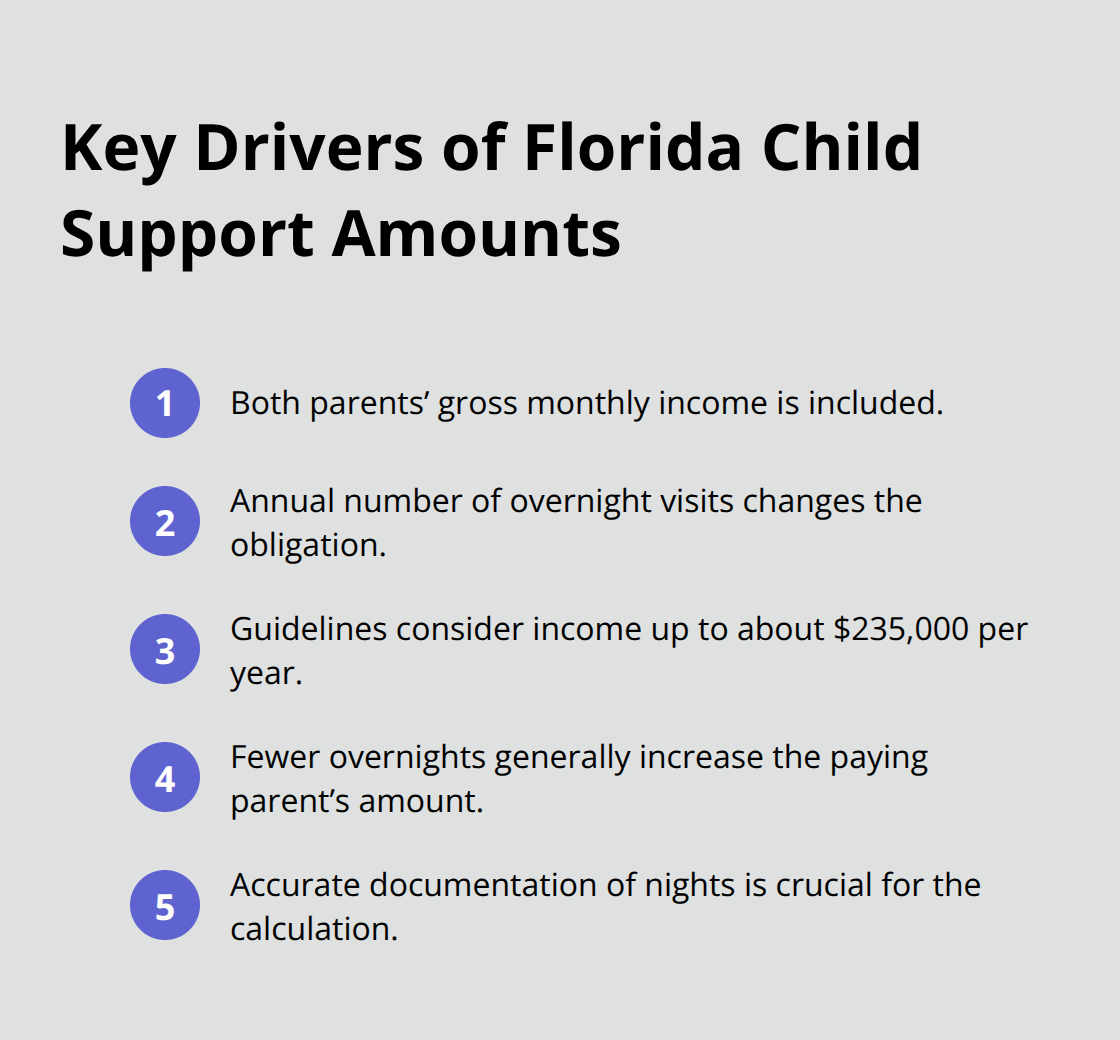
The overnight visit calculation matters enormously because it directly affects your monthly obligation or income. Courts count each night your child sleeps in your home, and this number determines where you fall within the support guidelines. Small differences in custody arrangements produce large differences in support amounts, so accurate documentation of actual time spent matters significantly.
How Property Division Works in Florida
Property division in Florida follows equitable distribution principles, meaning marital assets divide fairly but not necessarily equally-the court considers factors including the length of marriage, each spouse’s financial contributions, and each spouse’s earning capacity. Marital property includes anything acquired during the marriage with marital funds, while separate property (owned before marriage or received as inheritance) typically remains with the original owner. The distinction matters enormously because a house purchased during the marriage with joint income becomes marital property subject to division, while a house inherited from a parent remains separate property.
Understanding these specific rules prevents you from accepting unfavorable agreements based on misconceptions about Florida law. Many people assume that all assets acquired during marriage split equally, but Florida courts apply more nuanced analysis. A business started before marriage but grown substantially during the marriage may have both separate and marital components. Retirement accounts accumulated over decades of marriage face different treatment than inheritances received during the final year. These distinctions determine whether you maintain financial security or face years of recovery.
How Court Decisions Shape Your Family’s Future
Court decisions directly affect your family’s financial stability and your relationship with your children for years ahead. A custody arrangement established now influences school selection, healthcare decisions, and holiday schedules for the next decade. A support order affects your monthly budget and your children’s standard of living. Property division determines whether you maintain financial security or face years of recovery. These are not theoretical concerns-they shape your daily reality and your children’s opportunities.
When you understand how Florida law actually works, you recognize why your organized records and clear communication matter so much. The evidence you collected and the communication patterns you established provide the foundation that judges use to make these life-altering decisions.
Final Thoughts
The family law blog tips throughout this post address the real problems families face during disputes. Organization prevents evidence from disappearing when you need it most. Clear communication reduces conflict and creates records that protect your interests. Understanding Florida law prevents costly mistakes based on misconceptions about custody, support, and property division.
Implementing these strategies requires effort, but the payoff is substantial. Families who organize their documents, communicate in writing, and understand their legal obligations navigate disputes with significantly less stress and expense. Your organized records become the foundation that supports your position in court, your communication patterns demonstrate whether you prioritize your children’s stability, and your knowledge of Florida law prevents you from accepting unfavorable agreements.
The next step involves working with a family law attorney who understands your specific situation. Family law disputes involve complex statutes, procedural rules, and strategic decisions that determine outcomes affecting your family for years. We at Harnage Law PLLC handle sensitive family law cases including divorce and child custody throughout Florida, and our attorneys provide personalized attention to achieve the best possible outcomes for your family-contact us to discuss your situation and learn how we can help you protect your interests.