
Spousal Support Melbourne Florida: Negotiation Tactics That Get Results
Our Blog
Spousal Support Melbourne Florida: Negotiation Tactics That Get Results

Spousal support negotiations in Melbourne Florida require strategy, not just hope. The difference between a fair agreement and an unfavorable one often comes down to preparation and how you present your case.
At Harnage Law PLLC, we’ve seen countless clients strengthen their position by understanding the rules and approaching discussions with clear documentation. This guide walks you through the tactics that actually work.
How Florida Courts Calculate Spousal Support in Melbourne Florida
The Framework Behind Support Calculations
Florida courts apply a structured formula to calculate spousal support rather than relying on subjective judgment. Since July 2023, when Senate Bill 1416 took effect, judges follow a defined framework that ties support amounts directly to income differences and marriage length. The law eliminated permanent alimony and created four distinct types, each with specific rules and caps. Courts now treat the income difference between spouses as the primary driver of the calculation. According to the guidelines, alimony typically ranges from 25 to 35 percent of that income difference. For example, if one spouse earns $60,000 annually and the other earns $20,000, the $40,000 gap would suggest an alimony range of roughly $10,000 to $14,000 per year, or about $833 to $1,167 monthly.
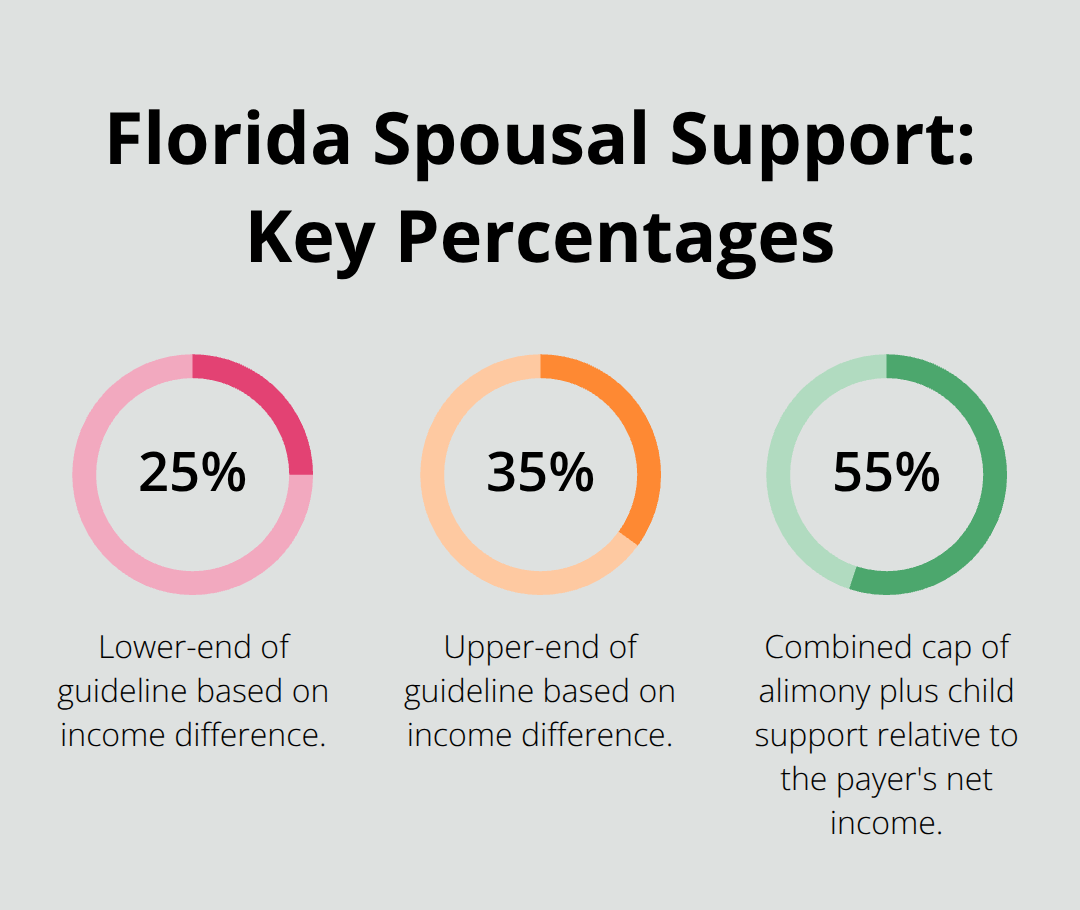
This calculation method isn’t arbitrary. Florida law uses what the statute calls “potential income” rather than actual income when a spouse is underemployed or intentionally earning less. The law also imposes a combined cap: total alimony and child support cannot exceed 55 percent of the paying spouse’s net income. This ceiling prevents one obligation from consuming the other and protects the obligor’s ability to meet basic living expenses.
What Courts Actually Examine
Courts examine the full financial picture when determining support amounts. Non-marital assets, retirement accounts, investments, debts, and earning capacity all factor into the decision. Age and health status carry real weight-a spouse with health limitations that prevent work may receive longer or higher support. Non-financial contributions like homemaking and child-rearing receive genuine consideration, not treatment as secondary factors. Education level and vocational skills directly influence how courts assess earning potential, which shapes the final award. The standard of living established during the marriage also carries significant weight in alimony decisions.
Bridge-the-Gap Alimony
Bridge-the-gap alimony covers immediate transitional needs for up to two years and becomes non-modifiable once awarded. This type works well for short-term income bridges during the adjustment period after separation. The non-modifiable nature makes it attractive in negotiations because both parties know exactly when the obligation ends.
Rehabilitative Alimony
Rehabilitative alimony funds education or job training with a strict five-year cap. The recipient must present a concrete, time-bound plan showing how they will achieve financial independence. Vague proposals fail court scrutiny, so this type requires detailed documentation of educational goals, timelines, and costs.
Durational Alimony
Durational alimony provides support for a fixed period tied to marriage length. Marriages fall into three categories: short (under 7 years), moderate (7 to 17 years), or long (17 or more years). For long marriages, durational alimony can extend up to 75 percent of the marriage length, aligning support duration with the years of commitment. This type requires careful financial modeling because the payment period extends further into the future than bridge-the-gap or rehabilitative options.
Temporary Alimony
Temporary alimony provides support during the divorce process and automatically ends when the final decree is issued. This type requires no further action once the divorce concludes. Understanding which type applies to your situation shapes negotiation strategy. Bridge-the-gap and rehabilitative alimony offer clear exit ramps and lower overall payouts, making them favorable starting points in settlement discussions. The type of support you negotiate directly affects how you prepare your financial documentation and present your case to the other party.
Building Your Financial Case for Negotiations
Gather Complete Financial Documentation
The foundation of any successful spousal support negotiation rests on documentation that proves your financial reality. Courts in Melbourne Florida require concrete evidence, not estimates or assumptions. Collect three years of tax returns, two months of recent pay stubs, and complete bank statements covering the last 90 days. Request employment verification letters from your employer stating your current salary, benefits, and job stability.
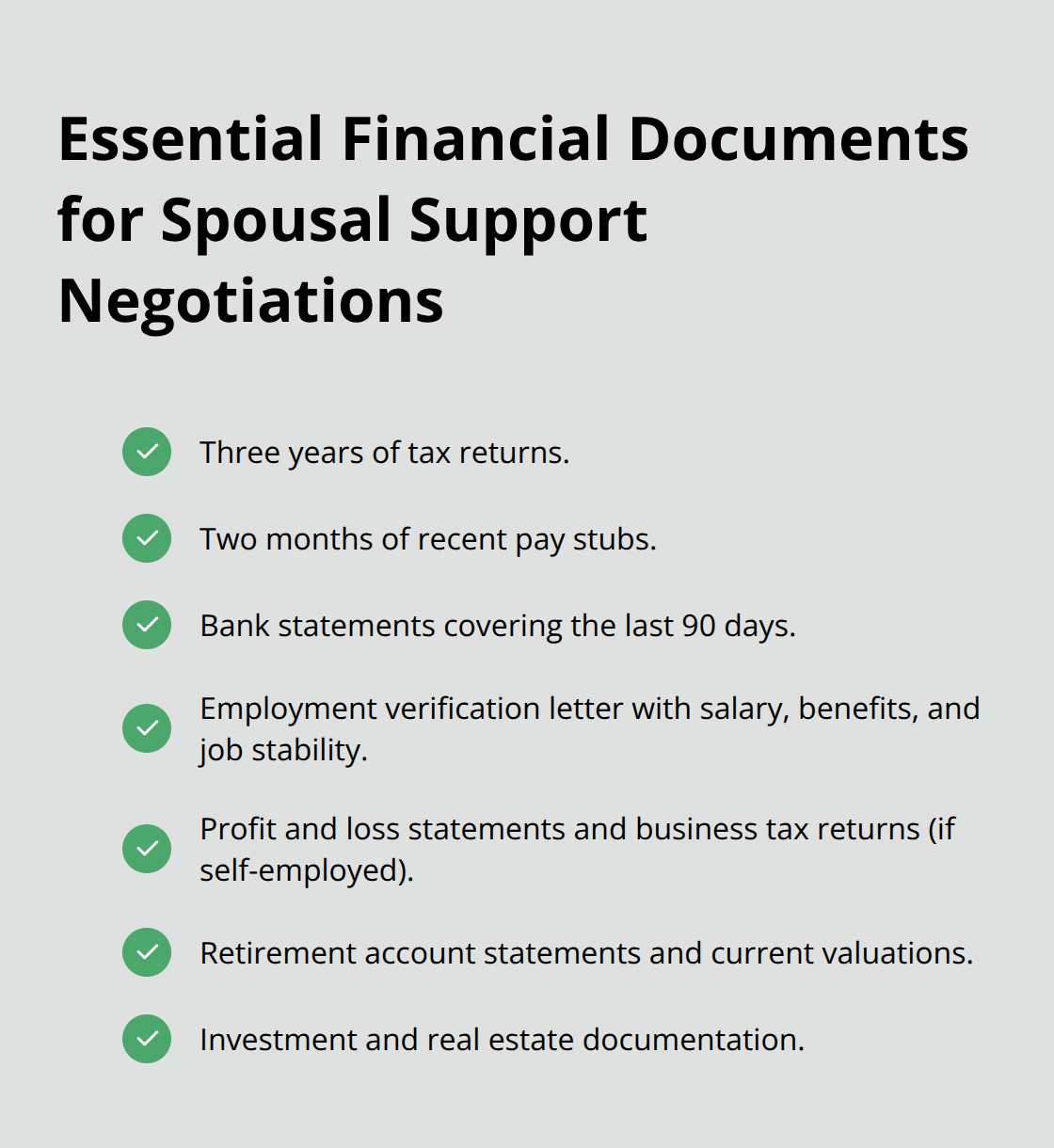
Self-employed individuals must compile profit and loss statements, business tax returns, and quarterly income reports. Pull statements from every retirement account-401(k)s, IRAs, pensions-along with current valuations. Document all investment accounts, real estate holdings, and any other assets that generate income or represent marital wealth. The American Academy of Matrimonial Lawyers reports that subpoenas to banks, employers, and business partners uncover financial misconduct in roughly 34 percent of high-asset cases, which means hidden or incomplete disclosures become obvious during discovery.
Organize Your Records for Maximum Impact
Establish a dedicated folder organized by category: income, assets, debts, and monthly expenses. This organization matters because mediators and judges expect clear, accessible documentation. When you present information in logical order, you signal competence and build credibility with the other party and any neutral third parties involved in your case. A divorce lawyer in Melbourne Florida can help you structure this documentation to strengthen your position.
Track Your Actual Monthly Expenses
Your actual monthly living expenses matter far more than what you think you need. Create a realistic budget by tracking every expense for 60 days-housing, utilities, groceries, insurance, healthcare, transportation, childcare, and personal care items. Many people underestimate costs by 20 to 40 percent when they estimate from memory. Use bank and credit card statements to verify real spending patterns.
The National Association of Realtors found that 68 percent of couples cannot afford to maintain mortgage payments alone, a statistic that directly supports arguments for adequate spousal support in negotiations. If you have children, include documented childcare costs, school expenses, and extracurricular activities. Healthcare costs typically add 20 to 40 percent to base expenses when you account for insurance premiums, copays, and medications.
Apply the 35 Percent Rule to Your Numbers
Once you have accurate numbers, use the 35 percent rule as a practical benchmark for initial proposals-alimony typically ranges 25 to 35 percent of the income difference between spouses. If the income gap is $40,000 annually, you’re looking at roughly $10,000 to $14,000 per year in support, or $833 to $1,167 monthly. This framework gives you concrete negotiating positions rather than vague demands.
Mediation before trial yields about a 60 percent resolution rate according to Florida mediation data, and settlements become far more likely when parties present detailed financial proposals backed by actual numbers. An alimony lawyer experienced in Melbourne Florida cases can help you refine these numbers and present them effectively during negotiations.
How to Set Your Bottom Line and Negotiate with Strength
Establish Your Non-Negotiable Floor
Knowing your financial bottom line before entering negotiations separates people who walk away satisfied from those who accept unfavorable terms out of desperation or fatigue. Your bottom line is the absolute minimum monthly support amount you will accept, calculated directly from your documented expenses and the 35 percent income-difference rule you established in your financial preparation. If your monthly expenses total $3,200 and the income gap suggests $1,100 monthly support, your bottom line sits at $3,200 because anything less forces you to deplete savings or take on debt. Write this number down and do not negotiate below it during discussions, regardless of pressure or emotional appeals from the other party. The reason this matters is straightforward: settlements you regret create post-divorce conflict, modification requests, and additional legal costs that erase any short-term savings from accepting inadequate terms.
Prepare Three Settlement Positions
Before mediation starts, prepare three settlement positions rather than just one. Your ideal position reflects what the law and your numbers suggest you should receive. Your acceptable position sits slightly below ideal but still covers your actual needs with a modest cushion. Your walk-away minimum is your documented bottom line-the point where you stop negotiating and prepare for court.
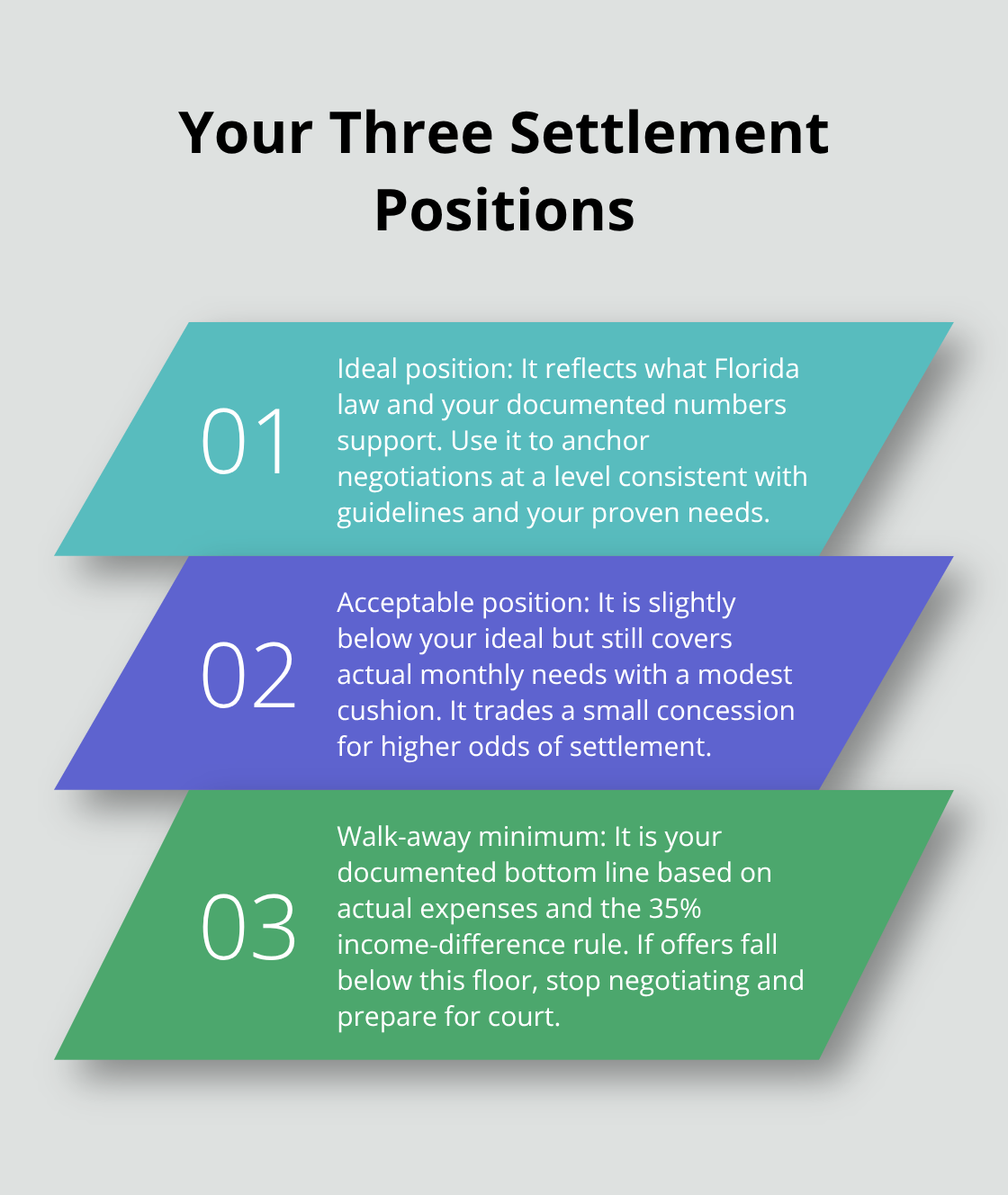
This three-position framework prevents you from making emotional decisions in real time. When a mediator or the other party’s attorney presents a figure, you already know whether it falls into acceptable range or requires rejection. Mediation data from Florida shows that about 60 percent of cases settle when parties present detailed financial proposals, but settlements fail when one side abandons their documentation and negotiates from emotion.
Present Your Financial Situation with Precision
During mediation, present your financial situation with clinical precision. Show the mediator your three months of bank statements, your 60-day expense tracking, and your income verification letters. Avoid language that sounds desperate or angry. Instead, state: I have documented expenses of $3,200 monthly, and my income is $2,100, creating a monthly shortfall of $1,100. Based on Florida’s guidelines, spousal support of $1,100 to $1,400 monthly aligns with the income difference and allows me to maintain the standard of living from our marriage. This approach removes emotion and anchors the discussion in verifiable facts. The other party’s attorney may propose multiple payment structures-monthly payments, lump-sum settlements, or hybrid arrangements combining both. Propose at least two payment options yourself to unlock agreements when rigid terms stall negotiations. Monthly payments spread risk and ensure ongoing income, but a lump-sum settlement of $36,000 to cover three years of bridge-the-gap alimony may appeal to the paying spouse if they want finality. Hybrid structures (such as $800 monthly for 24 months plus a $5,000 lump sum) can bridge gaps between positions and create movement toward settlement.
Leverage Court Standards in Your Favor
Florida courts require written findings when judges deviate from alimony guidelines, which means your documented case becomes harder for any judge to dismiss. This reality strengthens your negotiating position because the other party knows that if mediation fails and the case goes to trial, their position must withstand judicial scrutiny backed by written explanation. Settlement negotiations rarely end in a single conversation. Expect multiple discussions before resolution, and do not interpret slow progress as failure. Each discussion clarifies positions and narrows disagreement.
Maintain Transparency and Adapt to Changes
Between meetings, organize any new financial information your attorney requests and provide it promptly. Late information is typically harder to address and weakens your credibility with neutral parties. If your situation changes-a new job, income reduction, or relocation-inform your attorney immediately. Courts consider substantial changes in circumstances when modifying durational alimony, so transparency early in negotiations prevents disputes later about whether you misrepresented your financial situation (and protects your credibility throughout the process).
Final Thoughts
Spousal support negotiations in Melbourne Florida succeed when you combine solid documentation with realistic expectations grounded in Florida law. The tactics covered throughout this guide work because they replace guesswork with verifiable facts, and your financial records, expense tracking, and understanding of the 35 percent income-difference rule give you concrete positions to defend during mediation. Courts reward this preparation by applying their structured guidelines consistently, which means the other party cannot easily dismiss or undervalue your documented case.
The three-position framework prevents emotional decisions that lead to regrettable settlements. Your ideal position reflects what the law suggests you should receive, your acceptable position covers your actual needs with a modest cushion, and your walk-away minimum protects you from accepting terms that force future financial hardship (this clarity matters because settlement negotiations rarely conclude in a single conversation). Multiple discussions are normal, and slow progress does not signal failure-each discussion narrows disagreement and moves both parties closer to resolution.
Transparency throughout the process strengthens your credibility with mediators and judges, and when circumstances change, you should inform your attorney immediately rather than hoping the other party won’t notice. We at Harnage Law PLLC provide experienced legal representation for sensitive family law cases including divorce and spousal support matters, and our attorneys offer personalized attention and strategic counsel to help you achieve sustainable agreements that reflect your actual financial needs and Florida’s legal framework.