
Spousal Support Melbourne: Understanding Your Divorce
Our Blog
Spousal Support Melbourne: Understanding Your Divorce

Divorce brings financial questions that affect your future. Spousal support in Melbourne can be one of the most confusing parts of the process, with myths and misunderstandings clouding the facts.
We at Harnage Law PLLC help people navigate these decisions with clarity. This guide breaks down how spousal support actually works in Florida, what courts consider, and how to protect your financial interests.
What Types of Spousal Support Can Florida Courts Award?
Florida law recognizes four distinct forms of spousal support, each designed for different circumstances and timeframes. Temporary alimony, also called pendente lite, maintains financial stability while your divorce is pending and ends when the final judgment is issued. Bridge-the-gap alimony covers short-term needs like housing deposits or moving costs for up to two years and cannot be modified once ordered. Rehabilitative alimony supports you through education or job training to become self-sufficient, typically lasting no more than five years, and requires a concrete plan with specific steps and timelines. Durational alimony provides support for a set period after divorce, scaled to how long your marriage lasted, and cannot extend beyond the marriage length itself.
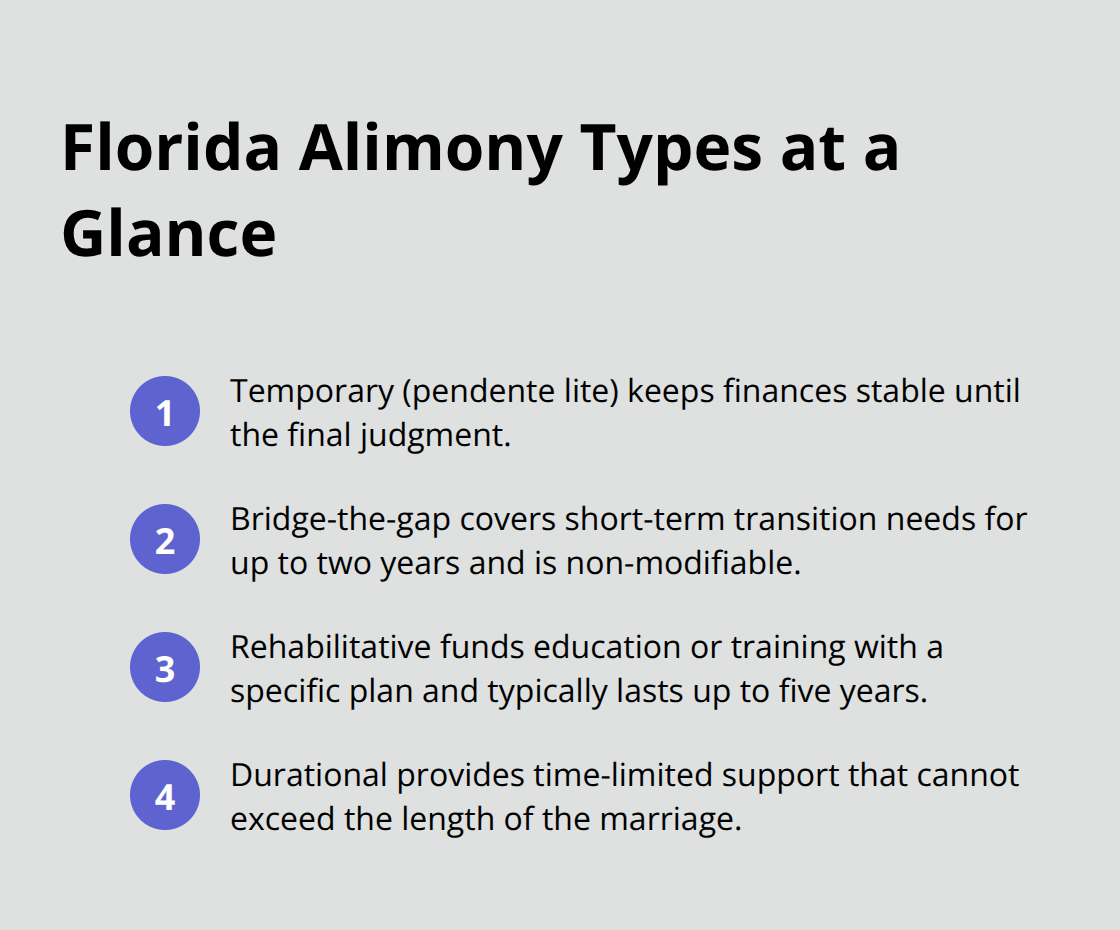
Under Florida’s 2023 reform law SB 1416, permanent alimony was eliminated for new cases, shifting focus toward time-limited support that reflects the length of your marriage and your actual need to become independent.
How Courts Calculate Support Amounts
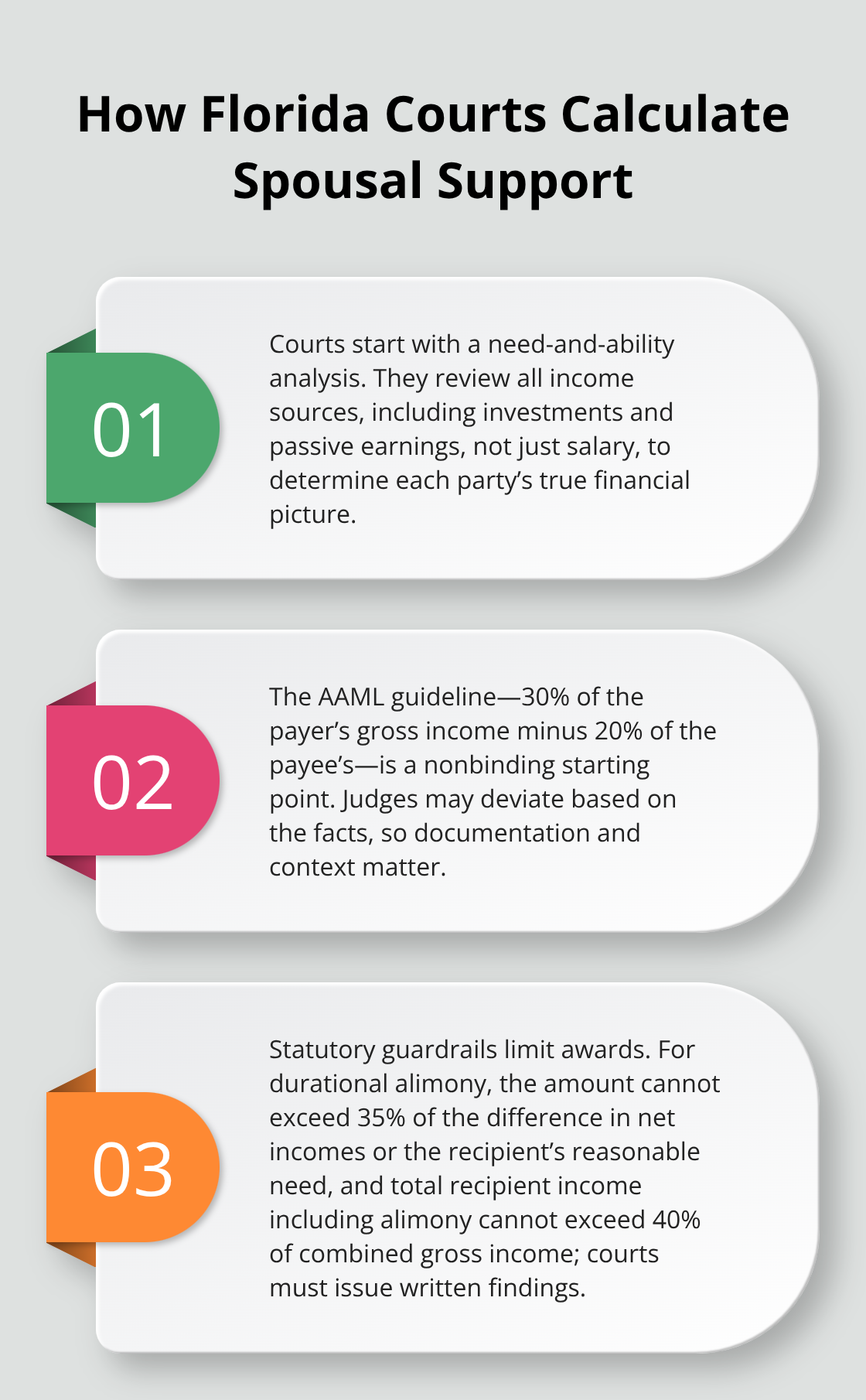
Florida courts apply a straightforward test: the recipient must demonstrate financial need, and the payer must show ability to pay. The American Academy of Matrimonial Lawyers suggests a starting calculation of 30 percent of the payer’s gross annual income minus 20 percent of the payee’s gross annual income, but Florida courts treat this as guidance, not a binding formula. Courts examine all income sources, including investments and passive earnings, not just salary. For durational alimony specifically, the amount cannot exceed 35 percent of the difference in net incomes or the recipient’s reasonable need, whichever is less. Courts must issue written findings that explain their reasoning, and the recipient’s total income including alimony cannot exceed 40 percent of the couple’s combined gross income under SB 1416 guidelines.
Complete financial documentation-tax returns, bank statements, investment records, and expense logs-provides concrete data to support your position rather than relying on estimates.
When Support Ends and How to Modify Orders
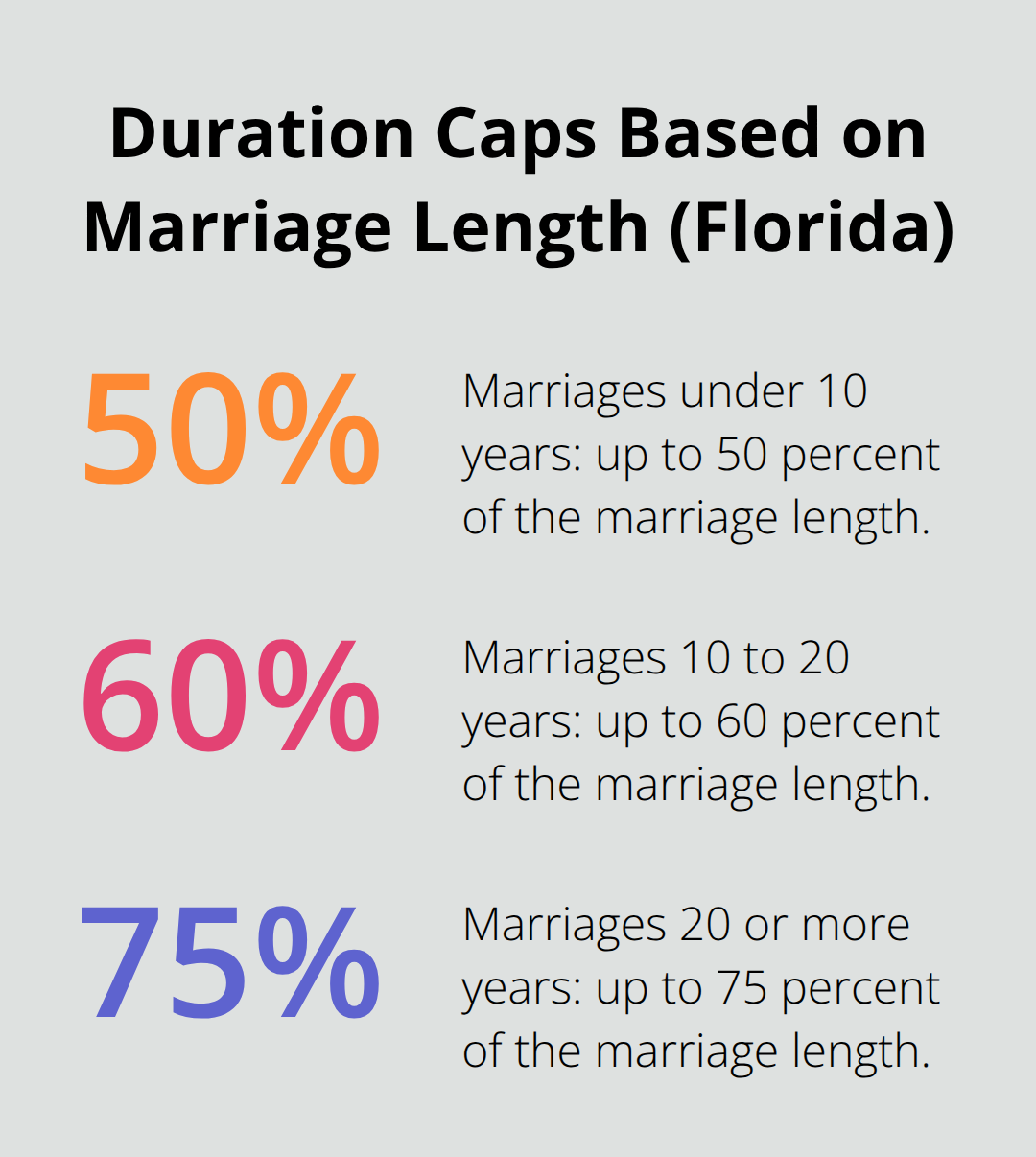
Durational alimony duration depends on your marriage length: marriages under ten years typically receive support for up to 50 percent of that length, moderate-term marriages of ten to twenty years up to 60 percent, and long-term marriages of twenty or more years up to 75 percent. Bridge-the-gap alimony terminates automatically after two years or upon remarriage or death, whichever occurs first, and cannot be extended or modified.
Rehabilitative alimony ends when you complete your plan or five years pass, though substantial life changes can trigger modification. All alimony types terminate upon the recipient’s death or remarriage. Modification becomes possible only when circumstances change substantially-such as job loss, significant income shifts, serious health problems, or retirement at federal retirement age or your profession’s customary retirement age. Courts rarely modify bridge-the-gap alimony except in extraordinary situations. If your income increases substantially or you retire, the other party can petition to reduce or end support, making it essential to document any major life changes promptly.
These support structures protect both parties by establishing clear expectations and timelines. Understanding which type applies to your situation shapes how you prepare financially and legally for what comes next.
Common Misconceptions About Alimony in Melbourne Florida
Gender Does Not Determine Who Receives Support
Florida courts award spousal support to whoever demonstrates need and whose spouse has the ability to pay, regardless of gender. Men receive alimony in Florida divorces, and courts apply the same legal standard to both spouses. The misconception that only women collect support stems from outdated divorce patterns, but modern Florida law treats financial need neutrally. If you earn less than your spouse and depend on their income, your gender does not factor into the court’s decision to award or deny support.
Courts examine facts like career sacrifices, time out of the workforce, and income differences, not whether you are male or female. This matters practically because men often underestimate their eligibility for support or fail to document their financial need, leaving money on the table during settlement negotiations.
Spousal Support Now Has Time Limits
The second major error is assuming spousal support lasts forever. Florida eliminated permanent alimony in 2023 through SB 1416, replacing it with four time-limited forms. Even before this reform, permanent alimony applied only in narrow circumstances, typically for older spouses or those out of the workforce for decades.
Today, durational alimony caps support based on marriage length: under ten years you receive up to 50 percent of that duration, ten to twenty years up to 60 percent, and twenty or more years up to 75 percent. Bridge-the-gap support ends after two years maximum. Rehabilitative support terminates when you complete your education plan or after five years. This shift reflects Florida’s policy that spousal support should help you transition to independence, not replace your spouse’s income indefinitely.
Many people negotiate settlements based on outdated assumptions about permanent support, accepting lower lump-sum payments when durational awards would serve them better over time.
High Income Alone Does Not Trigger Support Obligations
High earners do not automatically pay support just because they earn more. Courts require proof of your actual need and their genuine ability to pay after accounting for their own reasonable expenses, debts, and obligations like child support. A spouse earning $200,000 annually might owe nothing if they have substantial expenses, while someone earning $80,000 could owe support if the other spouse has no income and demonstrated need.
The court calculates a surplus or deficit on each party’s financial affidavit, examining all income sources and legitimate expenses. Judges have discretion and often deviate from formulas when circumstances warrant, so income alone never determines the outcome. Understanding this distinction shapes how you present your financial situation and what you should realistically expect from your case.
Protect Your Financial Future During Divorce
Gather Complete Financial Documentation
Your financial records form the foundation of your spousal support case. Courts decide alimony based on documented income and assets, not on claims or estimates. Collect tax returns from the past three years, recent pay stubs, bank statements, investment account statements, and retirement account documentation right away. Self-employed individuals should compile profit-and-loss statements and business tax returns. Document all regular expenses including housing, utilities, insurance, childcare, and debt payments. Florida law requires judges to calculate a surplus or deficit on each party’s financial affidavit, and incomplete documentation can work against you. The judge may make unfavorable assumptions or award support based on partial information if your records lack detail.
Most people overlook income sources when preparing their case. Bonuses, commissions, rental income, and investment returns all count toward your total income. Courts examine all income sources, so missing even one category shifts the final support amount significantly. Create a detailed expense spreadsheet showing what you actually spend monthly rather than what you think you should spend. Courts view inflated or vague expense claims with skepticism, so specific numbers tied to actual bills carry far more weight than round estimates.
Establish Your Need and Your Spouse’s Ability to Pay
Your rights to support depend on proving both your need and your spouse’s ability to pay. This requires understanding your financial position compared to theirs. If you earned significantly less during the marriage or stepped back from your career for childcare or to support your spouse’s education, document those sacrifices carefully. Courts consider contributions like homemaking and career support when calculating support, so gather evidence of any education or training you funded for your spouse, time you spent managing the household, or income you sacrificed.
The tax treatment of alimony changed in 2019: if your divorce finalizes after January 1, 2019, alimony is not deductible for the payer and not counted as income for the recipient. This affects how much support actually reaches you and what the other party truly owes. Understanding which type of alimony applies to your marriage length and situation matters greatly, since durational support for a twenty-year marriage differs dramatically from bridge-the-gap support lasting two years.
Work with Legal Representation to Understand Your Position
A family law attorney reviews your specific circumstances and determines what you can realistically expect from your case. An attorney helps you identify hidden assets and ensures accurate income calculations for support obligations. We at Harnage Law PLLC provide experienced legal representation in family law matters, including divorce and spousal support cases in Melbourne. Our attorneys offer personalized attention to help you navigate these complex financial and legal questions with confidence.
Final Thoughts
Spousal support in Florida divorce cases operates on clear legal principles, but the details matter enormously for your financial future. The four types of alimony available under current Florida law each serve specific purposes and timeframes, with durational support now replacing the permanent awards of the past. Courts base their decisions on documented need and ability to pay, applying the same standards regardless of gender or income level.
If you face divorce in Melbourne, Florida, your next step involves understanding your specific circumstances and what spousal support Melbourne courts would likely award in your situation. Start by organizing your financial records (tax returns, pay stubs, bank statements, and expense documentation), identify any career sacrifices you made during the marriage, and review the duration guidelines based on your marriage length. This preparation puts you in a stronger position when negotiating or litigating your case.
Contact Harnage Law PLLC to discuss your situation and determine the best path forward for protecting your financial interests during this significant life transition. Our attorneys offer personalized attention to help you navigate these complex financial and legal questions with confidence. We at Harnage Law PLLC provide experienced legal representation for family law matters including divorce and spousal support cases in Melbourne.