
Florida Exclusive Custody Rights: What It Means for Your Parenting Plan
Our Blog
Florida Exclusive Custody Rights: What It Means for Your Parenting Plan

Exclusive custody in Florida gives one parent full legal and physical custody of a child, which fundamentally changes how parenting decisions get made and where the child lives. At Harnage Law PLLC, we see families navigate this complex arrangement every day, and understanding what exclusive custody actually means can protect your parental rights.
This guide walks through how Florida courts award exclusive custody, what it means for your parenting plan, and the practical steps you need to take if you’re facing a custody decision.
What Exclusive Custody Actually Means in Florida
Florida’s Modern Custody Framework
Exclusive custody in Florida is not what many people think it is. Florida courts stopped using the word custody in 2011, replacing it with two separate legal concepts: parental responsibility (who makes major decisions) and time-sharing (where the child physically lives and when). This distinction matters enormously because a parent can hold sole parental responsibility for decisions without having exclusive time-sharing, and vice versa. When someone mentions exclusive custody today, they typically mean sole parental responsibility paired with the child living primarily or entirely with one parent. However, Florida law strongly presumes that shared parental responsibility serves the child’s best interests unless clear evidence shows otherwise.
The Rebuttable Presumption of Equal Time-Sharing
Courts start with a rebuttable presumption that equal time-sharing benefits children, which means you must present substantial evidence to overcome this starting point. The statute requires judges to consider factors like each parent’s ability to foster a close relationship with the child, the stability of each home environment, and any history of domestic violence or abuse. Full denial of the other parent’s access to the child is rare and requires serious documented problems such as verified abuse, abandonment, or neglect. Most cases that appear to involve exclusive custody actually involve one parent with sole decision-making authority in specific areas (like healthcare or education) combined with a time-sharing schedule heavily favoring one parent, rather than a complete cutoff.
When Courts Award Sole Parental Responsibility
Florida courts award sole parental responsibility only when joint decision-making would harm the child. This occurs most often in cases involving documented domestic violence, substance abuse with ongoing risk, child abuse or neglect, or a parent’s documented inability to cooperate. The court must make written findings that explain why shared responsibility would be detrimental before it awards sole responsibility to one parent.
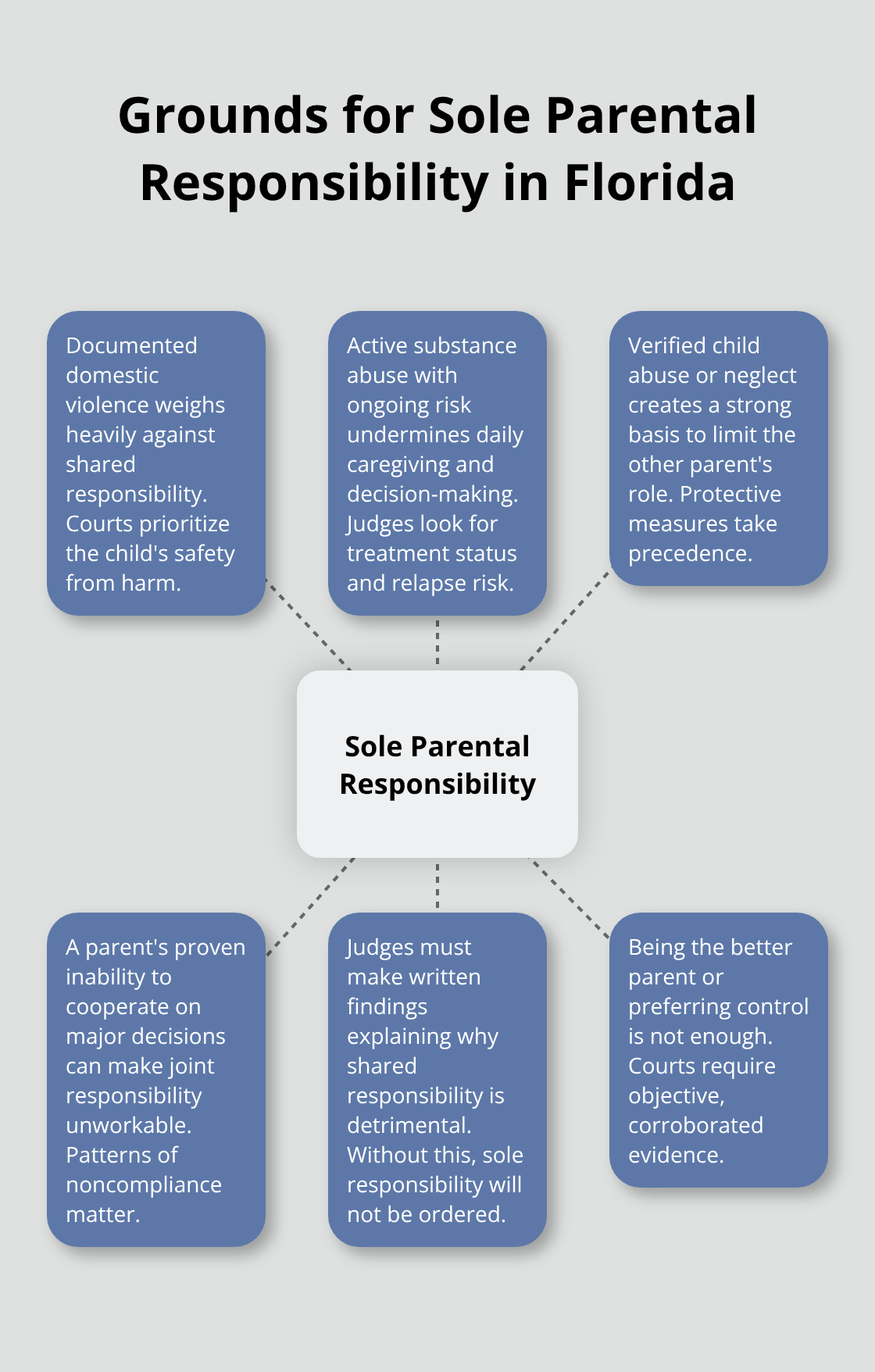
You cannot simply request exclusive custody because you believe you are the better parent or want to limit the other parent’s involvement. Courts examine specific, provable problems backed by evidence like police reports, medical records, dependency court findings, or testimony from credible witnesses. A parent’s personal preference for sole control does not meet the legal threshold.
Parental Rights Beyond Sole Responsibility
Even when sole parental responsibility is awarded for certain decisions, the non-custodial parent typically retains time-sharing rights and the legal right to information about the child’s health, education, and welfare unless a court order specifically restricts access due to safety concerns. This means that achieving what looks like exclusive custody requires far more than winning one custody hearing-it demands ongoing documentation of problems, cooperation with court orders, and sometimes expert testimony about why the child’s safety or welfare depends on limiting the other parent’s involvement. Understanding this reality shapes how you approach your parenting plan and what outcomes are actually achievable in your specific situation.
How Sole Parental Responsibility Reshapes Your Parenting Plan
Decision-Making Authority and Parental Rights
Sole parental responsibility fundamentally restructures how decisions about your child get made and who holds the authority to make them. When one parent receives sole responsibility, that parent can make major decisions about healthcare, education, extracurricular activities, and religious upbringing without consulting or obtaining consent from the other parent. This does not automatically mean the other parent loses all contact with the child.
Florida courts frequently award sole decision-making authority to one parent while still granting the other parent meaningful time-sharing, though the schedule may be restricted or supervised depending on the circumstances that led to the sole responsibility order. Your parenting plan must explicitly state which parent holds sole responsibility for which decisions, the time-sharing schedule, and any conditions on visitation such as daytime-only visits, supervised exchanges, or exchanges at neutral locations. Courts take these specifications seriously because vague language creates disputes that lead to expensive enforcement actions.
Healthcare and Educational Decisions
If your parenting plan states that one parent has sole responsibility for healthcare decisions, that parent can authorize medical treatment, dental work, mental health counseling, and prescription medications without the other parent’s approval. However, the other parent retains the right to information about the child’s medical status and treatment unless the court order specifically restricts access due to safety concerns.
The same principle applies to school enrollment and educational decisions. A parent with sole responsibility for education can select the school, approve curriculum choices, and make decisions about special education services, but the other parent still has the legal right to report cards, teacher communications, and school records unless explicitly cut off by court order.
Residential Arrangements and Time-Sharing Schedules
Residential custody arrangements under sole parental responsibility typically mean the child’s primary residence is with one parent, though the exact percentage of time-sharing varies widely depending on the facts of your case. Courts do not automatically award 100 percent time to one parent simply because that parent holds sole decision-making authority. A common arrangement places the child with one parent for 70 to 80 percent of the time while the other parent maintains regular visitation, often including overnight visits on weekends and rotating weekday time.
Some arrangements involve daytime-only visits without overnight stays, particularly when substance abuse, untreated mental health conditions, or safety concerns are documented. Recovery residences present a specific situation where Florida law restricts nighttime visits between 9 p.m. and 7 a.m. unless the court finds such visits serve the child’s best interests after considering the parent’s recovery status and safety.
Exchange Procedures and Logistics
The visitation schedule should address holidays, school breaks, summer vacation, and how time-sharing adjusts during these periods. Courts expect parenting plans to include detailed exchange procedures, designated exchange locations, and communication methods between parents. If safety concerns exist, the plan may require exchanges at a neutral location, through a third party, or at a supervised visitation center rather than direct exchanges between parents.
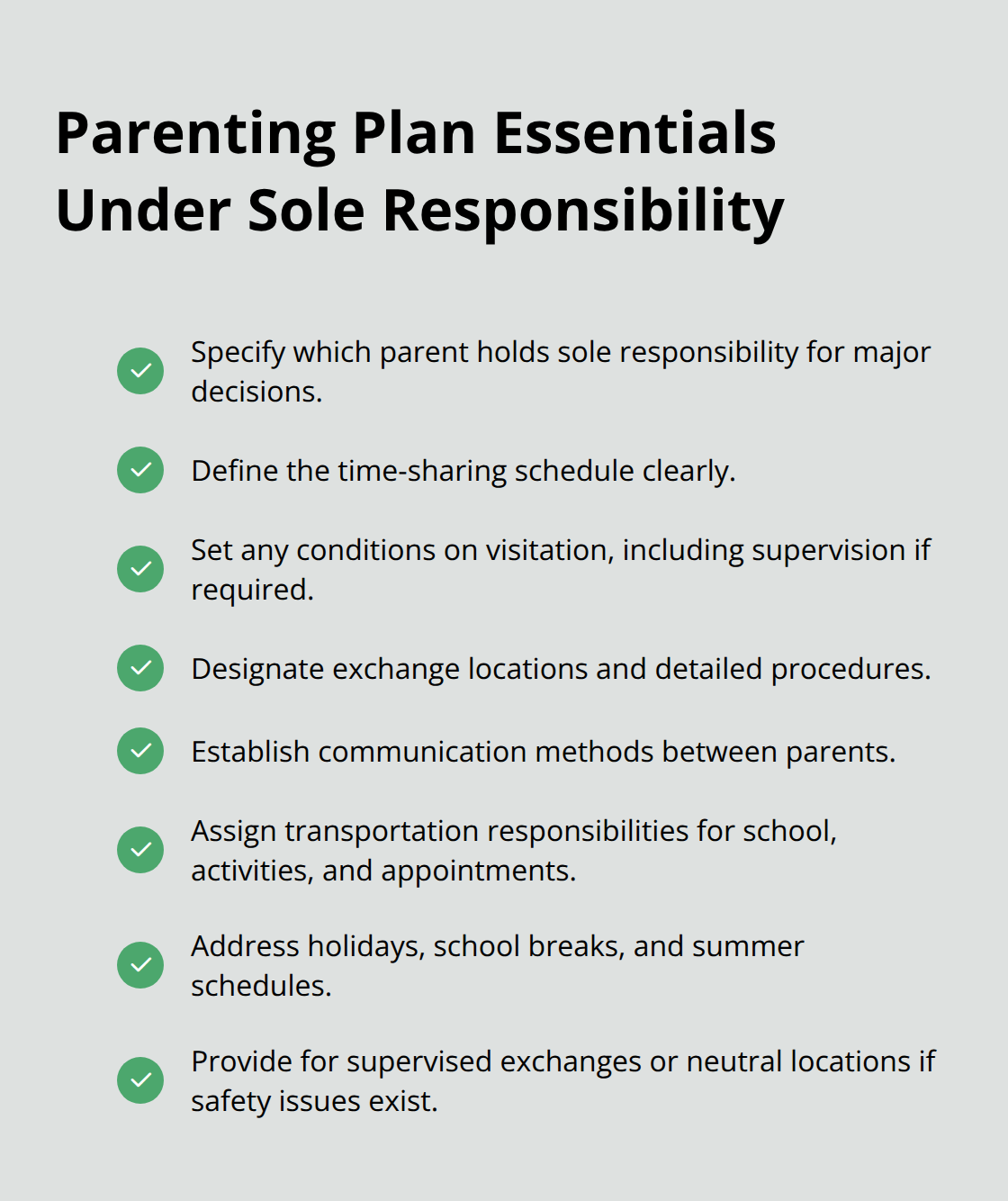
The plan should also specify how each parent handles transportation to school, extracurricular activities, and medical appointments. Transportation logistics often become a source of conflict, so clear language about who drives to soccer practice, who attends school conferences, and how medical appointments are scheduled prevents disputes that could lead to contempt of court findings or modification requests. These operational details determine whether your parenting plan actually functions smoothly or whether you face constant friction over who does what and when.
How Florida Courts Decide Sole Parental Responsibility
Florida courts apply a specific legal test when deciding whether to award sole parental responsibility, and understanding this test reveals why most parents seeking exclusive custody do not actually obtain it. The central question courts answer is whether shared parental responsibility would harm the child, not whether one parent is better than the other. This distinction matters because judges must find that joint decision-making poses actual risk to the child’s welfare before they can award sole responsibility to one parent.
The Legal Standard: Harm, Not Preference
Courts examine documented evidence of abuse, neglect, domestic violence, substance abuse with ongoing risk, or a parent’s demonstrated inability to cooperate in the child’s best interests. Without concrete, provable problems supported by police reports, medical records, dependency court findings, or credible witness testimony, courts will not override the statutory preference for shared responsibility. Many parents believe their superior parenting skills or financial stability qualify them for sole control, but Florida law does not work that way. The best interests standard requires judges to weigh specific factors about each parent’s ability to foster a relationship with the child, the stability of each home environment, the child’s safety from violence and abuse, the child’s moral and physical health, and each parent’s willingness to facilitate contact with the other parent.
Evaluating Parental Fitness Through Concrete Evidence
When courts evaluate parental fitness and stability, they focus on concrete indicators rather than assumptions or character judgments. A parent with documented substance abuse issues faces significant obstacles because courts recognize that active addiction directly impacts a parent’s ability to meet a child’s daily needs and make sound decisions. Similarly, a history of domestic violence or child abuse creates a presumption against shared responsibility because the court must prioritize the child’s safety from harm.
Courts also examine whether parents can cooperate despite disagreements, and a parent’s pattern of withholding information about the child, violating previous court orders, or attempting to alienate the child from the other parent weighs heavily against awarding that parent sole responsibility.
Building Your Factual Record
Documentation is critical here. If you have concerns about the other parent’s fitness, gather concrete evidence now: photographs of unsafe living conditions, medical records showing untreated mental health conditions, school records documenting the child’s behavioral decline during time with that parent, or police reports related to domestic violence or substance abuse. Isolated complaints or a single incident typically do not meet the legal threshold, but a pattern of documented problems does.
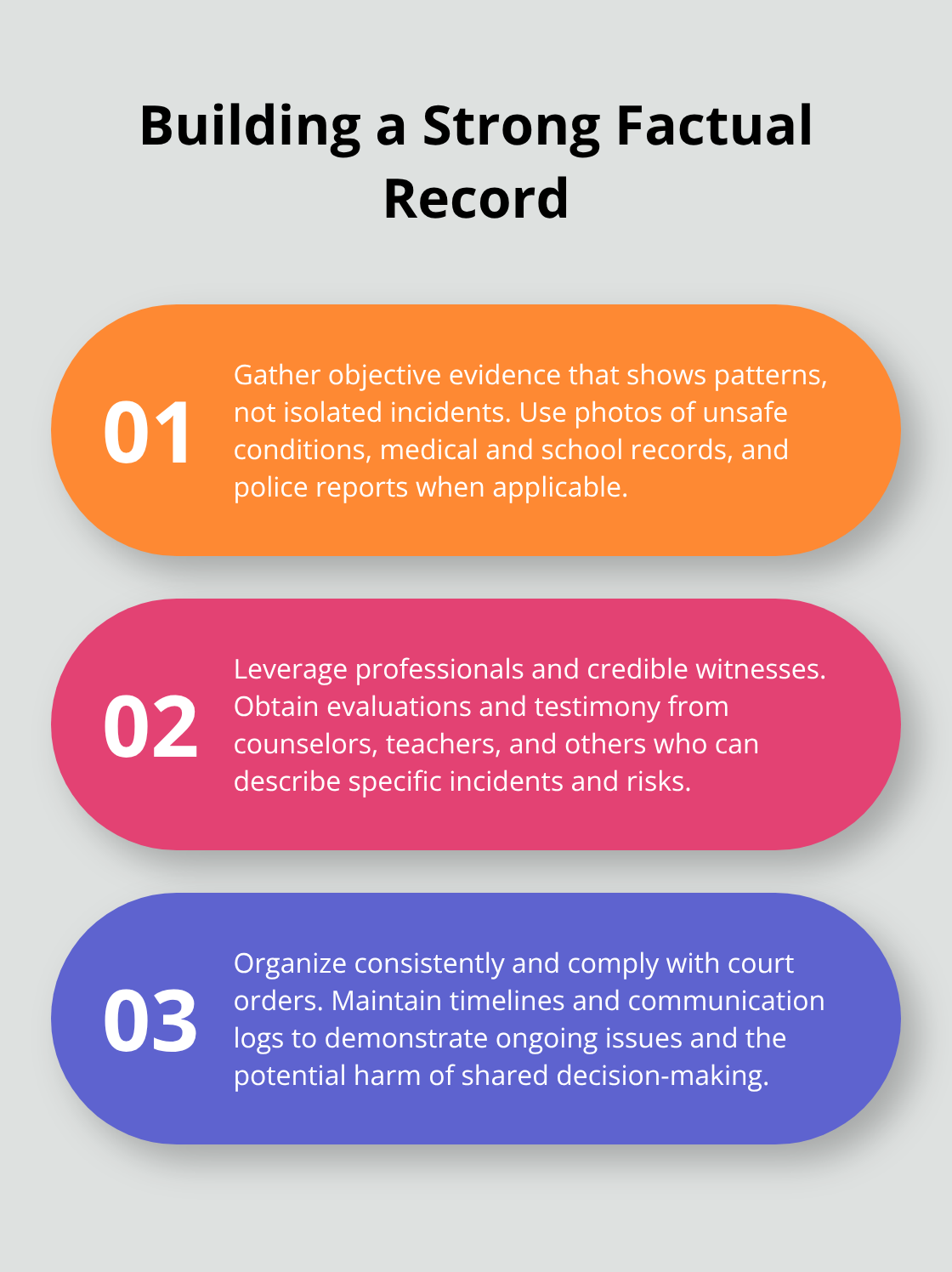
Courts rarely award sole parental responsibility based on testimony alone; they require objective corroboration. This reality means that if you are facing a custody dispute and seeking sole responsibility, you must build a factual record immediately through documentation, professional evaluations, and credible witnesses who can testify about specific incidents rather than general impressions. The strength of your evidence determines whether a court will find that shared responsibility would harm your child.
Final Thoughts
Exclusive custody in Florida demands far more than winning a single court hearing. Courts award sole parental responsibility only when shared decision-making would genuinely harm your child, and you must back that claim with documented evidence of abuse, neglect, domestic violence, or substance abuse. The law presumes both parents should remain involved in major decisions, so overcoming that presumption requires concrete proof rather than preference or opinion.
Building an ironclad factual record determines whether you can obtain Florida exclusive custody rights. Collect medical records, police reports, school documentation, and credible witness statements that demonstrate specific problems instead of general concerns. Courts rely on objective evidence, not anecdotes or character judgments, and a pattern of documented issues carries far more weight than isolated incidents or testimony alone.
Even when sole decision-making authority is awarded, the other parent typically retains time-sharing rights and access to information about the child unless safety concerns justify restrictions. Your parenting plan must specify exactly which parent holds responsibility for healthcare, education, and other major decisions, along with the time-sharing schedule and any conditions on visitation. Contact Harnage Law PLLC to discuss your situation and develop a strategy that protects your child’s best interests.