
Florida Parenting Plan Advice: Designing a Fair Schedule
Our Blog
Florida Parenting Plan Advice: Designing a Fair Schedule

A parenting plan is one of the most important documents you’ll create after separation or divorce. It outlines custody, time-sharing, and decision-making responsibilities that directly affect your children’s daily lives.
At Harnage Law PLLC, we help families in Melbourne, Florida develop parenting plans that work for their unique situations. Getting Florida parenting plan advice early prevents costly disputes and keeps your focus where it matters-on your children’s wellbeing.
What Your Florida Parenting Plan Must Actually Include
Florida Statute 61.13 requires every parenting plan to specify exact start and end times for each parenting period, the annual number of overnights per child totaling 365, and clear designations of decision-making authority.
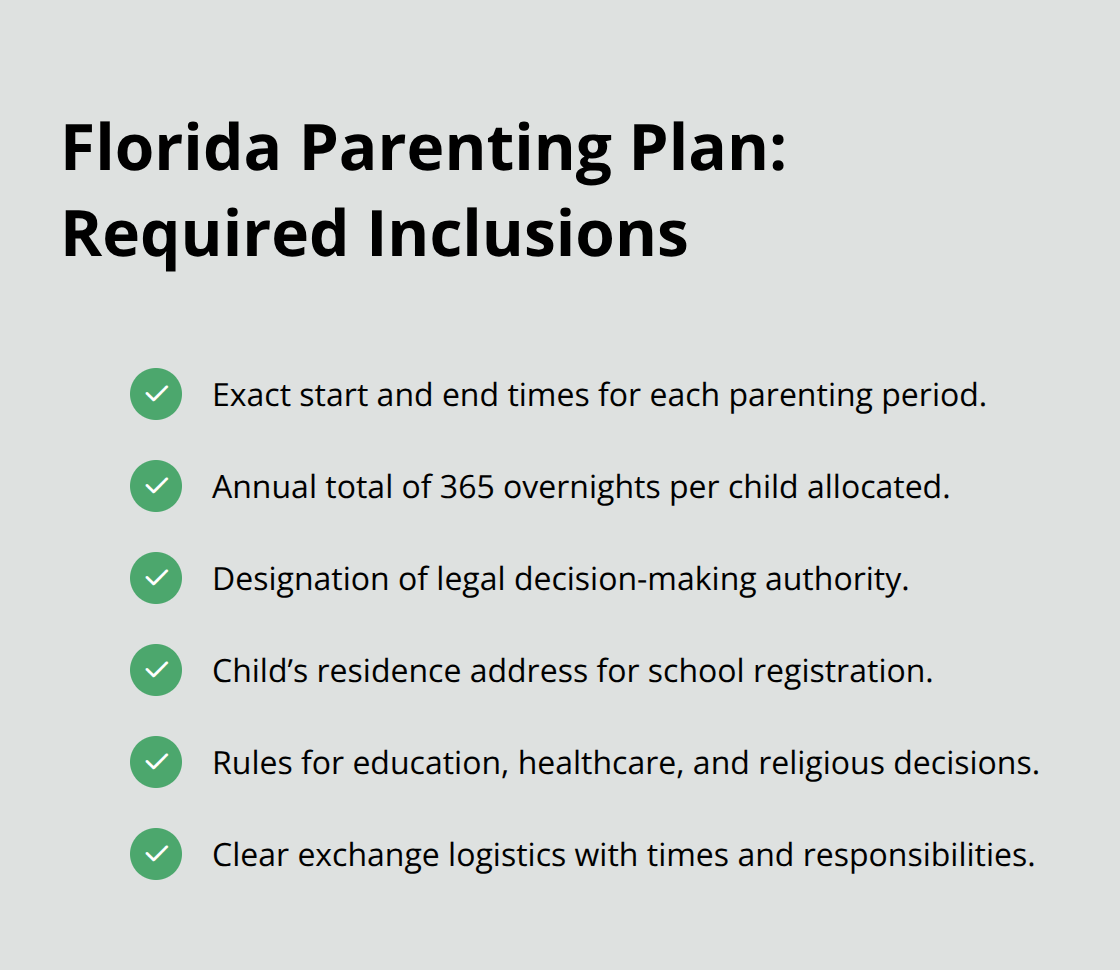
The court will not approve vague arrangements like “every other weekend” without concrete times. You need to state whether exchanges happen at 4 p.m. Friday to 8 a.m. Monday, or 6 p.m. Saturday to 6 p.m. Sunday. The parenting plan must also designate the child’s formal residence address for school registration and specify which parent makes decisions about education, healthcare, and religious practices. Courts generally prefer joint legal custody when possible, allowing both parents to participate in major decisions. However, if one parent cannot adequately care for the child, sole custody or majority time-sharing may be awarded instead. Physical custody outcomes vary widely-shared physical custody maintains relationships with both parents, but the exact split depends on what serves your child’s best interests under Florida law.
Transportation and Exchange Logistics
You must write who handles drop-offs, pick-ups, and what happens if a parent arrives late into your plan before you file it. This prevents disputes at the curb and reduces conflict when emotions run high.
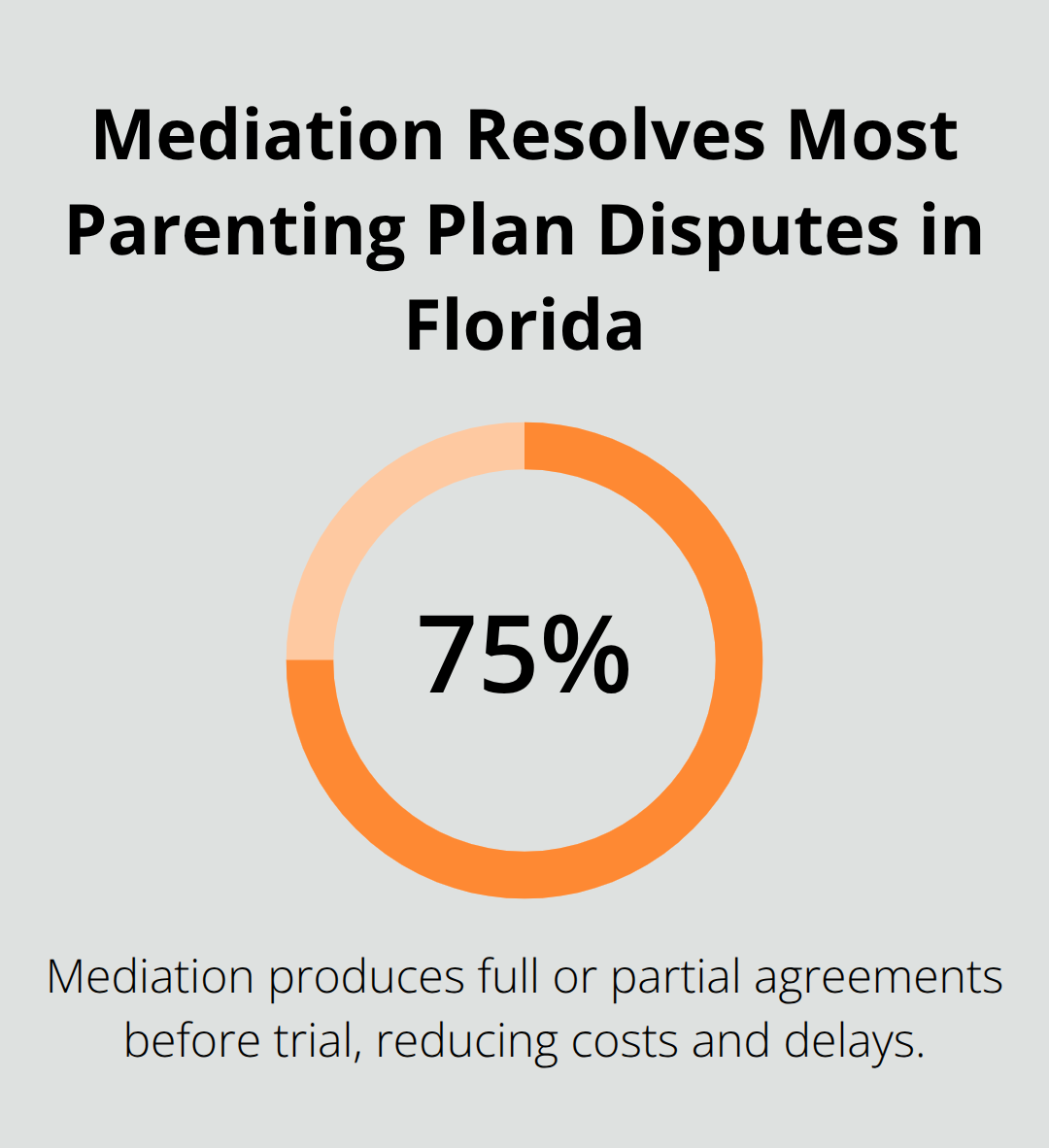
Include whether the child brings a bag to each exchange, who pays for travel costs, and procedures for late arrivals. Transportation logistics should be documented clearly to avoid misunderstandings. Mediation typically occurs before trial and produces full or partial agreements in about 75% of cases, saving you thousands in legal fees and months of court delays.
Communication and Holiday Allocation
Your plan must detail how parents communicate about school matters, medical appointments, and schedule changes. Florida courts expect you to identify whether you’ll use email, a shared calendar app, or in-person meetings. Summer and holiday schedules require explicit allocation-specify which holidays the child spends with each parent and whether these rotate annually. Highly structured plans demand precise holiday exchange times and rules for parent-child communication during holidays. Without this clarity, disputes over Thanksgiving or Christmas create additional litigation costs and stress. A visual calendar is strongly recommended and required in some Florida counties to clearly present the schedule, making it easy for both parents and your child to understand when transitions occur.
Decision-Making Authority and Parental Responsibility
You must designate which decisions fall to each parent and which require joint agreement. Courts often assign one parent as the ultimate decision-maker for specific issues (such as education or medical decisions) when joint decisions aren’t practical or in the child’s best interest. Your plan should clearly specify responsibilities for school enrollment, medical care, and daily decisions to prevent confusion and disputes. This clarity protects both parents and gives your child the stability that comes from knowing who makes which decisions. Understanding child custody laws in your jurisdiction helps ensure your plan meets all legal requirements and serves your family’s needs.
Common Parenting Schedule Models in Melbourne, Florida
Equal-Time Arrangements That Maintain Strong Parent-Child Bonds
The alternating week schedule remains the most straightforward equal-time arrangement, with each parent taking the child for seven consecutive days before exchanging. This model works best when parents live close enough to avoid excessive commute time and when children attend school in a stable location. The 3-4-4-3 pattern offers more frequent transitions, cycling through three days, four days, four days, and three days with alternating parents throughout the week. Courts in the Twelfth Judicial Circuit often approve the 3-4-4-3 pattern because it maintains stronger contact with both parents while reducing the psychological impact of week-long separations. However, this schedule demands reliable logistics and coordinated drop-offs, making it unsuitable for parents with inflexible work schedules or high conflict.
Extended Weekend Models for Traditional Work Schedules
The extended weekend model, sometimes called the 60/40 pattern, concentrates parenting time into longer blocks by placing weekdays with one parent and three-day weekends with the other. This arrangement suits parents with traditional Monday-through-Friday employment, though it requires careful planning around school schedules and extracurricular activities. The schedule aligns naturally with how many employers structure work weeks, reducing the need for complex mid-week exchanges that strain logistics and increase parental friction.
Primary Caregiver Models When Equal Time Isn’t Realistic
When one parent cannot manage equal time due to work demands or distance, the 70/30 or 80/20 patterns become more practical. The 70/30 model typically assigns majority time to one parent with shorter, regular periods for the other, often described as every-other-weekend arrangements. The 80/20 pattern concentrates even more time with the primary parent while maintaining predictable contact through alternating weekends. Florida courts recognize that equal time doesn’t always serve the child’s best interests when one parent has limited availability or when geographic distance makes frequent exchanges unrealistic.
Matching Schedules to Your Child’s Age and Your Work Reality
The key to success with any model involves matching the schedule to your actual work hours, commute times, and your child’s age. A seven-year-old handles week-long separations better than a two-year-old, who typically needs shorter, more frequent visits. Summer break and holiday schedules complicate all these models, requiring separate allocations that often rotate annually to maintain fairness. Tools like Custody X Change automatically calculate parenting time percentages and generate formal plans, eliminating the guesswork about whether your proposed schedule actually achieves the time-sharing split you intend.
Your choice of schedule model sets the foundation for your entire parenting plan, but the real complexity emerges when you layer in the specific factors that make your family unique-factors that determine whether a schedule actually works in practice or creates ongoing conflict.
Factors That Influence Your Parenting Plan Schedule in Melbourne, Florida
How Your Child’s Age Determines What Schedules Actually Work
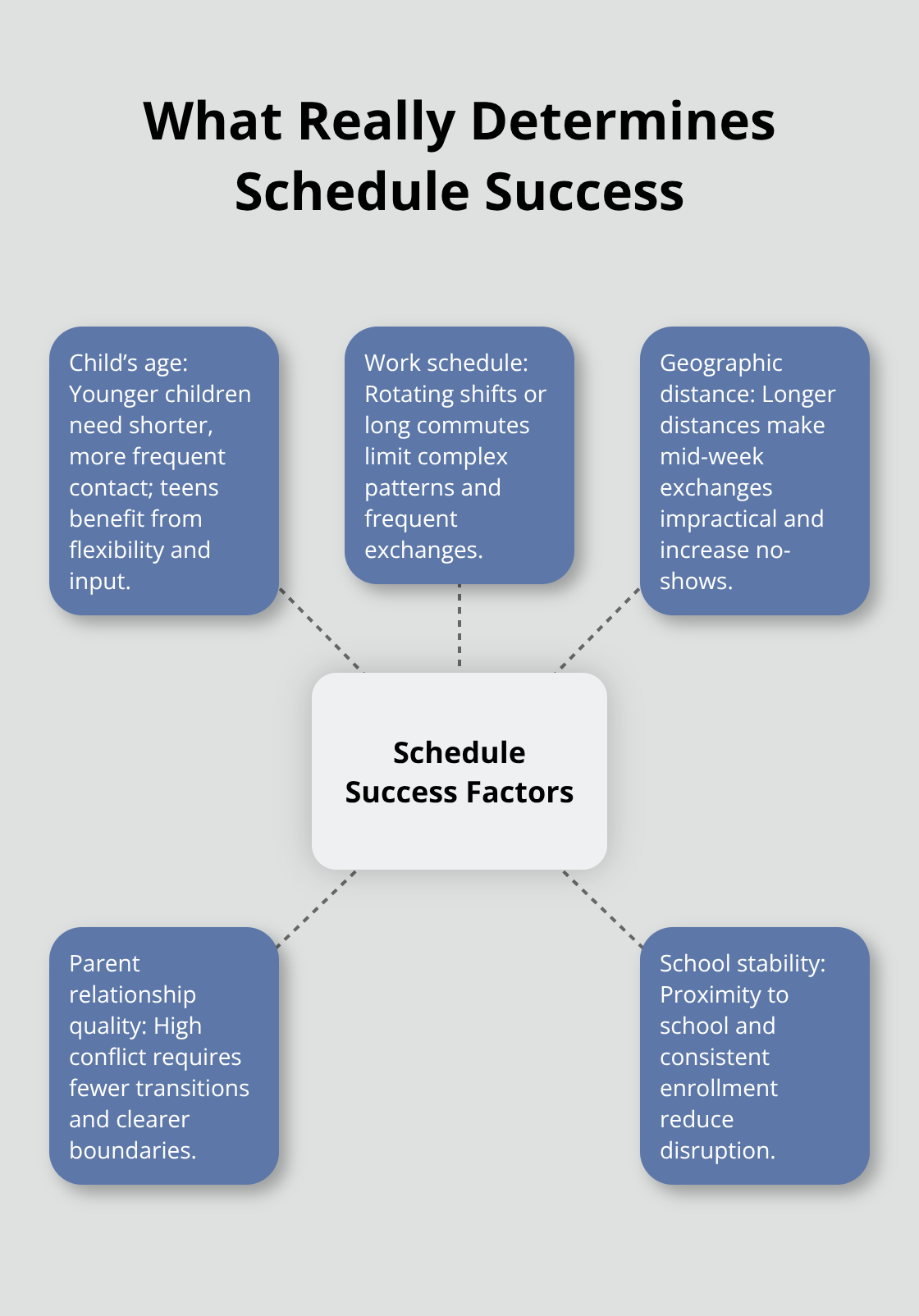
Your child’s age determines everything about timing and frequency in your parenting plan, and this factor alone eliminates half the schedule options you’re considering. A two-year-old cannot handle week-long separations without psychological distress, while a fourteen-year-old becomes frustrated by exchanges three times per week. Children under three years old benefit from shorter, more frequent contact with each parent-typically two to three days at a time-because their sense of time moves differently and extended separation creates anxiety. Children aged three to five can manage three to four-day blocks, while those five to thirteen handle week-long or longer periods effectively. Teenagers aged thirteen to eighteen often resist rigid schedules entirely and may push back against frequent exchanges, making flexibility and their input essential to plan success.
The Twelfth Judicial Circuit recognizes these developmental stages when evaluating parenting plans, and judges consistently reject schedules that ignore a child’s age-appropriate needs. Courts in Florida expect your proposed schedule to reflect your actual work hours, not the schedule you wish you had or plan to have someday.
Work Schedules and Geographic Distance as Hard Constraints
Your work schedule either enables or sabotages whatever parenting plan you choose, and pretending otherwise creates a plan that fails within months. If you work retail with rotating shifts, an alternating-week schedule becomes impossible to maintain consistently. If you commute ninety minutes each direction, a 3-4-4-3 pattern adds three hours of driving daily and exhausts you before the plan even begins.
Geographic distance between parent households acts as a hard constraint on what works in practice. If you live forty miles apart, mid-week exchanges become logistically punishing and often get skipped, undermining the entire arrangement. Geographic proximity also determines whether your child can attend the same school from both homes or must switch schools with each transition.
Honest assessment of commute times, work flexibility, and realistic travel costs prevents the plan drift that leads to modification disputes within two years.
Relationship Quality Between Parents Determines Schedule Success
The relationship quality between you and your other parent shapes whether any schedule actually functions or becomes a source of constant conflict. Parents who communicate civilly and share parenting values can manage complex schedules like the 3-4-4-3 pattern because they coordinate logistics smoothly and adapt when life changes. Parents with high conflict cannot manage frequent exchanges because each transition becomes a friction point, making even straightforward 50/50 splits deteriorate into disputes over timing and communication.
If you and your other parent struggle to discuss your child’s school performance without arguing, the schedule itself matters far less than reducing the number of transitions you must navigate together. Courts recognize this reality-judges sometimes impose less-frequent but longer blocks of time with each parent specifically to minimize contact points when conflict is evident. Your willingness to prioritize your child’s relationship with their other parent over your own preferences directly influences which schedules work. Parents who actively encourage the other parent’s involvement and communicate about the child’s needs make 50/50 arrangements succeed. Parents who view time-sharing as a zero-sum competition where every day with the other parent is a day lost find themselves back in court within eighteen months requesting modifications.
Mediation success rates in Florida reach approximately 75% for families who enter the process genuinely willing to cooperate, but that percentage drops sharply when one parent uses scheduling disputes as a proxy for ongoing conflict. Your honest assessment of whether you can coparent effectively determines whether you should pursue an equal-time arrangement or accept that a primary-caregiver model with structured visitation serves your child better.
Final Thoughts
Your parenting plan succeeds or fails based on how honestly you assess your family’s actual circumstances, not on which schedule model sounds fairest in theory. The elements we’ve covered-time-sharing arrangements, decision-making authority, transportation logistics, and holiday allocation-form the foundation, but flexibility determines whether your plan survives contact with real life. Children grow, work situations change, and unexpected events disrupt even the most carefully designed schedules.
Florida parenting plan advice consistently emphasizes that the child’s welfare must drive every decision you make about scheduling and responsibilities. This means choosing a schedule that genuinely works with your work hours and geographic reality, not one that looks good on paper but collapses within months. It means prioritizing your child’s relationship with their other parent over your own preferences, even when that feels difficult.
The path forward begins with honest conversation between you and your child’s other parent about what each of you can realistically provide. If that conversation stays productive, you may reach agreement without court intervention, and if conflict prevents direct negotiation, mediation offers a structured environment where a neutral third party helps you find common ground. We at Harnage Law PLLC help families in Melbourne, Florida navigate this process with personalized guidance tailored to your specific circumstances, and our family law team brings experience with the schedules and arrangements that actually work in practice.