
Handling a Child Support Dispute Melbourne
Our Blog
Handling a Child Support Dispute Melbourne
Child support disputes in Melbourne can escalate quickly when circumstances change or payments fall short. Income loss, custody modifications, and payment failures create real tension between parents and often require immediate action.
At Harnage Law PLLC, we help families navigate these conflicts with practical solutions. Whether you need negotiation, mediation, or court intervention, understanding your options makes all the difference.
Why Child Support Disputes Erupt in Melbourne
Income Loss Triggers Modification Battles
Income instability ranks as the primary trigger for child support conflicts in Melbourne. When a parent loses a job, faces a salary cut, or experiences reduced work hours, the original child support calculation no longer reflects reality. Florida’s income shares model bases child support on the combined net income of both parents, so any significant income shift creates legitimate grounds for dispute. A parent earning $60,000 annually who drops to $35,000 after job loss has a strong case for modification, but only if the change is substantial, permanent, and involuntary.
The key word here is involuntary-quitting a job to avoid child support obligations will not succeed in court. Courts examine work history, education, local job opportunities, and skills to determine whether unemployment represents genuine hardship or deliberate avoidance. In Brevard County’s defense contracting and aerospace sectors, layoffs occur regularly, and when they do, parents must act fast with documentation. Collect pay stubs, unemployment records, tax returns, and job search evidence immediately. Waiting months to file a modification request weakens your position because arrears continue accumulating during the delay.
Custody Changes Shift Financial Obligations
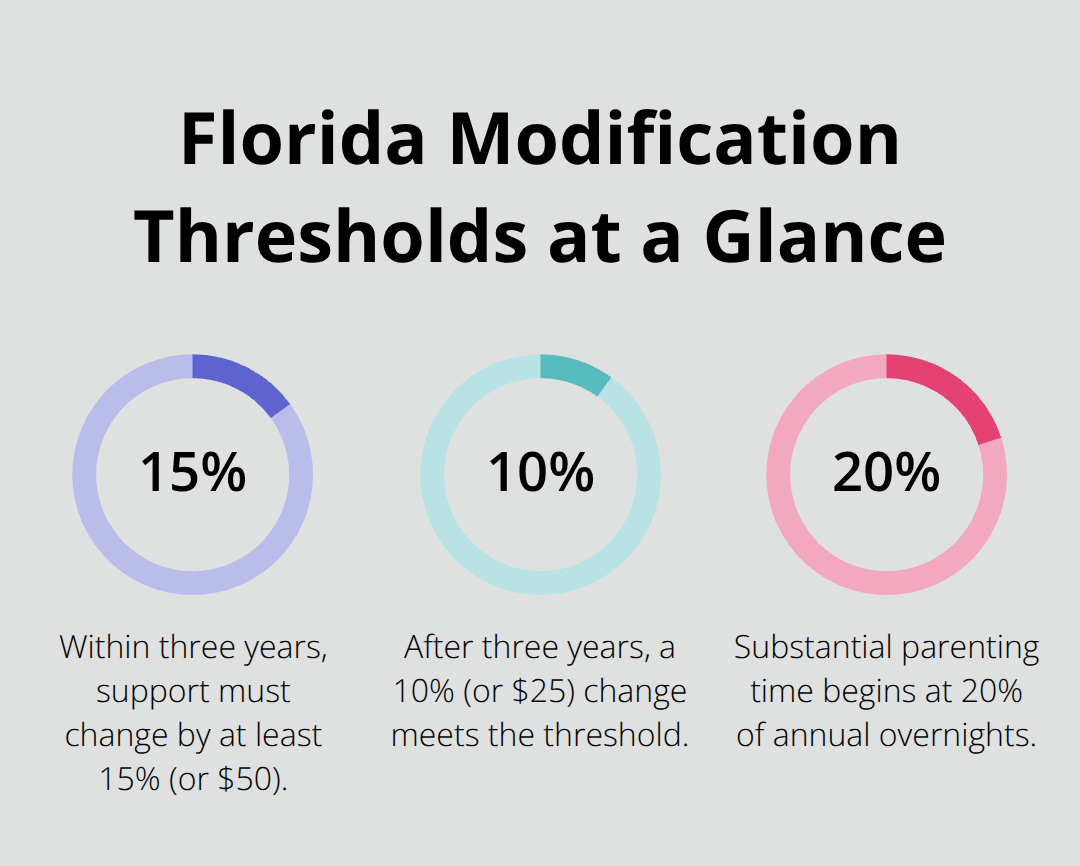
Custody arrangement changes create another major flashpoint. When overnight time-sharing increases from 10% to 25% with the child, the baseline calculation shifts dramatically under Florida law. The substantial parenting time threshold sits at 20% of overnight stays annually (roughly 73 nights per year). Once this threshold is crossed, judges recalculate the obligation by excluding daycare and health insurance costs, then multiply the result by 1.5 to reflect separate households. This recalculation often reduces what a paying parent owes significantly.
Payment Failures and Hidden Income Problems
Payment failures and underpayment disputes stem from different causes but pack equal destructive force. The Florida Disbursement Unit processes all child support payments through a centralized system, so discrepancies between what someone claims they paid and what actually arrived get caught quickly. Missing payments trigger wage withholding orders, license suspensions (including professional, recreational, and driver’s licenses), and potential legal consequences. The Voice Response Unit at 877-769-0251 allows parents to check payment history and disbursed amounts using their Social Security number and case number. If payments are sent but not posted correctly, tracing the problem through the FLSDU reveals whether the issue is incomplete payment information or processing delays.
Self-employed parents and business owners face heightened scrutiny because hidden income represents the biggest enforcement challenge in child support cases. Courts expect financial discovery and sometimes order forensic accounting to uncover unreported earnings. Melbourne’s business community includes contractors, consultants, and entrepreneurs whose income varies, making accurate reporting and documentation absolutely essential to avoid disputes. Understanding which trigger applies to your situation determines which legal path you should take next.
Resolving Child Support Disputes Without a Lengthy Court Battle
Negotiation and Mediation Clear the Path Forward
Negotiation and mediation offer the fastest path to resolution when both parents communicate openly. Direct negotiation between parents or their attorneys works best when emotions stay controlled and both sides recognize that compromise costs far less than litigation. Mediation introduces a neutral third party who identifies common ground and structures a settlement that addresses income changes, custody adjustments, or payment discrepancies. Florida courts strongly encourage mediation before modification hearings, and many judges will order it if either parent requests it.
The cost runs between $500 and $2,000 depending on the mediator’s hourly rate, compared to court battles that easily exceed $5,000 in attorney fees alone. If mediation succeeds, you avoid court delays and obtain a written agreement that becomes enforceable without judicial approval. This approach works particularly well in Melbourne when both parents work in the same professional or business community and understand the practical consequences of prolonged conflict. You must document every agreement in writing, even if informal, because verbal understandings about payment adjustments or custody changes will not hold up if disputes resurface later.
Court Modification Proceedings Address Substantial Changes
Court modification proceedings become necessary when negotiation fails or one parent refuses to acknowledge changed circumstances. Florida requires modifications to meet specific thresholds: within three years of the original order, the change must shift the amount by at least 15% or $50; after three years, the threshold drops to 10% or $25. The change must also be substantial, permanent, and involuntary.
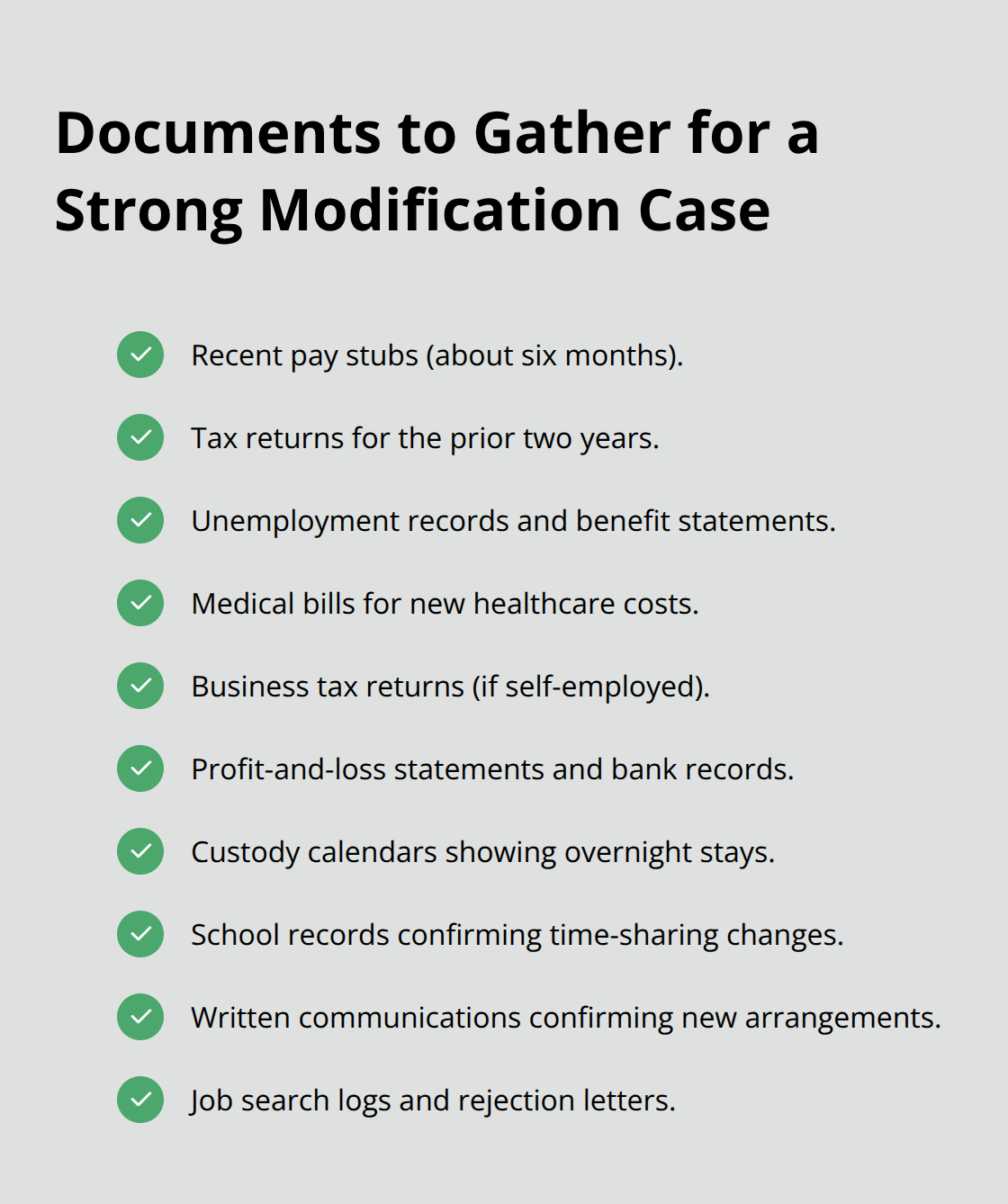
You file your petition in the circuit court where the original order was issued and gather documentation that proves the change (pay stubs, tax returns, unemployment records, medical bills for new healthcare costs). The Department of Revenue’s Child Support Enforcement division can initiate modifications administratively if you cannot afford attorney fees, though they move slowly and prioritize cases involving arrears. Prepare for a formal hearing where you present evidence and respond to questions about your changed circumstances.
Enforcement Actions Activate When Payments Stop
Enforcement actions through the court system activate when payments stop or fall short. Wage withholding orders reach the obligor’s employer directly, capturing child support from each paycheck before the employee receives funds. If the obligor is self-employed or income comes from multiple sources, the court may order bank account levies or property liens.
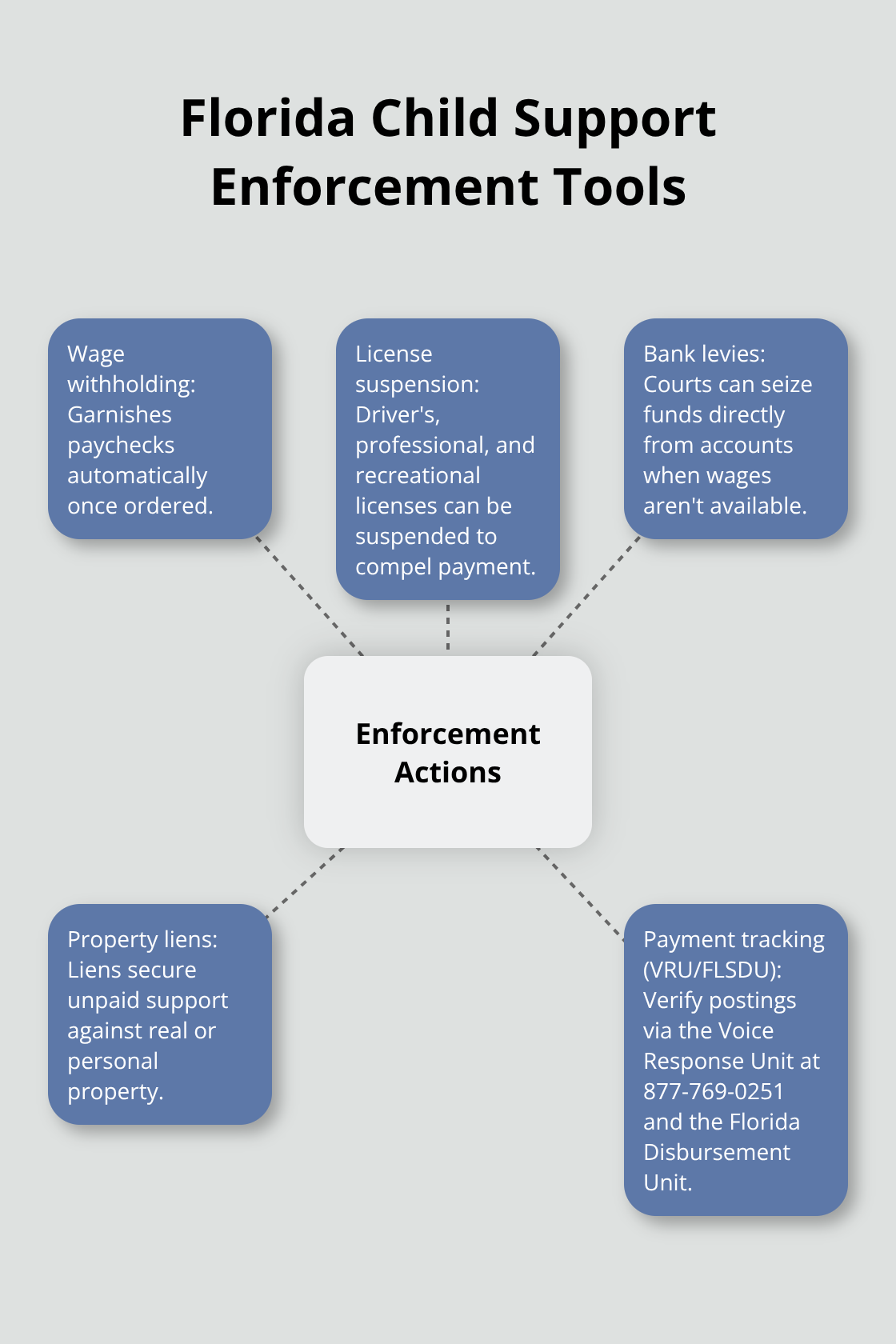
License suspension-including driver’s licenses, professional licenses, and recreational permits-creates immediate pressure because most people cannot function without driving privileges in Melbourne’s sprawling geography. The Voice Response Unit at 877-769-0251 allows you to track whether payments arrived at the Florida Disbursement Unit and confirm posting dates. If payments are missing, you request a payment history report and work with the Brevard County Clerk’s office or the Department of Revenue to locate the problem and initiate collection action.
Understanding Your Documentation and Evidence Needs
The strength of your position depends entirely on the evidence you present. Pay stubs from the past six months, tax returns for the prior two years, unemployment documentation, and medical bills for new healthcare costs all support your case for modification. Self-employed parents must provide business tax returns, profit-and-loss statements, and bank records that show actual income (not just what appears on tax filings). Courts scrutinize self-employed income carefully because hidden earnings represent the biggest enforcement challenge in child support cases.
You also need documentation of custody changes-a calendar showing overnight stays, school records, or communications with the other parent that confirm the new time-sharing arrangement. If you claim involuntary job loss, collect evidence of your job search efforts, rejection letters, and proof that you actively pursued comparable employment. This documentation transforms your modification request from a vague complaint into a compelling case that judges take seriously. The next section walks through what happens during the actual dispute resolution process and what timeline you should expect.
What Happens During a Child Support Dispute
Entering a child support dispute process means navigating specific procedural steps that most Melbourne parents encounter for the first time. The process demands accurate documentation, realistic timelines, and clear understanding of what judges actually decide. The outcome depends heavily on the strength of your evidence, the completeness of your financial disclosures, and whether your claimed changes meet Florida’s strict modification thresholds.
Documentation That Courts Require
Within three years of an original order, modifications must shift the amount by at least 15% or $50 minimum; after three years, the threshold drops to 10% or $25. Courts view modifications skeptically unless you present rock-solid proof that circumstances changed involuntarily and permanently.
Judges examine six months of recent pay stubs, the prior two years of tax returns, unemployment documentation, and medical bills for new healthcare expenses. Self-employed parents face the heaviest scrutiny because hidden income remains the biggest enforcement challenge in child support cases. Courts request bank records, business profit-and-loss statements, and sometimes order forensic accounting if income sources appear unclear.
If custody changed, you must document overnight stays with calendars, school records, or written communications from the other parent confirming the new time-sharing percentage. Courts will calculate whether you actually crossed the 20% overnight threshold (approximately 73 nights annually) because this triggers the 1.5 multiplier that fundamentally recalculates support amounts. Incomplete or missing documentation kills even legitimate modification requests, so you should gather everything before filing.
Timeline Expectations for Resolution
The timeline for resolution varies dramatically depending on whether you negotiate, mediate, or litigate. Direct negotiation between parents or their attorneys can produce a written agreement within weeks if both sides cooperate, avoiding court delays entirely. Mediation typically requires 2-4 sessions spanning 4-8 weeks, costing $500-$2,000 total compared to court battles exceeding $5,000 in attorney fees alone.
Administrative modifications through the Department of Revenue’s Child Support Enforcement division move slowly because they handle thousands of cases statewide, often taking 3-6 months for a decision. Court modification proceedings in Brevard County typically require 2-4 months from petition filing to hearing date, though judges occasionally expedite cases involving substantial income loss or payment failures. After the hearing, judges issue written orders within 2-4 weeks.
Once modification orders enter the system, the Florida Disbursement Unit updates payment calculations immediately, and the Voice Response Unit at 877-769-0251 reflects new amounts within one business day.
Potential Outcomes and Court Decisions
Outcomes range from no modification (if your evidence fails to meet thresholds) to upward or downward adjustments in monthly obligations, changes to healthcare cost allocation, or recalculation based on new custody percentages. Courts rarely eliminate child support entirely unless the obligor proves true financial destitution, and even then, arrears typically remain enforceable.
Judges have discretion to deviate from guideline calculations in cases of low income or extraordinary circumstances, but deviations require documented justification and appear in written orders. The strength of your case determines whether you receive the adjustment you seek or face rejection that leaves arrears accumulating while you wait for the next opportunity to modify.
Final Thoughts
Child support disputes in Melbourne demand swift action and solid documentation. The evidence you collect, the timeline you follow, and the legal path you select determine whether you resolve the matter quickly or face months of delay and mounting costs. Income changes, custody adjustments, and payment failures all require different approaches, but they share one requirement: proof that circumstances changed substantially, permanently, and involuntary.
Acting fast matters enormously because arrears accumulate daily while you delay, and missing the 28-day window for objections eliminates options you cannot recover. Collect your pay stubs, tax returns, unemployment records, and custody documentation immediately rather than waiting for the perfect moment. Negotiation and mediation offer the fastest resolution when both parents communicate honestly, producing written agreements within weeks instead of months.
We at Harnage Law PLLC handle child support disputes in Melbourne and other family law matters with personalized attention and strategic counsel. Contact us for a free initial consultation to discuss your situation and determine the strongest path forward.