
Temporary custody order Florida: What It Is and How It Works
Our Blog
Temporary custody order Florida: What It Is and How It Works

When a family situation becomes unstable, a temporary custody order in Florida can provide immediate protection and clarity for your children. These court-issued orders establish custody arrangements while your case moves through the legal system.
At Harnage Law PLLC, we help Melbourne Florida parents navigate this process and understand their rights during this critical period.
What Temporary Custody Orders Actually Do
A temporary custody order in Florida is a court-issued decision that establishes who cares for a child while family law matters are resolved. Unlike permanent custody arrangements, these orders address the immediate situation. Florida Statutes Chapter 751 governs temporary custody by extended family members, allowing grandparents, aunts, uncles, adult siblings, and stepparents to petition for legal authority when they already provide daily care. The order grants the custodian the power to make decisions about schooling, medical treatment, housing, and access to records without waiting for biological parents to agree. This matters because schools will not enroll children without proof of custody, hospitals will not discuss treatment with unauthorized caregivers, and public assistance programs require court documentation. Without an order, a biological parent can legally reclaim the child at any time, regardless of who has been raising them.
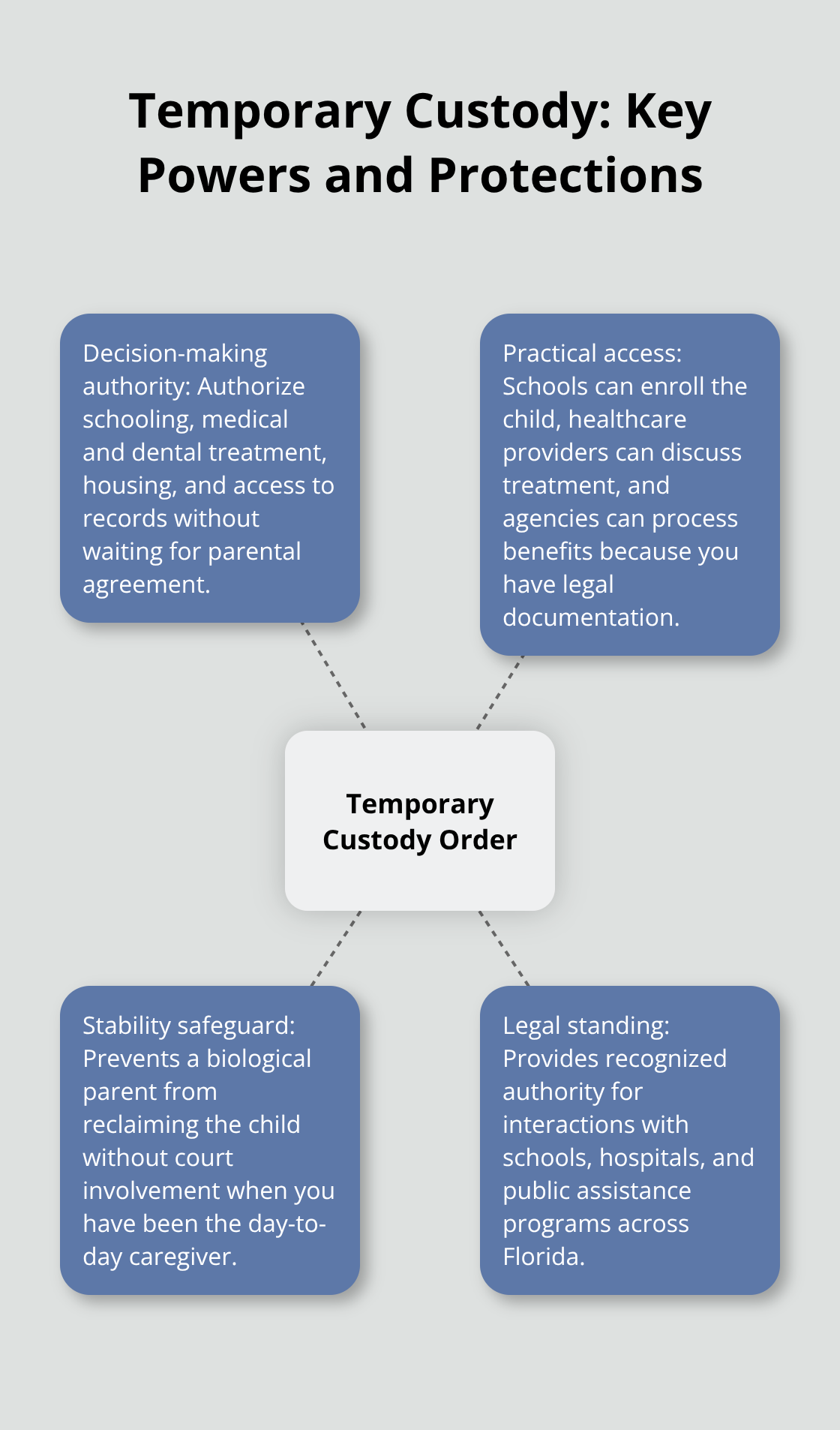
Courts issue temporary orders when parents are absent, incapable, or unwilling to care for their children, and when extended family members already step into that role.
How Long Temporary Orders Last
Temporary custody orders remain in effect until the court modifies or terminates them, but Florida law does not set a fixed expiration date. The duration depends entirely on the family’s circumstances and the child’s best interests. Courts can extend orders indefinitely if parents remain unfit or unavailable, or they can terminate them quickly if parents stabilize and regain capacity to care for their children.
When and How Orders Change
Modification occurs when either the custodian or the parents petition the court with evidence that conditions have changed significantly. If a parent who struggled with substance abuse completes treatment and demonstrates stability, the court may transition the child back to parental custody with a reasonable plan to ease the adjustment. Conversely, if a parent’s situation deteriorates further, the order can be strengthened. The court considers the length of time the child lived with the custodian, the child’s age and developmental stage, and the time needed for a smooth transition when making these decisions.
Why Timing Matters for Your Petition
File for temporary custody as soon as you provide ongoing care rather than waiting for a crisis to force the issue. Proactive legal action prevents school enrollment problems, medical access disputes, and the constant threat of parental interference. The next section walks through the specific steps you must take to file your petition and what the court process actually looks like in Melbourne Florida.
How to File for Temporary Custody in Melbourne Florida
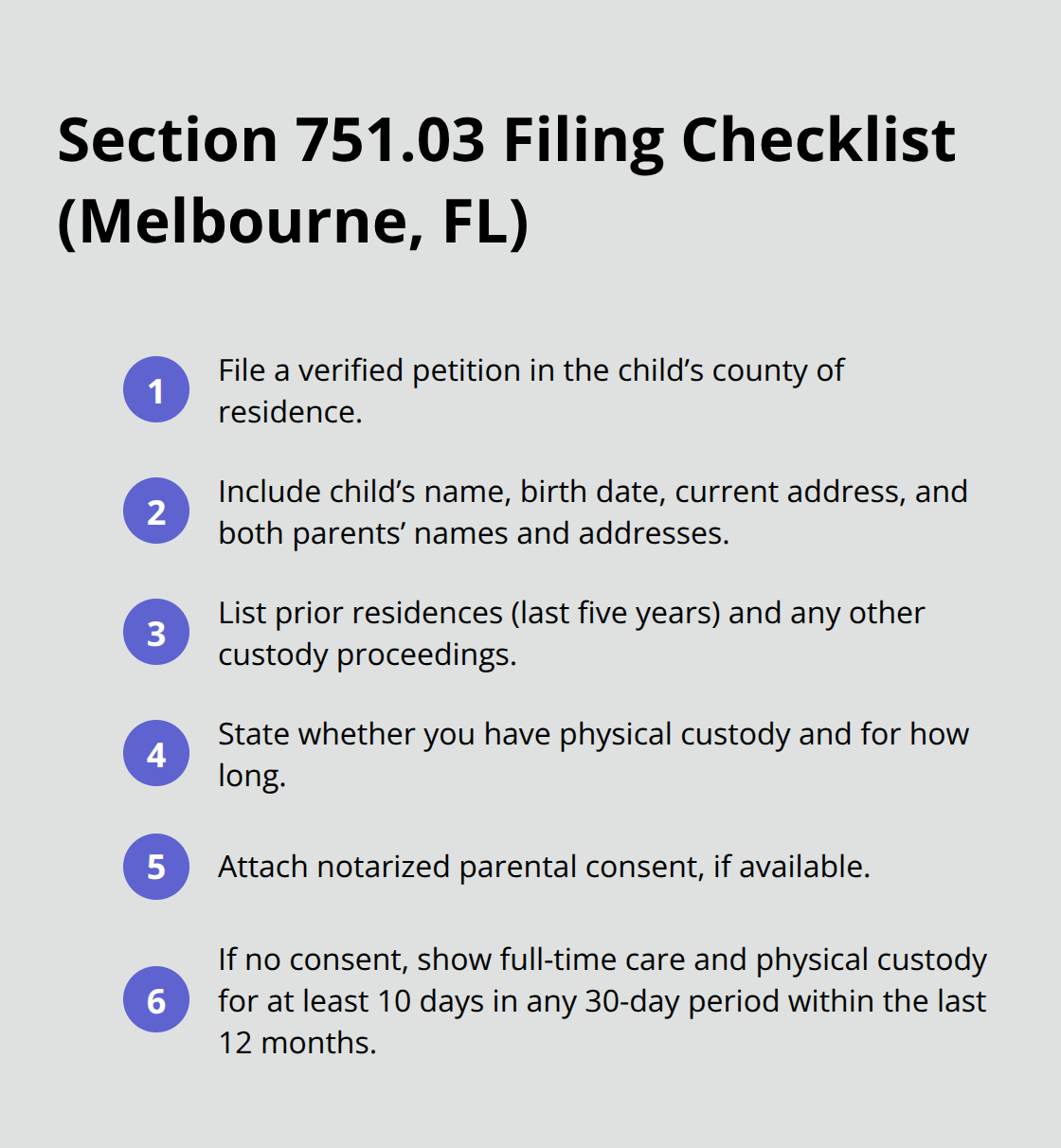
Getting a temporary custody order started in Melbourne Florida requires you to file a verified petition in the circuit court of the county where the child lives. Florida Statutes Section 751.03 specifies exactly what your petition must include: the child’s full name, birth date, current address, both parents’ names and addresses, prior residences within the last five years, details of any other custody proceedings, and your relationship to the child. You must also state whether you have physical custody of the child and for how long. If the parents have signed notarized consent, attach that document to your petition. If not, you must show that you care for the child full-time as a substitute parent and have had physical custody for at least 10 days in any 30-day period within the last 12 months.
What Documents Strengthen Your Petition
Supporting documents matter tremendously here. You should gather school enrollment records, medical records showing the child’s residence with you, utility bills or lease agreements in your name at the child’s address, and any communications from the parents that acknowledge your care arrangement. Police reports, CPS involvement records, or evidence of parental substance abuse strengthen your case significantly. The court requires clear proof that the arrangement already exists, not a hypothetical situation you want to create.
Serving the Parents and Moving Forward
Once you file your petition, the parents must receive formal notice of the proceedings through service of process. If both parents consent in writing, the process accelerates considerably and the court can grant your petition without a hearing. If either parent does not consent, the court must schedule a hearing and provide reasonable notice and opportunity to be heard.
What Happens at the Hearing
At the hearing, the judge weighs whether temporary custody serves the child’s best interests. The court examines the stability of your home, your relationship with the child, the length of time you have provided care, and the circumstances that make parental custody unsuitable. You should expect the hearing to last 30 to 90 minutes depending on whether the parents contest the petition and present evidence. If the court finds that temporary custody is in the child’s best interest, it issues an order that grants you custodial authority. This order becomes your legal proof to schools, hospitals, and government agencies that you can make decisions for the child.
Timeline and Next Steps
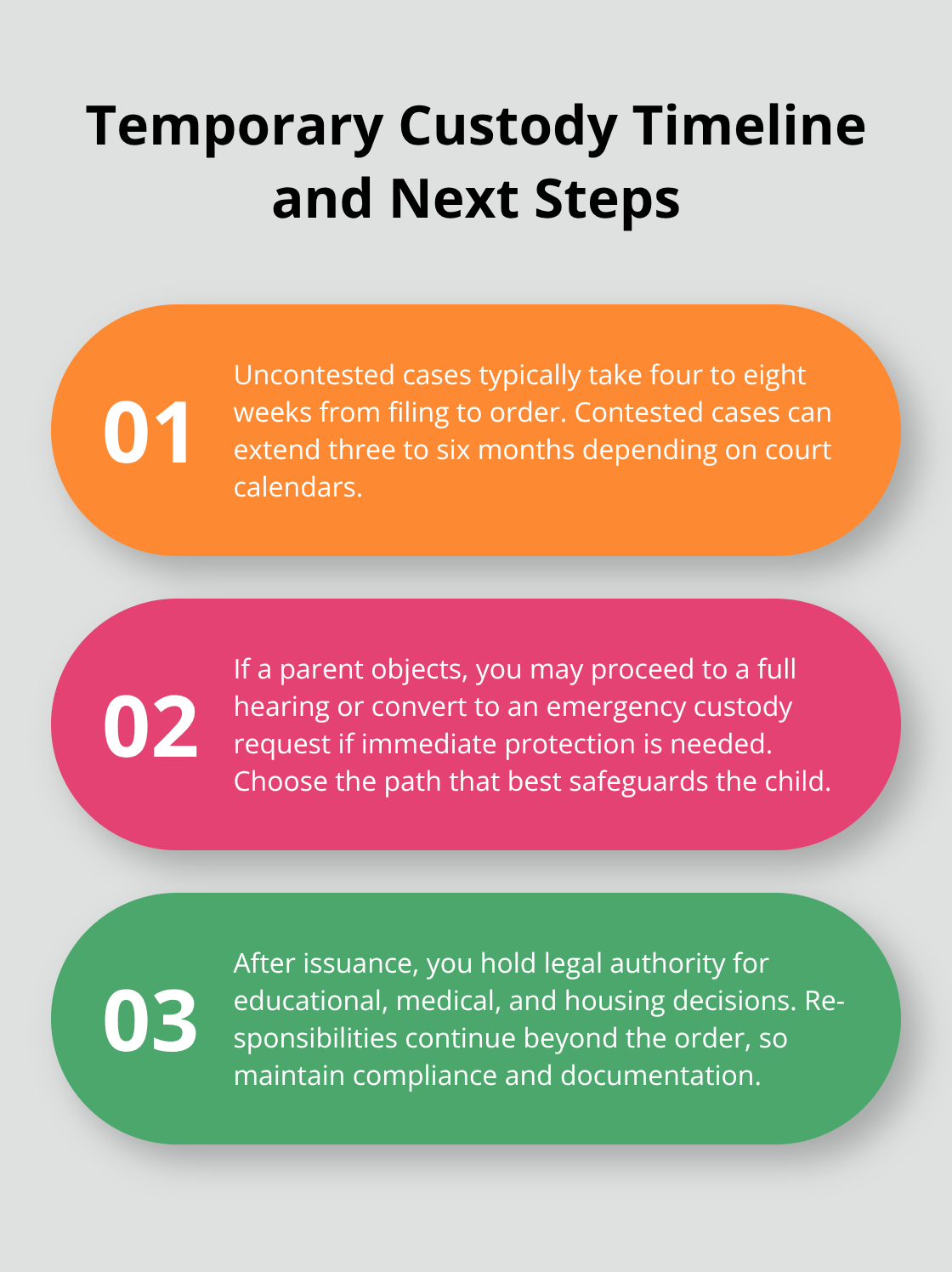
The entire process from filing to receiving an order typically takes four to eight weeks if uncontested, but contested cases can extend three to six months depending on court scheduling. If a parent objects and contests the petition, you have the option to proceed to a full hearing or convert your petition to emergency custody if circumstances warrant immediate protection. Once the court issues your temporary custody order, you gain the legal authority to make educational, medical, and housing decisions for the child-but your responsibilities under that order extend far beyond these initial decisions.
What You Can and Cannot Do With a Temporary Custody Order
Once a court grants your temporary custody order, you gain significant decision-making power over the child’s daily life and future planning. You can enroll the child in school without parental consent, authorize medical and dental treatment, access school and healthcare records, apply for public assistance programs, and make decisions about housing and living arrangements. You cannot relocate the child out of Florida without court approval, change the child’s name, consent to adoption, or make irreversible decisions like cosmetic surgery without explicit court permission or parental consent.
How Parental Rights Remain Protected
The order does not terminate parental rights, meaning both parents retain their legal status as the child’s mother and father. This distinction matters because it shapes what happens if circumstances change. If a parent stabilizes through treatment, employment, or housing improvements, they can petition the court to modify or terminate your temporary custody order. Courts evaluate these petitions by examining whether the parent has genuinely addressed the problems that led to the original order, how long the child has lived with you, and whether returning the child would cause harm or instability. Florida courts prioritize the child’s best interests above all else, which means a parent’s improved situation does not automatically restore custody if the transition would damage the child’s wellbeing.
Child Support and Financial Responsibility
Financial obligations under a temporary custody order depend on whether the court issues a child support order. If both parents have been served and have the ability to pay, the court can order one or both parents to contribute to the child’s expenses. The order may redirect existing child support payments from previous arrangements directly to you as the custodian, and it can address unpaid arrearages the parents owe. If the court does not issue a child support order at the time of your temporary custody award, you can petition later if the parents’ financial circumstances improve or if you experience hardship covering the child’s needs.
Visitation and Communication Standards
Visitation and communication between the child and parents depend entirely on what serves the child’s best interests. The court may allow unsupervised visitation if the parents pose no risk, order supervised visitation if safety concerns exist, restrict contact to phone calls or video calls, or prohibit contact entirely if the parents have abused or severely neglected the child. Many temporary custody orders include specific visitation schedules and guidelines about communication to prevent conflict and protect the child from exposure to parental disputes.
Following Court Orders Protects Your Custody
You must follow these guidelines precisely because violating court-ordered visitation restrictions or communication limits can result in contempt of court charges against you, even though you hold the custody order. Courts take violations seriously and may modify your custody order if you consistently interfere with the parents’ relationship with the child without legitimate safety concerns (such as documented abuse or neglect). Compliance with the court’s visitation and communication terms strengthens your position and demonstrates to the judge that you respect the legal framework protecting the child.
Final Thoughts
A temporary custody order Florida provides the legal foundation your family needs when extended family members step into a caregiving role. This order transforms an informal arrangement into a court-recognized authority that schools, hospitals, and government agencies will respect. Without it, you operate in legal limbo where a biological parent can reclaim the child at any moment, regardless of who has been providing daily care and stability.
The process requires clear documentation, honest disclosure of your caregiving history, and a genuine commitment to serving the child’s best interests. Filing proactively rather than waiting for crisis prevents enrollment disputes, medical access problems, and constant uncertainty about your legal standing. Courts in Melbourne Florida examine whether you already provide substantial care, whether the parents consent or contest your petition, and whether granting temporary custody protects the child from harm or instability.
Navigating a temporary custody order in Florida involves legal complexity that benefits from professional guidance. At Harnage Law PLLC, we help Melbourne Florida families through every step of this process, from drafting your petition to representing you at hearings and handling modifications if circumstances change. Contact us to discuss your situation and learn how we can protect your family’s stability through proper legal channels.