
Alimony Melbourne Florida: What It Means for Your Divorce
Our Blog
Alimony Melbourne Florida: What It Means for Your Divorce

Alimony in a Melbourne Florida divorce can significantly impact your financial future, yet many people don’t understand how it works or what they might owe or receive.
Florida courts follow specific guidelines when calculating alimony payments, considering factors like income, marriage length, and earning potential. We at Harnage Law PLLC help clients navigate these complex calculations to protect their interests.
What Factors Determine Your Alimony Amount
Florida courts reject one-size-fits-all formulas for alimony. Instead, judges examine your specific financial situation, marriage history, and personal circumstances to reach a decision. The American Academy of Matrimonial Lawyers suggests a starting point of 30% of the paying spouse’s gross annual income minus 20% of the receiving spouse’s gross annual income, but courts aren’t bound by this guideline. What matters most is whether one spouse genuinely needs support and whether the other spouse can afford to pay it.
How Courts Assess Your Income and Financial Capacity
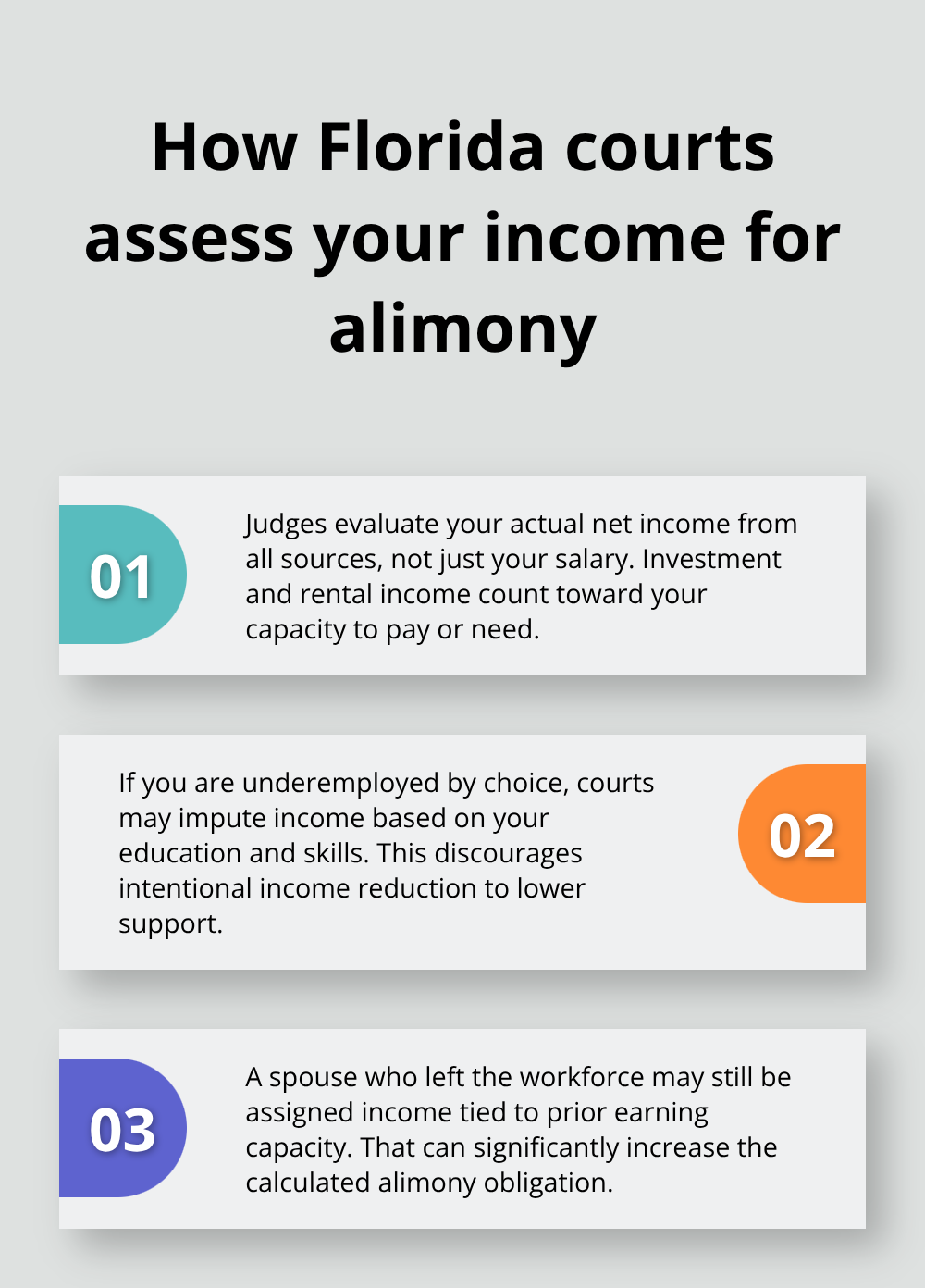
Courts look at your actual net income from all sources, including investments and rental properties, not just your salary. If you’re underemployed or deliberately earning less than you could, judges may assign you imputed income based on your education and job skills. This means a spouse who quit work to raise children might face an income assignment based on their previous earning capacity, which significantly raises the alimony obligation.
Marriage Length and Standard of Living
The length of your marriage heavily influences both the type and amount of alimony you’ll receive. Marriages lasting fewer than 10 years fall into the short-term category, while marriages between 10 and 20 years are moderate-term, and those exceeding 20 years are long-term. For moderate-term marriages, durational alimony can’t exceed 60% of the marriage length. For long-term marriages, that cap rises to 75%.
The standard of living you maintained during marriage also plays a significant role. If you lived comfortably with substantial discretionary spending, the court considers whether one spouse can maintain that lifestyle after divorce. A spouse who stayed home while the other built a successful career generally has a stronger case for longer-term support.
Age and Health Impact Your Support Award
Your age and physical or mental health condition directly affect how judges evaluate your ability to work and earn. A 55-year-old spouse facing health challenges has different employment prospects than a 35-year-old in excellent health. Courts consider whether you can realistically return to work or transition to a new career. Chronic health conditions, disabilities, or mental health issues that limit your earning capacity strengthen a claim for support.
The paying spouse’s age and health matter equally. If a 62-year-old spouse with heart disease faces limited working years before retirement, courts may award shorter durational alimony rather than extending support indefinitely. Retirement age also influences decisions. Florida doesn’t automatically terminate alimony when someone reaches retirement age, but paying spouses can petition for modification if retirement significantly reduces their income and ability to pay. The court examines whether retirement was voluntary or medically necessary, and whether the spouse could reasonably continue working.
These personal factors prevent cookie-cutter outcomes and ensure alimony reflects each person’s real situation. Once you understand how courts calculate your alimony amount, the next step involves recognizing which type of alimony applies to your specific circumstances in your Melbourne Florida divorce.
Which Type of Alimony Applies to Your Divorce
Florida’s 2023 alimony reform eliminated permanent alimony and created four distinct types of support, each designed for different situations. Understanding which type applies to you matters because it directly affects how long you’ll pay or receive support and whether modifications are possible later.
Temporary Alimony During Divorce Proceedings
Temporary alimony, also called pendente lite alimony, exists only during your divorce proceedings and ends the moment the final court order takes effect. This type preserves the financial status quo while your case moves through the court system, typically lasting anywhere from several months to over a year depending on how contested your divorce becomes. If you’re the higher earner, expect temporary alimony requests as soon as you file for divorce. If you’re the lower earner, filing early gives you leverage to request temporary support before your spouse depletes marital assets. Courts award temporary alimony based on the same factors they use for other awards, so the calculations tend to be straightforward once your financial affidavits are complete.
Bridge-the-Gap Alimony for Short-Term Transitions
Bridge-the-gap alimony provides short-term financial help during your transition from married to single life, lasting no more than two years. This type works best for spouses who need a brief runway to find employment, relocate, or stabilize their housing situation. The critical advantage is that bridge-the-gap awards cannot be modified in amount or duration once the court enters the order, giving both spouses certainty about their financial obligations. If you receive bridge-the-gap support, you know exactly when it ends and can plan accordingly.
Rehabilitative Alimony for Education and Training
Rehabilitative alimony funds education, training, or skill development that makes you self-supporting within approximately five years. This requires a detailed rehabilitative plan specifying what education or training you’ll pursue, the timeline, costs, and expected income upon completion. Courts take these plans seriously and can terminate support if you fail to follow through.
Durational Alimony Based on Marriage Length
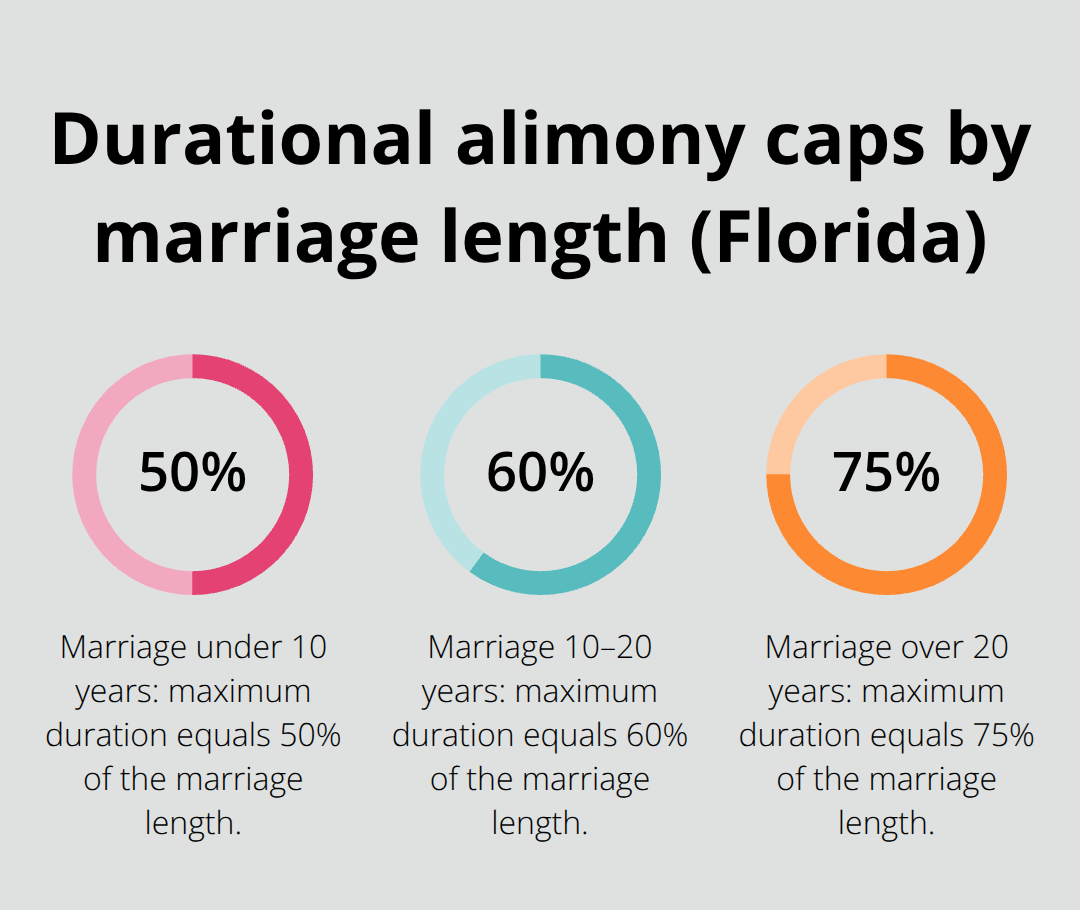
Durational alimony provides ongoing support for a set period after divorce, with the duration tied to how long your marriage lasted. For marriages under 10 years, durational alimony cannot exceed 50% of the marriage length. For marriages between 10 and 20 years, the cap is 60% of the marriage length. For marriages over 20 years, you can receive support for up to 75% of the marriage length, though exceptional circumstances like caring for a disabled child can extend this further.
Unlike bridge-the-gap awards, durational alimony can be modified if substantial changes in circumstances occur, such as job loss or significant income changes. Durational alimony ends upon remarriage or death of either spouse, so your support obligations disappear if your ex remarries.
Each alimony type serves a specific purpose in your Melbourne Florida divorce, and the right choice depends on your marriage length, financial situation, and future plans. Knowing which type applies helps you anticipate your obligations or plan for the support you’ll receive. The next critical question involves what happens when your circumstances change significantly after the court enters your alimony order.
Modifying or Terminating Alimony Obligations
Life doesn’t stop after your divorce is finalized, and Florida law recognizes that your financial situation may shift dramatically after the court enters your alimony order. You can petition the court to modify or terminate alimony if you experience a substantial change in circumstances, which Florida courts define as a significant and material change that was neither anticipated nor within your control when the judge issued the original order.
Substantial Changes in Financial Circumstances
A job loss, serious illness, or unexpected inheritance all qualify as grounds for modification. The paying spouse bears the burden of proving the change is real and substantial, not temporary or self-imposed. Courts won’t accept deliberate income reduction as justification, so if you quit a high-paying job to take lower-paying work, judges will likely impute your previous income and maintain your alimony obligation at the original level.
However, if you lose your job through no fault of your own or face a documented medical condition that prevents you from working, you have genuine grounds for modification. The modification process requires filing a formal petition with the court and submitting updated financial affidavits showing your current income and expenses. You’ll often attend a hearing where both sides present evidence. This process typically takes two to four months depending on court schedules and whether your ex contests the modification.
Remarriage and Cohabitation Effects
Remarriage of the recipient spouse automatically terminates alimony in Florida, period. This is one of the few situations where alimony ends without court involvement, though the paying spouse should still notify the court in writing to ensure the obligation officially stops.
Cohabitation is more complicated and doesn’t automatically end support, but Florida law allows the paying spouse to petition for termination or reduction if the recipient lives with another person in a supportive relationship. The court examines whether the cohabiting partner contributes to household expenses or financial support, effectively reducing the recipient’s need for alimony. Proving cohabitation requires concrete evidence like utility bills showing both names, joint bank accounts, or testimony from neighbors, not assumptions based on rumors or social media.
Modification Rules by Alimony Type
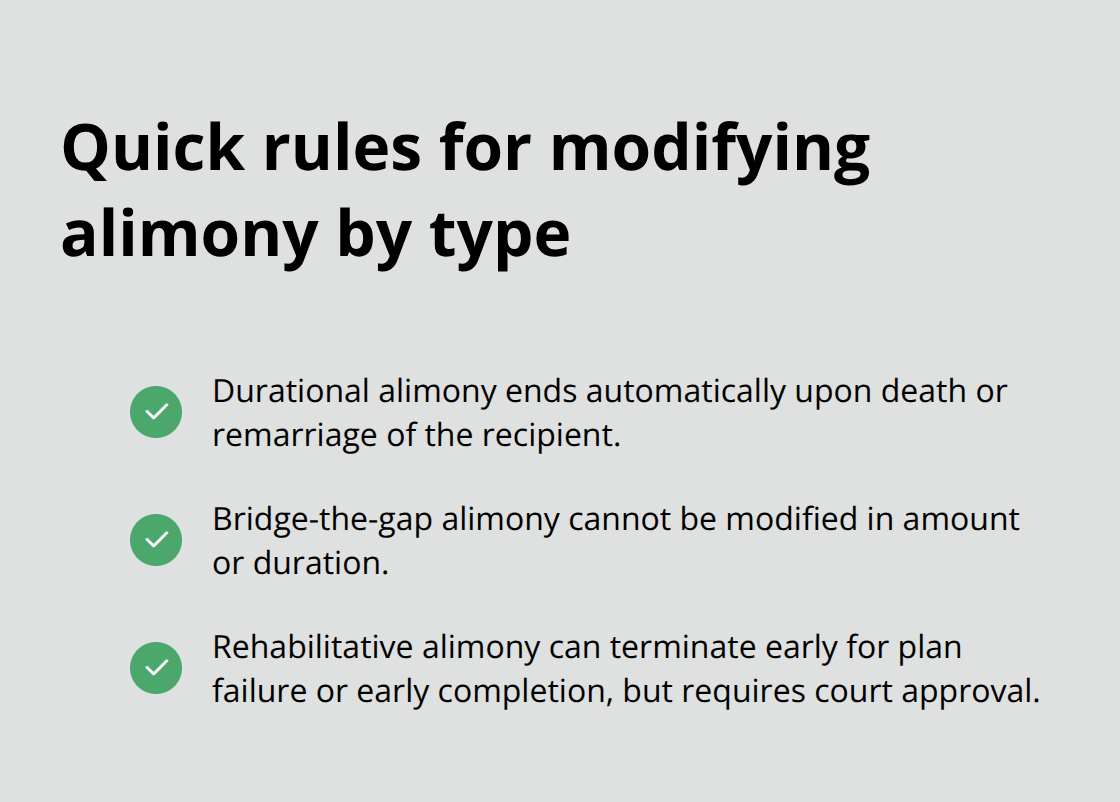
Durational alimony ends automatically upon the recipient’s death or remarriage, so you don’t need court approval for those situations. Bridge-the-gap alimony cannot be modified at all, which is why that type provides certainty to both parties. Rehabilitative alimony can be terminated early if the recipient fails to follow the agreed rehabilitation plan or completes their education ahead of schedule, but this also requires court approval through a formal modification petition.
We at Harnage Law PLLC advise paying spouses to document cohabitation carefully before filing a petition, as judges require substantial proof before modifying awards based on this ground.
Final Thoughts
Alimony in Melbourne Florida divorces shapes your financial reality for years after your marriage ends, making it essential to understand how courts calculate payments, which type applies to your situation, and when you can request changes. Florida’s four alimony types-temporary, bridge-the-gap, rehabilitative, and durational-each serve distinct purposes based on your marriage length and circumstances. The factors courts examine, from your actual income to your health and earning potential, directly determine whether you’ll pay support and for how long.
Your marriage length matters significantly, as short-term marriages under 10 years typically qualify for durational alimony capped at 50% of the marriage length, while moderate-term marriages between 10 and 20 years can support awards up to 60% of that length. Long-term marriages exceeding 20 years allow durational alimony lasting up to 75% of the marriage length, with exceptions for caregiving situations. Understanding where your marriage falls within these categories helps you anticipate your obligations or plan for incoming support.
Modification remains possible when substantial changes occur, as job loss, serious illness, or the recipient’s remarriage can trigger modifications or termination (though bridge-the-gap awards remain fixed and cannot be changed). The complexity of alimony calculations and the long-term financial impact demand professional guidance tailored to your specific circumstances. Harnage Law PLLC provides legal representation for both paying and recipient spouses navigating alimony disputes in Melbourne Florida divorces, helping you understand your rights and obligations while protecting your financial future.