
Florida Divorce Filing Requirements: What You Need to Prepare
Our Blog
Florida Divorce Filing Requirements: What You Need to Prepare
Filing for divorce in Florida requires careful preparation and understanding of specific legal requirements. At Harnage Law PLLC, we help clients navigate the Florida divorce filing requirements so they can move forward with confidence.
You’ll need to gather documents, meet residency rules, and complete the right paperwork before submitting your petition to the court. This guide walks you through everything you need to prepare.
Meeting Florida’s Residency and Jurisdiction Rules
Florida’s Six-Month Residency Requirement
Before you file for divorce in Florida, you must satisfy the state’s residency requirement. Florida law requires that at least one spouse has lived in the state for a minimum of six months before filing. This six-month period is non-negotiable, and the court will verify it through your petition and supporting documents.
If you file for divorce, you must have established residency in Florida six months before submitting your petition. If your spouse initiates the filing, they must meet this requirement instead. The clock starts from the date you or your spouse established Florida residency, not from the date you separated or stopped living together. Many people misunderstand this rule and attempt to file too early, which results in immediate dismissal.
Jurisdiction and Venue in Florida Divorce Cases
Jurisdiction determines which Florida county court has the authority to handle your case, and venue rules specify which particular court location is appropriate. Florida courts gain jurisdiction over your divorce if you meet the residency requirement and the case involves marital property located in Florida or children who reside in Florida.
Venue is typically proper in the county where you or your spouse resides. If your spouse lives out of state but you maintain Florida residency and your children live in Florida, you can file in your Florida county even without your spouse’s presence. The state’s venue rules are straightforward: file where either spouse resides or where the marital property is located.
Serving an Out-of-State Spouse
Out-of-state spouses present a different challenge because the court must properly serve them with divorce papers according to Florida rules. Service can occur through certified mail, personal delivery, or authorized agents, and your spouse has thirty days to respond after service.
If your spouse lives overseas or the court cannot locate them, Florida allows alternative service methods approved by the court (though these require additional steps and judicial approval). Mistakes in service can delay your entire case or invalidate the proceedings. Once you understand these jurisdictional and service requirements, you can move forward with gathering the financial documents and records that the court will require.
What Documents to Gather Before Filing
The 45-Day Financial Disclosure Deadline
Florida’s automatic financial disclosure rule requires you to exchange complete financial documents with your spouse within 45 days after they receive divorce papers. This deadline is mandatory, and courts take it seriously. If you miss it, the judge can dismiss your case or deny you relief. Start gathering documents now rather than scrambling later.
Essential Personal and Property Documents
You’ll need your marriage certificate, government-issued ID, and birth certificates for any children. These form the foundation of your petition. Next, collect the last three years of tax returns for both spouses, current pay stubs showing year-to-date income, and bank statements from all accounts opened during the marriage.
The court uses income figures to calculate child support and alimony, so accuracy matters tremendously. Florida’s child support guidelines are based on each parent’s income and the number of children, with adjustments for overnight contact arrangements. Gather property deeds, mortgage statements, vehicle titles, retirement account statements (including 401(k)s and IRAs), investment accounts, and life insurance policies. Courts divide marital assets using equitable distribution, which starts with a presumption of 50/50 but allows adjustments based on marriage length, each spouse’s contribution, and financial circumstances.
Organizing Financial Records Effectively
Don’t overlook credit card statements, loan documents, and any business ownership paperwork if applicable. Many people underestimate how thoroughly the court examines financial history. Create a separate folder for each category and make copies of everything. Original documents stay with you; copies go to your attorney and eventually to the court.
Financial institutions often take weeks to send official statements, so request them immediately rather than waiting until the filing deadline approaches. If you’re self-employed, compile profit and loss statements, business tax returns, and documentation of business assets. The court needs clear evidence of actual income, not estimates.
Protecting Your Interests Through Documentation
Property division disputes frequently arise when one spouse underreports income or hides assets, so thorough documentation protects your interests. Organize documents chronologically and label them clearly. This preparation accelerates your case and reduces legal fees since your attorney spends less time hunting for information. Disorganized financial records often cost clients thousands in additional attorney time.
Once you’ve compiled these documents, you’re ready to understand the specific forms and paperwork the court requires for your petition.
Filing Forms and Court Costs in Florida Divorce
Required Forms for Your Divorce Petition
Florida requires specific forms to initiate your divorce, and the state provides standardized templates through the Florida Courts system. The primary document is the Petition for Dissolution of Marriage, which outlines your grounds for divorce and your requests regarding property division, child custody, and support. You’ll also file a Family Law Cover Sheet, which helps the court track your case. If children are involved, you must submit a Parenting Plan that addresses time-sharing schedules and decision-making authority, since Florida requires courts to consider the child’s best interests when determining custody arrangements. The financial affidavit is mandatory and must disclose your complete income, expenses, and assets. These forms are available through the Florida Courts website at no charge, though many people hire attorneys to complete them accurately rather than attempting the paperwork alone.
Understanding Filing Fees and Service Costs
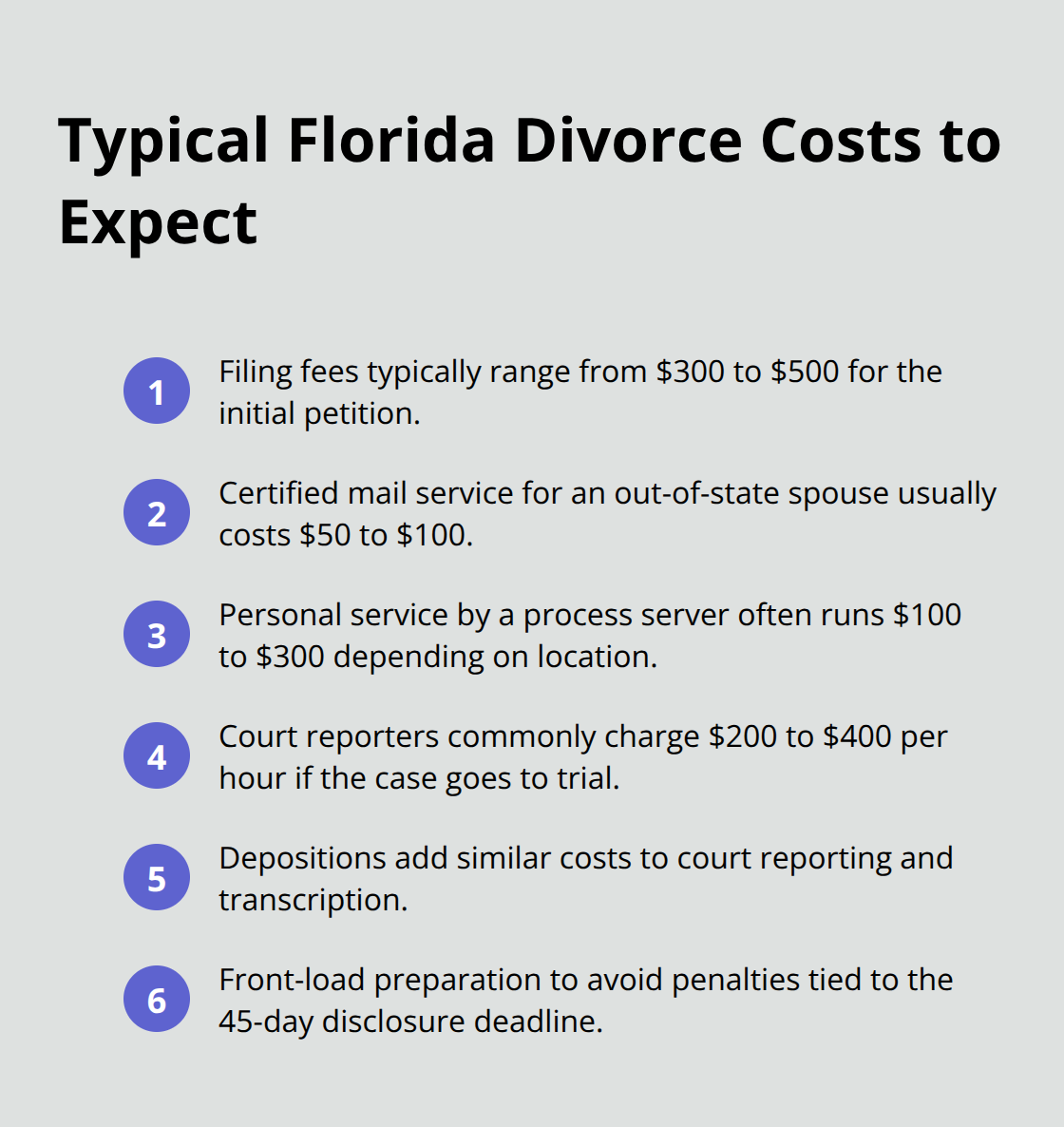
Filing fees in Florida vary by county but typically range from $300 to $500 for the initial petition, plus additional costs for service of process and certified copies. If your spouse lives out of state, certified mail service costs roughly $50 to $100, while personal service through a process server runs $100 to $300 depending on location difficulty. Court reporters charge $200 to $400 per hour if your case proceeds to trial, and depositions add similar costs. The 45-day automatic financial disclosure deadline means you cannot delay gathering documents without facing judicial penalties, so front-loading your preparation prevents expensive last-minute scrambling.
Fee Waivers and Budget Planning
If you cannot afford filing fees, Florida allows fee waivers for qualifying low-income filers, though you must demonstrate financial hardship through an affidavit. Most cases settle before trial, which eliminates substantial courtroom costs, but you should budget conservatively assuming your case requires at least a temporary hearing where both parties present financial information to the judge. The timeline from filing to final judgment typically spans four to six months for uncontested divorces and twelve to eighteen months for contested matters involving significant asset disputes or custody disagreements.
Final Thoughts
Thorough preparation before filing your divorce petition separates smooth cases from complicated ones. Start by verifying your six-month Florida residency and gathering every financial document you can locate-tax returns, bank statements, property deeds, and income records. Organize these materials by category and create copies so your attorney can review them without delay, since the 45-day automatic financial disclosure deadline arrives quickly after your spouse receives papers.
After you file your petition, the court schedules a temporary hearing within weeks where both parties present financial information to the judge. This hearing often determines temporary child support, alimony, and custody arrangements while your case proceeds, and your spouse has thirty days to respond after service. Most Florida divorces settle before trial, but you should prepare mentally and financially for the possibility of a contested hearing.
Understanding Florida divorce filing requirements and preparing properly gives you control over your case timeline and costs. The difference between organized and disorganized filers often amounts to thousands of dollars in legal fees and months of unnecessary delay. We at Harnage Law PLLC handle sensitive family law cases including divorce and child custody matters, and we provide personalized attention to help you navigate this process strategically-contact us today to discuss your specific situation.